Thomas Tiemann

The BOLT score is a simple breath-hold test that records the time until your first urge to breathe. Take a normal breath out, hold your nose, and time how long it takes until you feel the first definite urge to breathe. That number - in seconds - is your score. A higher BOLT score does not establish better oxygen use or exercise performance.
- The BOLT score records a comfortable breath-hold, not your blood CO2 or lung capacity or how long you can hold your breath at maximum.
- You stop timing at the first urge to breathe - not discomfort or desperation.
- Coaching score bands are not validated medical or fitness thresholds.
- Regular nasal breathing practice and targeted exercises can raise your score over weeks.
- The test takes under two minutes and requires no equipment.
If you're working on nasal breathing during exercise, the BOLT score gives you a concrete baseline to track your progress - and a way to understand why nose breathing can feel harder at certain intensities.
What the BOLT Score Measures
BOLT stands for Body Oxygen Level Test, a term associated with the Buteyko breathing tradition. Despite the name, the test does not directly measure blood oxygen. What it records is the time until you feel the urge to breathe after a normal exhale; that time is influenced by more than CO2 alone.
During ordinary breathing, CO2 builds up between breaths and triggers the next inhale. People with a low CO2 tolerance feel that urge very quickly, even when blood oxygen is still adequate. This can push them toward faster, shallower, or mouth-dominant breathing patterns - especially under exercise load.
Why CO2 Tolerance Matters for Breathing
Carbon dioxide plays a direct role in how oxygen moves from your blood into your muscles. The Bohr effect does not establish that a longer breath-hold improves athletic oxygen delivery. For athletes, this connection is one reason practitioners of Buteyko breathing use the BOLT score as a training benchmark: the score is a coaching measure, not proof of improved oxygen delivery.
How to Take the BOLT Breathing Test (Step by Step)
What You Need Before You Start
Sit still for at least five minutes. Do not test immediately after exercise, a large meal, or any forced deep breathing. You want your breathing to be at its natural resting rhythm. A phone timer or stopwatch is all the equipment required.
- Breathe normally for 30 seconds. Do not control or deepen your breathing. Just let it settle.
- After a relaxed exhale, close your mouth and pinch your nose shut. This is a normal breath out - not a forced, emptied exhale.
- Start your timer.
- At the first distinct urge to breathe - not discomfort, not urgency, just the first signal - stop the timer and release your nose.
- Resume breathing through your nose only. If you need to open your mouth or take a gasping breath, you held too long. Rest two minutes and repeat.
Your BOLT score is that elapsed time in whole seconds. Take it two or three times across different sittings and average the results for a reliable baseline. For more structured ways to train around this number, see breathing exercises for athletes.
How to Read Your BOLT Score
| Score (seconds) | Coaching description, not a diagnosis | What the score cannot establish |
|---|---|---|
| Under 10 | Short recorded pause | Does not diagnose a breathing disorder |
| 10–20 | Short-to-moderate recorded pause | Does not measure blood oxygen |
| 20–30 | Moderate recorded pause | Does not predict an exercise threshold |
| 30–40 | Longer recorded pause | Does not prove better oxygen use |
| Above 40 | Longer recorded pause | Does not prove superior endurance |
There is no established general-population normal range for this coaching test. A score of 40 or above is the benchmark often cited in Buteyko-based coaching as a coaching goal, not a validated measure of efficient breathing.
These ranges are descriptive, not diagnostic. A low score is not proof of poor CO2 tolerance; it does not diagnose a medical condition.
How Nasal Breathing Affects Your BOLT Score

The link is not established as a clinical rule. A comfortable breath-hold may change with practice, but a higher BOLT score does not prove that chemoreceptors have adapted or that exercise breathing is more efficient.
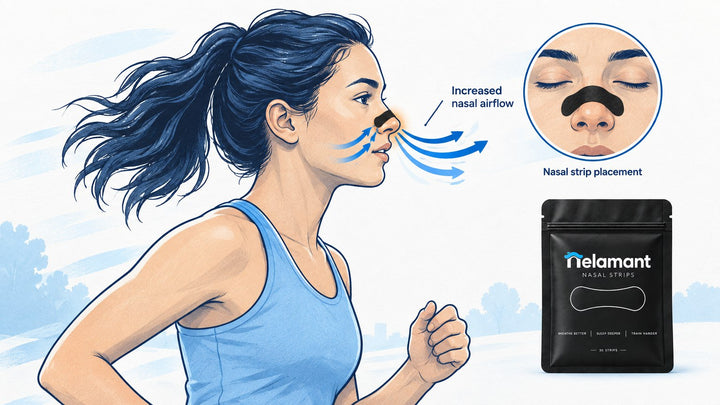
One practical barrier to nasal breathing during workouts is airflow resistance at the nose. For some people, the nasal passages narrow under higher breathing demand, making nose breathing feel labored even when CO2 tolerance is not the limiting factor. A nasal strip like Nelamant Air gently lifts the sides of the nose to widen the nasal opening, which can make it easier to maintain nasal breathing - giving your CO2 tolerance training a cleaner run at the actual goal.

How to Improve Your CO2 Tolerance Over Time
The core method is simple and repetitive: spend more time breathing through your nose, keep breathing volume calm and controlled, and introduce short reduced-breathing exercises consistently. There is no established four-to-eight-week improvement timetable for this score.
Practical starting points:
- Default to nasal breathing at rest and during low-intensity activity. Do not force nasal-only breathing if it feels restrictive.
- Keep any breath-hold practice seated. If you choose to practice, stay seated and stop at the first urge to breathe; never practice in water, while driving, or where dizziness could cause a fall.
- Keep breathing comfortable during easy exercise. Do not use a post-exercise breath-hold score to decide whether you have overbreathed.
- Retest every two weeks. The score is most useful as a trend, not a single reading.
For a structured program built around these principles, breathing exercises for athletes covers several protocols with practical progressions. The wider framework these draw from is explained in the guide to Buteyko breathing.
Frequently Asked Questions
What is a good BOLT score for an average person?
There is no established average score for all adults. Use your own comfortable baseline rather than forcing a target. Coaching targets are not medical thresholds.
How is the BOLT score different from a maximum breath-hold test?
A maximum breath-hold test measures how long you can suppress the breathing reflex through willpower. The BOLT score specifically measures the moment of the first urge to breathe after a normal exhale - no effort, no pushing through. That first-urge moment is a cleaner signal of CO2 sensitivity and is not improved by practice at suppressing discomfort.
Can I improve my BOLT score in a few weeks?
Your recorded time may change with practice, but a four-to-eight-week improvement is not established. The rate depends on how much time you spend practicing and how consistently you default to nasal breathing throughout the day.
Should I take the BOLT test before or after exercise?
Always test at rest, after at least five minutes of quiet sitting. Exercise changes breathing drive, making post-exercise readings difficult to compare with resting readings. Testing in the morning before eating or activity generally gives the most consistent baseline reading.
Does nasal breathing during workouts raise your BOLT score over time?
Not necessarily. Breathing route alone does not establish a predictable change in CO2 or chemoreceptor sensitivity. Do not treat a score change as proof of that mechanism.
Putting Your BOLT Score to Work
The bolt score is most useful as a direction arrow, not a finish line. Test, note your number, practice nasal breathing consistently, and retest. A change from 15 to 25 seconds records a longer pause, not a proven improvement in exercise breathing. From there, the protocols in the guides to breathing exercises for athletes and Buteyko breathing give you the next steps - and nasal breathing during exercise covers why the mechanical side of airflow matters alongside the CO2 training side.