Thomas Tiemann

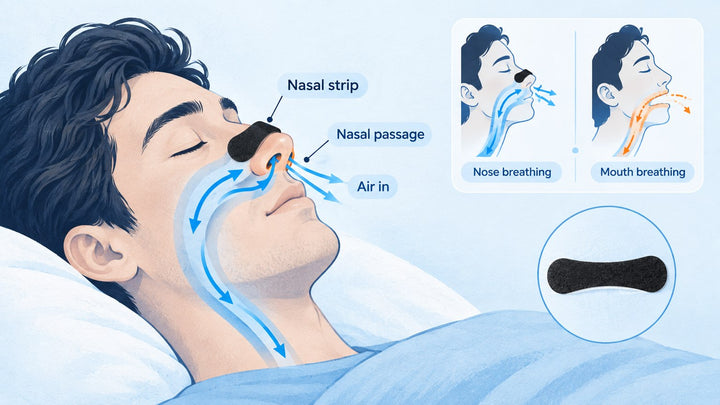
Nasal strips can help you sleep better when a narrow or congested nasal passage is what's disrupting your breathing - they work by gently lifting the sides of your nose open so air flows with less effort. If your breathing problems at night come from your nose, the difference can be noticeable from the first night. If the root cause is elsewhere - your throat, your airway position, or a condition like sleep apnea - a strip on the nose won't resolve it.
- Nasal strips open the nasal passages mechanically - no drugs, no side effects from the strip itself.
- They work best for sleepers whose breathing difficulties or snoring start in the nose: congestion, a narrow nasal valve, or mild nasal resistance.
- They are not a treatment for sleep apnea and do not address throat-based snoring.
- Extra-hold adhesive matters overnight - a strip that peels loose mid-sleep gives you nothing.
- Most people notice a change in how easily they breathe through their nose from the first use; whether that translates to better sleep depends on what was causing the problem.
For a full picture of how to make nose breathing work during the night, see the guide to how to breathe through your nose while sleeping.
What a Nasal Strip Actually Does While You Sleep
A nasal strip is a stiff, spring-like band with adhesive on one side. You press it across the bridge of your nose, and when the adhesive grips the skin, the band tries to return to its flat shape - pulling the sides of the nose outward and opening the nasal passages wider. The whole mechanism is physical, not chemical. Nothing is absorbed; nothing interacts with medication you might be taking.
The part of your nose that a strip acts on is the nasal valve - the narrowest point of the nasal airway, just inside the nostrils. When that area is too narrow, whether because of anatomy, swelling from congestion, or tissue that softens during sleep, resistance builds up and you have to work harder to pull air through. That resistance is what a strip is designed to reduce.
During sleep, your muscle tone drops. Tissues that hold structure during the day relax, and nasal resistance tends to increase. That's partly why people who breathe fine during the day still find themselves mouth-breathing or snoring at night. A strip applies a passive outward force throughout the night that partly compensates for that relaxation - it stays effective as long as it stays on.
For a deeper explanation of the mechanics, the guide to how nasal strips work and why the design matters covers the spring-lift mechanism in full.
How Nasal Strips Can Improve Sleep Quality
Nasal breathing during sleep is meaningfully different from mouth breathing in ways that affect how well you rest. The nose warms, humidifies, and filters incoming air. It also produces nitric oxide, which plays a role in how efficiently your body uses the oxygen it takes in. When you breathe through your mouth all night, you bypass those functions - and the dry air can irritate your throat, disrupt sleep stages, and leave you waking up feeling unrefreshed.
When a nasal strip lowers the resistance in your nose enough that you stay on nasal breathing through the night, those downstream effects can improve. Fewer micro-arousals from labored breathing, a less dry throat, and quieter, more settled sleep are the practical results some nose-restricted sleepers notice. For more on why mouth breathing at night has those effects, the guide on mouth breathing and sleep quality covers the mechanisms in detail.

For Nose Snorers
Snoring that originates from a blocked or narrow nose - where turbulent airflow through the nasal passage creates vibration - is the scenario where a nasal strip is most directly useful. By widening the nasal valve, the strip reduces that turbulence and can lower or eliminate the sound. A strip won't help with snoring that comes from the throat, the soft palate, or the base of the tongue; for those situations, the cause is further back in the airway than a strip can reach.
If you already know your snoring is nasal in origin - you snore more when congested, you breathe through your nose otherwise, and your snoring stops when your nose is clear - a strip is a reasonable first step. The full breakdown of when strips help and when they don't is in the guide to whether nasal strips help snoring.
For Stuffy-Nose Sleepers
Congestion from a cold, seasonal allergies, or pregnancy rhinitis tends to peak when you lie flat, because blood pooling in the nasal tissue increases swelling. A strip can't drain that swelling, but it can widen the nasal opening enough that breathing through the congestion becomes easier. That partial relief - not a cure, but enough airflow to stay off mouth breathing - is what makes strips useful during illness and allergy seasons even when the underlying swelling persists.
Who Gets the Most Benefit at Night
Nasal strips for better sleep work best for a specific group of people:
- Chronic mouth breathers at night who have nasal resistance rather than a structural blockage - the strip lowers the effort enough that nasal breathing becomes the path of least resistance again.
- Congestion-driven poor sleepers - anyone whose sleep breaks down specifically when they're sick, have allergies, or experiences nasal dryness and swelling at night.
- Mild nasal snorers whose snoring is nose-based and not accompanied by breathing pauses or gasping.
- People who wake up with a dry mouth or sore throat after mouth-breathing through the night - a strip that keeps the nose open can help redirect airflow back through the nose.
The benefit is real but conditional: a strip solves a nasal airflow problem. It doesn't relax tense airways, change sleeping position, reduce alcohol's effect on muscle tone, or treat anatomical issues further down the throat.

When Nasal Strips Are Less Likely to Help You Sleep
If your disrupted sleep comes from a source other than the nose, a strip won't address it. The most common example is obstructive sleep apnea - a condition where the upper airway collapses repeatedly during sleep, causing full breathing pauses. Nasal strips are not a treatment for sleep apnea and should never be used as a substitute for prescribed therapy like CPAP. If you snore loudly, wake gasping, or are told you stop breathing in your sleep, those symptoms need medical evaluation. The article on snoring versus sleep apnea explains how to tell the difference and what warrants a sleep study.
Throat-based snoring, obesity-related airway narrowing, and alcohol-related muscle relaxation are similarly outside what a strip on the nose can fix.
How to Use Nasal Strips for the Best Night's Results
Getting the adhesive to hold all night is the practical challenge - a strip that peels away at 2 a.m. helps no one. These steps make a consistent difference:
- Wash and dry the skin on your nose bridge thoroughly. Oil, moisturizer, sunscreen, and sweat all weaken adhesion. Pat dry with a clean towel and wait a minute before applying.
- Place the strip across the widest part of the nose bridge, just above the nostrils. Press firmly along the full length of the strip and hold for a few seconds to activate the adhesive.
- Avoid applying any moisturizer to the nose after the strip is on. Skincare products near the edges of the strip will migrate under it overnight.
- Remove it slowly in the morning. Wet the strip slightly if needed, then peel from one end toward the other. Don't pull straight up from the center.
Nelamant Air is designed with an extra-hold adhesive that resists sweat, oil, and overnight movement - the kind of grip that matters when you shift positions in your sleep. The wider, more balanced lift distributes the opening force across the nose bridge rather than concentrating it at one point, which also makes morning removal gentler. Hypoallergenic materials mean the adhesive is formulated to be gentle on skin even with nightly use, though individual reactions are always possible.
For more detail on placement and common fit problems, the guide to how to breathe through your nose while sleeping covers setup in a full step-by-step context.
Try Nelamant Air for Your Next Night's Sleep
$14.99 for 30 strips · 30-day returns
Shop Nelamant AirWhat Else Affects How Well You Sleep Through Your Nose
A nasal strip is one tool, not the whole picture. A few other factors influence whether you stay on nasal breathing through the night:
- Sleeping position: Side sleeping reduces the nasal congestion that builds when lying flat on your back. Back sleepers tend to have more nasal resistance and more throat-based snoring. A positional change and a strip together can do more than either alone.
- Bedroom humidity: Dry air dries out nasal membranes, which increases resistance and makes mouth breathing more likely. A humidifier set to a moderate level can complement what the strip does mechanically.
- Timing around allergen exposure: If nighttime allergies are driving congestion, managing the allergen load in your bedroom (air filters, washing bedding, keeping pets out) addresses the cause; a strip handles the result.
- Alcohol and sedatives before bed: Both relax throat and nasal tissue beyond what a strip can counteract. Reducing intake close to bedtime helps nasal strips - and sleep generally - work better.
If you want a full comparison of nasal strips against other products tested for nighttime use, the guide to the best nasal strips for sleeping runs through the options side by side with specific overnight criteria in mind.
Frequently Asked Questions
Do nasal strips help you sleep even if you don't snore?
Yes. Snoring is not a requirement for a strip to be useful at night. If you mouth-breathe during sleep, wake with a dry mouth or throat, or feel like your nasal breathing is labored when you lie down, a strip can help by reducing nasal resistance - regardless of whether that resistance is loud enough to cause snoring.
Can nasal strips improve sleep quality when you're congested?
They can improve nasal airflow during congestion, which makes it easier to stay on nose breathing through the night. They don't reduce the swelling or clear mucus directly - that's the job of saline rinses, decongestants, or antihistamines depending on the cause. Think of the strip as keeping the door open while you address what's blocking it.
How quickly will I notice better sleep from nasal strips?
Many people notice their nasal breathing feels easier from the first night. Whether that translates to a measurable improvement in how rested you feel depends on how much your nasal resistance was actually contributing to your sleep disruption. If it was the main factor, the change can be immediate. If other issues are also at play, the strip addresses one piece of the picture.
Is it safe to use nasal strips every night for sleep?
Nasal strips are drug-free and act mechanically on the outside of the nose, so nightly use is not associated with the dependency or rebound effects that can come with decongestant sprays. If your skin becomes irritated from the adhesive with daily use, giving the skin a night off or trying a more skin-gentle formulation is a sensible response. For a full look at long-term use considerations, see the guide to how to breathe through your nose while sleeping.
Do nasal strips work for sleep apnea?
No. Nasal strips are not a treatment for obstructive sleep apnea. Sleep apnea involves repeated collapses of the upper airway during sleep - a structural event that happens well behind the nose. A strip can help with nasal congestion that makes CPAP mask breathing more comfortable, but it does not address the apnea itself and must never replace prescribed therapy. If you suspect sleep apnea, the article on snoring versus sleep apnea explains the key differences and next steps.
The Bottom Line
Nasal strips do help you sleep better when nasal resistance is genuinely what's getting in the way - whether that's congestion, a narrow nasal valve, or the tissue relaxation that comes with lying down at night. They work on the first use, carry no drug-related side effects, and the practical barrier is simply keeping the strip securely on through the night. If your sleep problems go beyond the nose, they're one useful tool in a larger toolkit, not a standalone solution.