Thomas Tiemann

Nasal strips work by using a spring-loaded band to gently lift the sides of your nose outward, widening the nasal passages so air flows through with less resistance. The mechanism is entirely mechanical - no drugs, no chemicals, just physical tension applied to the outside of your nose. This guide explains exactly how do nasal strips work, what the spring band actually does, why design details like lift width and adhesive strength matter, and how to get the most from whichever strip you choose.
- A nasal strip is a stiff spring band covered by adhesive tabs; when the band tries to return to its flat shape, it pulls the nasal walls outward.
- Wider, more balanced lift distributes force across the bridge rather than at a single pull point - relevant when comparing strip designs.
- Strips address nasal-level narrowing: they support the nasal passage opening but do not open an obstructed throat or treat the underlying causes of sleep apnea.
- Proper skin prep is the single biggest factor in whether a strip stays on through the night or a workout.
- All cluster topics - application, removal, safety, sizing, cost, types and specific use cases - are covered in their own dedicated guides linked throughout this page.
What Are Nasal Strips?
A nasal strip is a small adhesive bandage worn on the outside of the nose. It contains one or more stiffened bands - typically made of a flexible polymer or similar springy material - bonded between two layers of a breathable backing. The adhesive on the underside holds the strip against the skin of the nose bridge.
Unlike nasal sprays, internal dilators or oral devices, strips work entirely from the outside and contain no active drug ingredients. They are single-use, applied before sleep or exercise, and peeled off afterward. Most strips are sized to fit across the widest part of the nose, just above the nostrils, where the nasal walls (the lateral cartilage and surrounding soft tissue) are most responsive to outward pressure.
Strips were introduced as a consumer product in the early 1990s and became widely recognized when professional athletes began wearing them visibly during televised games. Today they are used for sleep, congestion relief, exercise and general nasal comfort.
The Spring Band: Anatomy of a Strip
The business end of a nasal strip is the spring band - a pre-curved or pre-formed stiffener that wants to lie flat. When you press it against the curved surface of your nose, you are bending it into a tighter curve. The band's resistance to that bend is what creates the outward lift.
Most strips use a single central band. Some designs use two parallel bands or a wider single element to spread force more evenly across the nose bridge. The width of that band, how far it extends toward the nostrils, and how the adhesive tabs are positioned all affect whether the lift is concentrated at one point or distributed more broadly. You can see how Nelamant Air's geometry compares with other designs in the nasal strip design and lift comparison.
What Do Nasal Strips Do to Your Nose?
At rest, the soft tissues and cartilage of the nose can partially collapse inward, especially during the reduced muscle tone of sleep or under the high-velocity airflow of hard exercise. That inward deflection narrows the nasal passages and raises airflow resistance - meaning you have to work harder to pull the same volume of air through your nose, or you switch to mouth breathing.
A nasal strip counters that tendency by applying a steady outward force against the outer nasal wall. It does not inflate or irrigate anything; it simply supports the nasal structure in a more open position. The effect is similar to holding the sides of a collapsible tube slightly open so liquid can flow more freely.
Because the mechanism is physical rather than pharmaceutical, the strip begins working as soon as it is applied and stops when it is removed. There is no absorption time, no rebound congestion risk from overuse, and no systemic effect.
How Nasal Strips Open Your Airways
The nasal valve - the narrowest functional segment of the nasal airway - sits just inside the nostril, at the junction of the upper and lower lateral cartilages. This is where most functional nasal obstruction originates, even when deeper structures like the turbinates or sinuses are also involved.
When a nasal strip lifts the outer nasal wall in the region of the nasal valve, it increases the cross-sectional area of that narrowest point. A larger cross-section means air can move through at lower velocity and with less turbulent resistance for the same breathing effort. The result is air that feels easier to pull in - particularly noticeable when you are lying down, congested or breathing hard.
It is worth being precise about what "opening your airways" means here: strips act on the nasal passage specifically. They do not act on the back of the throat, the soft palate or the lower airway. If breathing difficulty originates lower down - for example from enlarged tonsils, a recessed jaw or significant airway obstruction during sleep - a nasal strip addresses only the nasal component of that picture.
Nasal Strip Mechanics at a Glance
| Component | Function | Why It Matters |
|---|---|---|
| Spring band | Stores tension when bent against the nose; tries to return to its flat shape | The source of all outward lift - stiffness and geometry determine lift strength |
| Adhesive tabs | Anchor the ends of the band to the skin on either side of the bridge | If adhesion fails, the spring force is lost - skin prep is critical |
| Backing / substrate | Holds band and adhesive together; sits against or just above the skin | Material affects breathability, flexibility and skin compatibility |
| Band width / placement | Determines where on the nose bridge lift is applied and how evenly | Wider, more central placement distributes force rather than concentrating it at one point |
| Hypoallergenic / skin-safe layer | Reduces contact irritation during extended wear | Relevant for daily users and anyone with sensitive skin |
Nelamant Air: Broader Lift, Extra-Hold Adhesive
Most of the mechanics above apply to any nasal strip. Where strips differ is in how wide the spring element is, how the lift is distributed, and how well the adhesive holds under real-world conditions - sweat, natural skin oils, overnight movement.
Nelamant Air is designed around a wider, more balanced lift: the spring geometry spans more of the nose bridge so the outward force is spread across a broader area rather than pulling at a single narrow point. The adhesive is formulated to resist sweat and oil, which matters both for overnight wear and for use during workouts. Materials are hypoallergenic and intended to peel off cleanly without leaving a sticky residue - though "hypoallergenic" means the materials are selected to minimize the chance of a reaction, not that no one can ever react.
Each pack contains 30 single-use strips - a month of nightly use - and packs can be bought individually or in bundles. The strip is drug-free and works for sleep, congestion and exercise.
Do Nasal Strips Actually Work?
Whether a nasal strip produces a noticeable difference depends on where your breathing difficulty is coming from. Strips are most effective when nasal-level narrowing - at the nasal valve or along the lateral wall - is a significant part of the problem. If your nose feels blocked because of swollen turbinates from a cold or allergies, a strip can still help by supporting the passage opening, though it does not reduce swelling directly. If congestion comes from deeper structural blockage, the effect will be smaller.
The evidence base for nasal strips is focused on nasal airflow resistance, snoring associated with nasal obstruction, and exercise breathing. Results vary between individuals, which is why trying a strip for a few nights - rather than just one - gives a fairer picture of whether it works for you.
For the full breakdown of what the research does and does not show, see the dedicated guide on whether nasal strips work.
How to Apply Nasal Strips Correctly
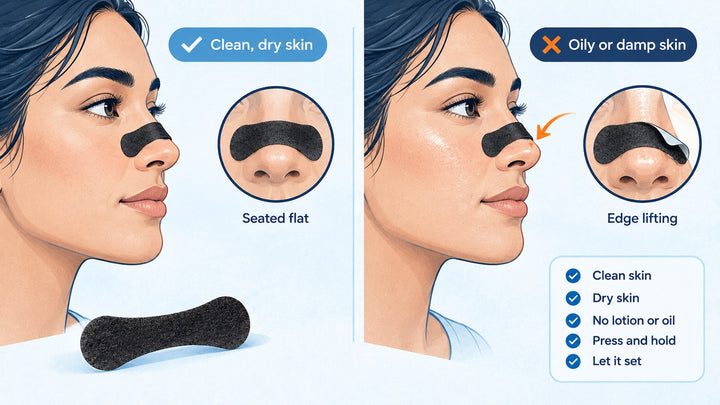
Application technique is one of the main reasons strips underperform. The adhesive bonds to skin, not to oils, moisturizer or water - so the skin surface needs to be clean and dry before you place the strip. The general process:
- Wash and dry the nose area thoroughly.
- Avoid applying any moisturizer, sunscreen or skincare product to that area beforehand.
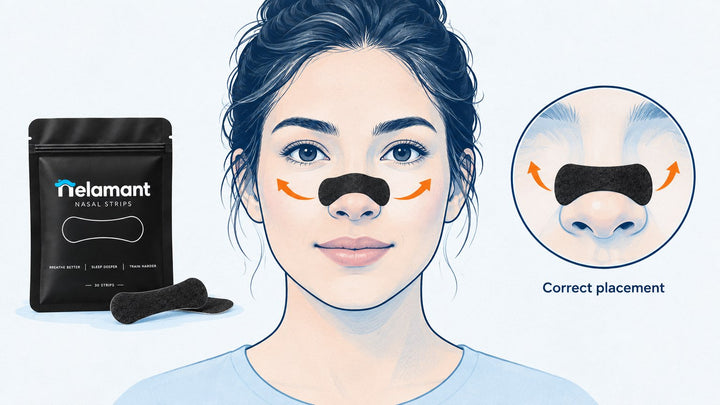
- Centre the strip across the widest part of the nose, just above the nostrils.
- Press the adhesive tabs firmly against both sides of the nose bridge and hold for a few seconds.
- Smooth the strip from the centre outward to remove air pockets.
Placement slightly too high (on the bony part of the nose) reduces the lift effect because the strip cannot flex the bony bridge. Slightly too low and the tabs sit on the nostril edges rather than the cartilage region where lift matters most. The complete step-by-step walkthrough, including tips for oily skin and different nose shapes, is in the guide on how to apply nasal strips.
How to Remove Nasal Strips Without Skin Irritation
Ripping a nasal strip off quickly is the fastest route to redness and skin irritation, particularly around the delicate skin at the sides of the nose. The recommended approach is to loosen the adhesive first - warm water or a wet cloth held against the strip for 20–30 seconds softens the bond significantly. Then peel slowly from one edge toward the centre.
Strips with a gentler, residue-free adhesive are easier to remove cleanly. If you notice skin redness after removal it is usually from the peel force rather than an ingredient reaction, though repeated irritation in the same area is worth monitoring. For a full guide on protecting your skin during removal, see how to remove nasal strips.
Are Nasal Strips Safe?
For most adults, nasal strips used as directed are well-tolerated. They contain no drugs, do not affect breathing mechanics beyond the nose, and the main risk is minor skin irritation from the adhesive or the removal process. Because they are single-use and worn externally, there is no ingestion risk and no interaction with medications.
People with very sensitive skin, certain skin conditions, or known adhesive allergies should check ingredient disclosures before use. Strips should not be placed over broken, sunburned or irritated skin. The question of age suitability - particularly for children - is covered in the dedicated safety article. For the complete picture on safety considerations, see whether nasal strips are safe.
How Often Can You Wear Nasal Strips?
Because nasal strips are drug-free mechanical devices, there is no pharmacological reason to limit use the way you would with a decongestant spray. Many people use them every night without issue. The practical limits come from skin tolerance - the same patch of skin being subjected to adhesive and removal repeatedly needs monitoring, especially if you notice any cumulative redness or sensitivity.
Giving the skin an occasional rest night, ensuring thorough but gentle removal each time, and rotating between slightly different placements if needed can all help with daily use. How long you can wear a single strip in one session also has a practical answer - for the details on both questions see the guides on using nasal strips every night and how long you can wear a nasal strip.
Types of Nasal Strips
Not all nasal strips are structurally identical, and the category has broadened over the years. The main distinctions:
- Standard adhesive strips: The original design - a spring band held to the nose by adhesive tabs on either side. The overwhelming majority of products sold are in this category.
- Extra-strength variants: A stiffer or wider spring element for people who need more lift or whose skin tolerates stronger adhesive.
- Medicated strips: Some brands add a menthol or eucalyptus layer to the underside for a cooling sensation that can help with congestion. The mechanical lift mechanism is the same; the sensation is separate.
- Fabric-backed vs. plastic-backed: The backing material affects how the strip conforms to the nose and how it feels during wear.
It is also worth distinguishing adhesive external strips from internal nasal dilators - small stent-like devices worn inside the nostrils - and from magnetic external dilators, which use a different attachment mechanism. These are real alternatives with different trade-offs. The full breakdown is in the guide on types of nasal strips and how they compare.
How to Choose the Right Nasal Strip
The most useful filtering questions when choosing a nasal strip:
- What is the main use case? Sleep and overnight use demand strong adhesive that resists movement and sweat. Exercise use adds sweat-resistance as a priority. Congestion relief during the day may favour a softer adhesive for shorter wear.
- What is your skin type? Oily skin needs a strip engineered to bond through sebum. Sensitive skin needs hypoallergenic materials and a peel-friendly adhesive.
- What lift strength do you need? If you have previously tried a strip and found it came loose or provided no noticeable effect, a wider or stiffer design may be worth trying.
- Do you wear glasses? Frame placement affects where on the nose bridge a strip can sit - covered separately below.
The detailed guide with a full decision framework is at how to choose nasal strips without wasting money.
Nasal Strip Sizes
Most brands offer two or three sizes - commonly small/medium and large, sometimes with a dedicated "extra large" for wider nose bridges. Sizing refers primarily to the length of the strip and the span of the adhesive tabs, not the spring stiffness. A strip that is too short will not reach far enough across the nose to anchor properly; one that is too wide may fold or gap at the edges.
A common practical guide is that the strip should sit on the fleshy part of the nose - above the nostrils but below the bony upper bridge - and that the tabs should contact skin, not cartilage tip or bony ridge. For a full sizing breakdown and how to measure, see the guide on nasal strip sizes and how to pick yours.
Common Questions: Sticking, Reuse and Nose Shape
Why Won't My Nasal Strip Stay On?
A strip that peels off within an hour or two is almost always a skin prep issue. Residual moisturizer, facial oil, sweat from a warm environment or even a light touch of water can prevent the adhesive from bonding fully. The fix is usually as simple as wiping the nose with a clean dry cloth immediately before application. In rare cases the strip size is wrong and the tabs are sitting on an edge or curve that prevents full contact. The full troubleshooting guide is at why nasal strips won't stick and how to fix it.
Can You Reuse a Nasal Strip?
Nasal strips are designed and sold as single-use items. After one use the adhesive is contaminated with skin oils and the spring band may have taken a set from the curve of your specific nose. The practical answer is no - the strip will not adhere properly or provide consistent lift on a second use. See the dedicated article on whether you can reuse nasal strips for the full reasoning.
Do Nasal Strips Change the Shape of Your Nose?
No. A nasal strip creates a temporary external tension while it is worn; the cartilage and soft tissue return to their resting position once the strip is removed. Permanent nose shape requires either surgical intervention or significant sustained tissue remodeling - a night's worth of gentle external lift does not meet that threshold. The question gets asked often enough that it has its own article: do nasal strips change the shape of your nose.

Cost, Availability and Practicalities
How Much Do Nasal Strips Cost?
Nasal strips range from budget store-brand options to premium branded products. At the low end, generic strips run roughly $0.20–$0.40 per strip. Mid-range branded products typically fall in the $0.40–$0.70 range per strip. Per-strip cost drops with larger pack sizes. Nelamant Air is $14.99 for 30 strips, with multi-pack bundles available at lower per-strip prices. For a full cost comparison across the category, see how much nasal strips cost.
Are Nasal Strips FSA Eligible?
FSA and HSA eligibility for nasal strips depends on the specific plan and the IRS guidance in effect at the time of purchase. The eligibility status of over-the-counter breathing aids has shifted over the years. Check with your plan administrator for current eligibility. The dedicated article on whether nasal strips are FSA eligible covers the relevant rules and what to look for.
Do Nasal Strips Expire?
Adhesive degrades over time, particularly if strips are stored in warm or humid conditions. Most manufacturers print a best-by date on packaging. Using an expired strip risks reduced adhesion rather than any safety problem. See the full guide on whether nasal strips expire.
Can You Cut a Nasal Strip to Size?
Cutting a strip shortens the spring band and changes the leverage geometry, which can reduce or eliminate the lift effect. It also leaves a raw adhesive edge that can catch and peel. In most cases a different size is the better solution. The full case is made in the article on whether you can cut nasal strips.
Where to Buy Nasal Strips
Strips are widely available at pharmacies, grocery stores and online retailers. The range varies significantly by channel - brick-and-mortar stores typically stock two or three brands while online options are broader. Buying directly from a brand's own store gives access to bundle pricing and returns policies. For a channel-by-channel breakdown, see where to buy nasal strips.
When to Use Nasal Strips
The three most common use cases map closely to the three situations where nasal-level narrowing is most likely to be a limiting factor:
- Sleep: Muscle tone decreases during sleep, making the nasal walls more likely to deflect inward. A strip supports them in a more open position through the night.
- Exercise: High-velocity airflow through the nose creates negative pressure that can pull the nasal walls inward - the strip counters this, reducing the effort needed to sustain nasal breathing during hard training.
- Congestion: Inflammation or swelling inside the nose can narrow the passage to the point where the mechanical support from a strip makes a noticeable difference to comfort, even if it does not reduce the underlying swelling.
There are also less obvious moments - flying, seasonal allergies, post-workout recovery, pregnancy rhinitis - where strips are useful. For a detailed look at each scenario, see the guide on when to use nasal strips and which situations they help most.
Nasal Strips with Glasses or Piercings
Glasses frames rest across the nose bridge in roughly the same area where a nasal strip needs to sit. Whether the two are compatible depends on the frame style: thin wire frames often allow a strip to be placed just below the nose pads, while thick or low-sitting frames may conflict directly. Bridge piercings present a similar placement challenge. In both cases the practical solutions involve placement adjustment rather than ruling out strips entirely. For specific guidance, see the article on using nasal strips with glasses or a nose piercing.
Are Nasal Strips FDA Approved?
The regulatory status of nasal strips in the United States is nuanced. As external mechanical devices - not drugs - they fall under FDA oversight as medical devices rather than drug products. The specific regulatory category and what it means for quality and safety claims is explained fully in the article on whether nasal strips are FDA approved. The short version: approval, clearance, and exemption are different regulatory categories; the current nasal-dilator classification is generally 510(k)-exempt, subject to exemption limits.

Beyond the Basics: Related Guides
This guide covers how nasal strips work and links to every article in the Nasal Strips 101 cluster. If you are ready to compare specific products, the best nasal strips guide covers the full market with audience-specific recommendations - from sleep and snoring to exercise and sensitive skin.
If you want a close look at one product specifically, the Nelamant Air review covers the lift design, adhesive, application experience, who it suits and who it does not, with honest pros and cons.
Frequently Asked Questions
How do nasal strips work differently from nasal sprays or internal dilators?
A nasal strip applies outward mechanical force to the exterior of the nose - it physically holds the nasal wall open. A nasal spray (decongestant type) works pharmacologically: it constricts blood vessels inside the nasal lining to reduce swelling, which also opens the passage but through a different mechanism entirely, with different limitations including rebound congestion risk. An internal dilator sits inside the nostril and pushes outward from within, rather than pulling from outside. All three can increase nasal airflow; which is more appropriate depends on the source of the narrowing and how long you need the effect to last.
What are nasal strips made of?
Most nasal strips consist of a flexible polymer or resin spring band, a fabric or film backing, and a pressure-sensitive adhesive. The specific polymers and adhesive formulations vary by brand and are not always disclosed in full. For sensitive skin users, look for products explicitly labelled hypoallergenic - this means the materials have been selected to reduce irritation risk, though it does not guarantee that no individual will react. For Nelamant Air specifically: the product uses hypoallergenic materials intended to peel cleanly.
Can nasal strips open your airways enough to reduce snoring?
Strips can reduce or quiet snoring that originates from nasal obstruction - where the narrowed nose is forcing the sleeper to breathe through the mouth or creating turbulent airflow in the nasal passage. If snoring comes primarily from throat-level vibration (soft palate, uvula, tongue base) unrelated to nasal narrowing, a nasal strip addresses only the nasal component and may have little effect on the sound. Many people have both nasal and throat contributions to their snoring, so the result can range from a clear improvement to a modest one. Snoring that is loud, frequent or associated with gasping warrants a conversation with a doctor to rule out sleep apnea.
How long does it take for a nasal strip to work after you apply it?
The mechanical effect is immediate - as soon as the strip is in place and the spring tension is loading against your nose, the outward lift is active. There is no absorption or activation time. Most people notice the change in airflow within the first few breaths. The sensation can feel more pronounced in the first few minutes as you consciously attend to it, but the physics are working from the moment of application.
Do nasal strips work for a deviated septum or nasal valve collapse?
A nasal strip provides external support to the lateral nasal wall and nasal valve area - it does not move the septum or correct structural anatomy. For a mildly deviated septum where the primary functional problem is reduced nasal valve area on one side, a strip can provide partial relief by widening the affected passage externally. For significant structural deviation, strips address only the functional component and do not substitute for a medical evaluation. Nasal valve collapse - where the lateral wall deflects inward under negative pressure - is one of the clearest indications for an external nasal strip, since the strip directly counters that inward movement.
Why does the width of the spring band affect how well a nasal strip works?
A narrow band concentrates its lifting force at a single point across the nose bridge. If that point does not align precisely with where the nasal valve sits on your particular nose, much of the force goes into lifting skin and subcutaneous tissue rather than the nasal wall itself. A wider band distributes the lift across more of the bridge, increasing the likelihood that the force reaches the functionally relevant area and reducing the chance that one edge lifts while the other gaps. Width also affects how the strip sits on noses of different widths and curvatures - a design that works well for a narrower nose bridge may not contact evenly on a wider one.
Conclusion
Understanding how nasal strips work comes down to one simple mechanical principle: a pre-tensioned spring band, anchored to the skin, creates outward lift on the nasal wall the moment it is applied. The variables that separate a strip that works well from one that does not - band width, adhesive strength, placement, skin prep - are all within your control once you know what to look for. Every topic from application technique and removal to types, sizing, costs and specific use cases has a dedicated guide linked throughout this page. Start with the question most relevant to your situation, or go straight to comparing products at the best nasal strips guide.