Thomas Tiemann

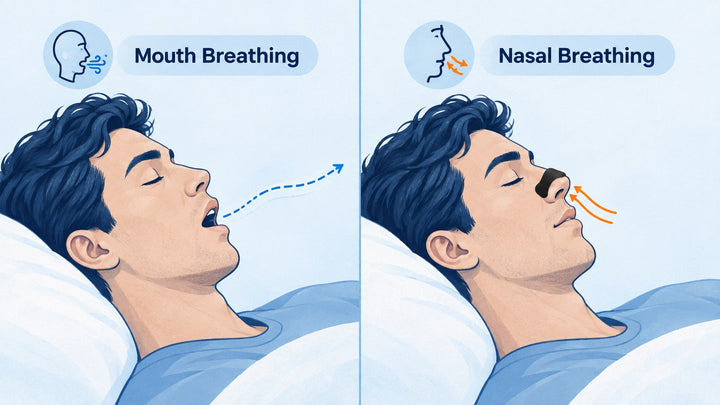
When you breathe through your nose, your paranasal sinuses continuously produce nitric oxide and release it into the air you inhale. That gas travels into your lungs with every breath. When you breathe through your mouth, that production is bypassed entirely. Nasal breathing nitric oxide delivery is one of the clearest, most concrete physiological reasons the nose outperforms the mouth as a breathing route.
- Your paranasal sinuses produce nitric oxide constantly; nasal breathing delivers it directly to your airways and lungs.
- Nitric oxide acts as a vasodilator and bronchodilator, supporting blood flow and oxygen uptake.
- Mouth breathing bypasses sinus-derived nitric oxide entirely.
- Nitric oxide also has antimicrobial properties in the upper airway.
- Keeping your nasal passages open - especially at night and during exercise - is a practical first step to making the most of this mechanism.
What Nitric Oxide Actually Is
Nitric oxide (NO) is a small, short-lived signalling molecule your body produces in several tissues. In the cardiovascular system it is best known as a vasodilator - it causes blood vessel walls to relax and widen, which reduces resistance and supports circulation. In the respiratory system, it also relaxes smooth muscle in the airways themselves, a bronchodilatory effect that can make breathing feel easier.
The nose and sinuses are a major site of NO production in the body. The paranasal sinuses - the hollow spaces around your nasal cavity - act as a reservoir, and inhaling through the nose pulls that gas into the airstream and then into the lungs with each breath. This is separate from the NO your body produces endogenously in blood vessels and elsewhere; sinus-derived NO is literally inhaled.
Understanding this mechanism sits alongside the broader story of why nasal breathing matters for your health, which covers filtration, humidification, and the full picture of what the nose does that the mouth cannot.
How the Nose Produces Nitric Oxide
The paranasal sinuses - maxillary, frontal, ethmoid and sphenoid - are lined with cells that express nitric oxide synthase enzymes. Those enzymes convert the amino acid L-arginine into nitric oxide as part of normal cellular metabolism. Because the sinuses are relatively sealed cavities with small openings into the nasal passage, NO accumulates there and is released into the nasal airstream when you inhale.
Nasal NO levels are substantially higher than oral air. This concentration difference is why the route of breathing matters: every nasal breath carries a measurable dose of sinus-derived NO into the lower airways; every mouth breath carries essentially none from this source.
One well-documented side note: humming increases nasal NO release significantly compared with quiet nasal exhalation. The vibration appears to enhance gas exchange between the sinuses and the nasal cavity. This is a curiosity relevant to breathing exercises, but ordinary steady nasal breathing still delivers a meaningful continuous supply.
Why Mouth Breathing Bypasses This Entirely
Air drawn through the mouth enters the throat and trachea without passing through the sinus-connected nasal cavity. The sinus openings do not connect to the oral airway. So no matter how active your paranasal sinuses are, mouth breathing produces no meaningful sinus-derived NO delivery to the lungs. This is one of several physiological penalties of habitual mouth breathing - it is not a minor detail.
What Nitric Oxide Does in the Airways and Blood
Medically administered inhaled NO can act locally on the pulmonary vasculature. By relaxing smooth muscle in small blood vessels, it can improve the match between ventilation and perfusion - essentially helping more of the blood flowing through the lungs come into contact with fresh air. Medical inhaled-NO findings do not establish an oxygen-delivery benefit from ordinary nasal breathing.
In a small study using 80 ppm inhaled NO, researchers observed modest bronchodilation in people with asthma, but not in healthy volunteers. Lower resistance means the same respiratory effort moves more air, or moves the same air with less effort. This physiology does not make nasal breathing a treatment for asthma or other lower-airway narrowing.
There is also a well-established antimicrobial dimension. Nitric oxide is toxic to a range of bacteria, viruses and fungi at the concentrations found in the upper airway. The nose functions as both a mechanical filter and a chemical one. Chronic mouth breathers lose this layer of front-line defence on every breath.
It is worth keeping these effects in proportion. Sinus-derived NO is not a drug dose - it is a physiological signal operating within the body's normal range. The benefits are real but cumulative and background rather than immediately dramatic. They also depend on patent, open nasal passages through which the gas can flow consistently.
Nitric Oxide and Athletic Performance
Athletes and coaches have paid attention to nasal breathing partly because of its NO link. It has not been established that ordinary nasal breathing produces an NO-mediated endurance advantage. Better ventilation-perfusion matching and lower airway resistance are exactly the kinds of marginal gains that matter in endurance sports.
The practical evidence for nasal-strip-mediated athletic benefit is reviewed in detail separately. The short version: strips help keep nasal passages open during heavy breathing, which supports consistent nasal airflow and, by extension, NO delivery. For a thorough look at whether nasal strips improve athletic performance, including what the available research actually shows, that article covers the evidence in full.
For most recreational athletes, the bigger obstacle to nose breathing during exercise is not a performance question - it is the sensation that nasal airflow feels insufficient at higher intensities. Keeping the nasal passages as open as possible is the first practical step.
Nitric Oxide and Sleep
During sleep, consistent nasal breathing keeps the NO mechanism running through the night. Overnight nasal breathing also supports upper airway tone, adequate humidification of inhaled air, and the filtration role the nose performs during waking hours. All of these interact: congested passages that force mouth breathing at night cut off sinus-derived NO delivery for the entire sleep period, which is typically the longest continuous stretch of breathing in any day.
Nasal congestion at night is one of the most common reasons people shift to mouth breathing while asleep, often without noticing. The full picture of how nasal breathing affects sleep quality - beyond the NO mechanism alone - is covered in the guide to the benefits of nasal breathing.

How to Get More Nitric Oxide From Nose Breathing
The mechanism is straightforward: breathe through your nose, keep it open, breathe through your nose consistently. Here are the practical steps that actually matter:
- Default to nose breathing. During rest, light activity and sleep, nasal breathing should be your baseline. If mouth breathing is habitual, consistent practice re-establishes nasal breathing as the default over time.
- Clear congestion before bed. Nasal congestion is the main physical barrier. Saline rinses, adequate hydration, and addressing allergen exposure in your bedroom all help keep passages open overnight.
- Try humming as a warm-up. Brief periods of humming during nasal exhalation have been shown to increase nasal NO concentration. This is not a substitute for consistent nose breathing but may be a useful reset.
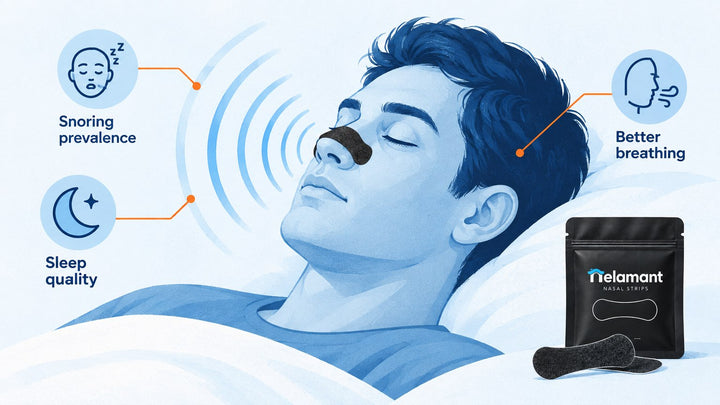
- Support nasal airflow during sleep and exercise. If nasal congestion or a narrow nasal valve limits airflow, an external nasal strip can help. Nelamant Air strips apply a broader, more balanced lift across the bridge of the nose to open the nasal passages mechanically - no drugs, no systemic effects. This helps you stay on the nasal breathing route where the NO mechanism operates.
- Address persistent congestion at the source. Allergies, structural narrowing and other underlying causes of blocked nasal passages limit how much of this mechanism you can use. Treating the cause matters more than any single intervention on top of it.

Keep Your Nasal Passages Open
Nelamant Air Nasal Strips - broader lift, extra-hold adhesive.
$14.99 for 30 strips · 30-day returns
Shop Nelamant AirFrequently Asked Questions
- Does humming really increase nitric oxide?
- Yes, according to research on nasal gas exchange. Humming creates oscillating airflow through the nasal cavity that dramatically increases the rate of gas exchange between the sinuses and the airstream compared with quiet exhalation. The effect is real but temporary - it does not replace consistent nasal breathing. Think of it as a sinus ventilation tool, not a therapeutic regimen.
- Do nasal strips increase nitric oxide production?
- Nasal strips do not produce or synthesise nitric oxide. What they do is help keep the nasal passages open so that nasal breathing - the delivery route for sinus-derived NO - is easier to maintain. If congestion or a narrow nasal valve is causing you to mouth-breathe, a strip like Nelamant Air can support consistent nasal airflow and, by extension, keep the NO mechanism running. The strip supports the route; your sinuses do the chemistry.
- Is nitric oxide the same as nitrous oxide?
- No. Nitric oxide is NO - one nitrogen atom, one oxygen atom - a signalling molecule your body produces. Nitrous oxide is N₂O, the anaesthetic gas used in dentistry and surgery. They are chemically and pharmacologically unrelated. The nasal breathing connection is entirely to nitric oxide (NO), not nitrous oxide.
- Does nose breathing at night produce nitric oxide throughout sleep?
- Your sinuses produce nitric oxide continuously regardless of sleep state. Whether that NO gets inhaled depends on whether you are nose breathing. If you maintain nasal breathing throughout the night, NO delivery continues all night. If congestion pushes you to mouth breathing, that delivery stops. This is one practical reason to address overnight nasal congestion rather than accept it.
The Bottom Line
The connection between nasal breathing and nitric oxide is one of the clearest mechanistic reasons to prioritise nose breathing. Your sinuses produce NO constantly; nasal breathing delivers it to your airways and lungs where it supports vasodilation, oxygen uptake and upper-airway defence. Mouth breathing cuts that supply off on every breath. Keeping your nasal passages open - with good congestion management, consistent nasal breathing habits, and mechanical support when you need it - is the most direct way to make nasal breathing nitric oxide delivery work for you around the clock.