Thomas Tiemann

Disclosure: Nelamant makes Nelamant Air, our top pick in this guide.
If you wake up with a dry mouth, a sore throat, or the sense that you never quite caught your breath overnight, there is a good chance you are breathing through your mouth instead of your nose. The right nasal strip physically lifts the sides of your nose open, reducing the airflow resistance that pushes you toward mouth breathing in the first place. For our picks on the best nasal strips for mouth breathers, we focused on lift geometry, adhesive staying power, and materials that hold up through a full night of sleep. For a broader look at the whole category, see our guide to the best nasal strips overall.
- Nasal strips work mechanically - they lift the nasal passages open, cutting the resistance that forces you to breathe through your mouth.
- For mouth breathers, adhesive strength and lift geometry matter more than for occasional users; strips that peel off at 2 a.m. are useless.
- Nelamant Air is our top pick: broader, more balanced lift across the bridge and an extra-hold adhesive designed to stay on through sweat and overnight movement.
- Internal dilators, mouthguards, and mouth tape each solve a different part of the mouth-breathing puzzle - strips address nasal restriction specifically.
- If mouth breathing persists despite open nasal passages, an underlying cause like a deviated septum or enlarged turbinates may need evaluation.
Why Mouth Breathers Need a Different Kind of Strip
Most people who default to mouth breathing at night do so because nasal airflow feels restricted - congestion, a narrow nasal valve, or structural factors all raise the effort it takes to inhale through the nose. Once that effort exceeds a threshold, the body simply reroutes air through the mouth. The result is poor sleep quality, a dry and irritated airway on waking, and for many people, louder snoring.
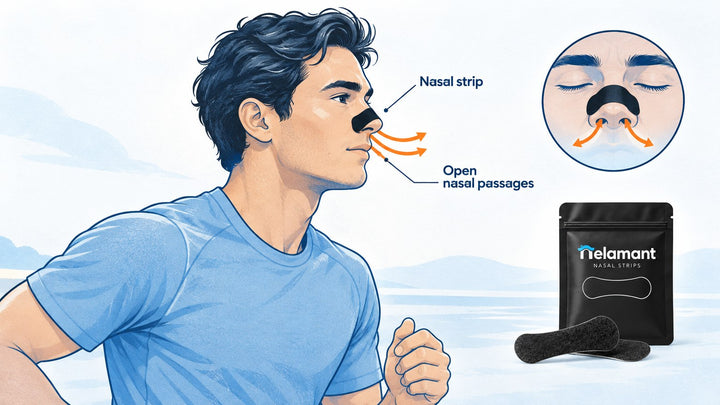
Nasal strips counteract this by applying a gentle outward spring force across the nasal bridge, widening the nasal valve area and lowering airflow resistance. That is the mechanical basis: less resistance means breathing through the nose becomes the easier path again.
For mouth breathers specifically, two strip characteristics matter above anything else. First, lift geometry - a strip that delivers force at a single point can feel uneven and may slip on wider bridge profiles; a strip with broader, more distributed lift spans more of the nasal wall and stays more stable. Second, adhesive durability - if the strip loosens during sleep, the resistance returns and so does mouth breathing. Strips rated for sweat and oils tend to stay anchored through a full night.
Understanding why you mouth breathe in the first place also shapes how much a strip can help. Why you breathe through your mouth when you sleep covers the most common causes - nasal congestion, anatomy, and habit - in detail. And if you want the full picture of what habitual open-mouth breathing does over time, the guide on mouth breathing effects is worth reading before you settle on a solution.
Best Nasal Strips for Mouth Breathers - Compared
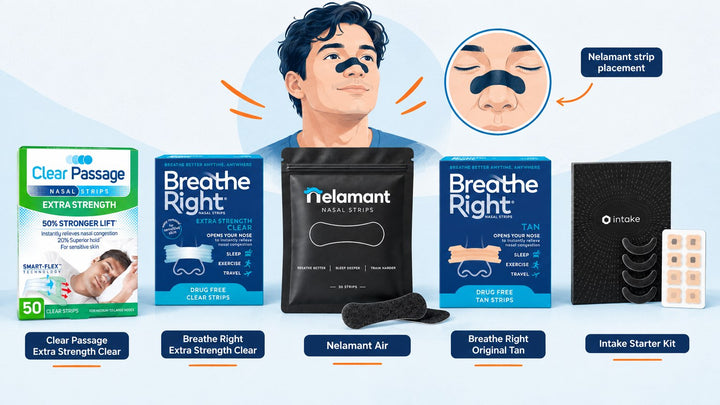
The five products below represent the practical range of adhesive external nasal strips available to mouth breathers. Prices and exact specifications are subject to change; check current listings before purchasing.
| Product | Lift Style | Adhesive Grade | Hypoallergenic | Best For | Price (approx.) |
|---|---|---|---|---|---|
| Nelamant Air | Broad, balanced bridge lift | Extra-hold; sweat/oil resistant | Yes | All-night mouth breathers, sensitive skin | $14.99 / 30 strips |
| Breathe Right Extra Strength | Strong central spring band | Standard-plus | Check current product details | Heavier snorers, broader nasal bridges | Check current product details |
| Breathe Right Original | Moderate central spring band | Standard | Check current product details | First-time strip users, lighter congestion | Check current product details |
| Intake Breathing Strip | Check current product details | Check current product details | Check current product details | Athletes, active daytime users | Check current product details |
| Clear Passage Extra Strength Clear | Check current product details | Check current product details | Check current product details | Budget-conscious buyers seeking strong lift | Check current product details |
#1 TOP PICK Nelamant Air Nasal Strips
Nelamant Air - Best Nasal Strip for Mouth Breathers
$14.99 for 30 strips · 30-day returns
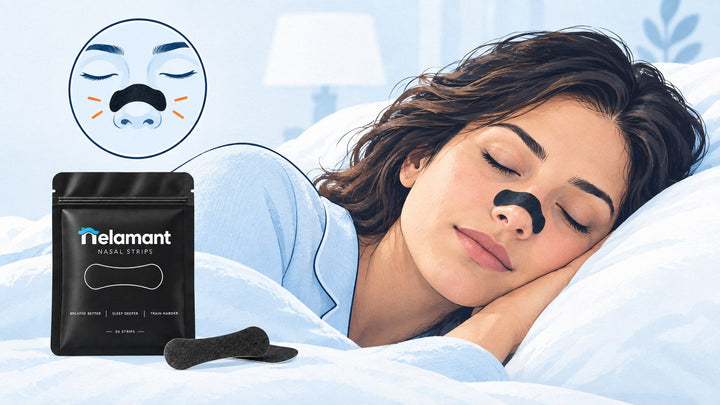
Shop Nelamant Air →Nelamant Air stands out for mouth breathers because of how the lift is distributed. Rather than concentrating spring force at a single point, it delivers a wider, more even lift across the bridge - which matters when you need the strip to hold its position through hours of sleep, position changes, and normal overnight sweating. The extra-hold adhesive is designed to resist oil and moisture, so the strip does not lose grip as the night goes on. Materials are hypoallergenic and the strip peels off cleanly in the morning without leaving a sticky residue.
It is drug-free and works mechanically, which means you can use it alongside decongestants or saline rinses without any interaction concern. At 30 strips per pack, a single purchase covers a full month of nightly use. Bundles of two or three packs are available at a lower per-strip cost; see the Nelamant Air product page for current bundle pricing.
Pros for mouth breathers:
- Broader lift geometry stays stable on a wider range of nose shapes
- Extra-hold adhesive resists the sweat and skin oils that loosen standard strips overnight
- Hypoallergenic materials suit sensitive skin and nightly use
- Peels off cleanly - no morning adhesive scrubbing
- Drug-free; can be combined with other breathing aids without conflict
Cons:
- Available primarily through the Nelamant website, not in physical retail stores
- Single-use only; not reusable
Breathe Right Extra Strength
Breathe Right Extra Strength is the most widely recognized name in nasal strips and the benchmark most other products are measured against. The Extra Strength version has a stronger spring band than the Original, making it a reasonable option for mouth breathers who find standard strips feel inadequate. It is widely available in pharmacies and online.
The spring force concentrates more at the center of the strip than across the full bridge, which works well for many nose shapes but may feel uneven on others. It is a solid, proven option and worth trying if you prefer to pick something up locally.
Pros: Widely available; established track record; strong spring force.
Cons: Less distributed lift than Nelamant Air; may leave more residue for some users.
Breathe Right Original
The Original Breathe Right is a lighter version of the same design - a single spring band with moderate lift. For mouth breathers whose nasal restriction is relatively mild (seasonal congestion, light narrowing), it can be a comfortable starting point, especially for users who find the Extra Strength version too stiff on the nose. It is not the strongest option, and habitual mouth breathers with more significant nasal resistance may find the lift insufficient to shift their default breathing pattern overnight.
Pros: Gentle, easy to wear; widely available; good for trying nasal strips for the first time.
Cons: Lighter lift may not overcome the nasal resistance that drives habitual mouth breathing.
Intake Breathing Strip
The Intake Breathing Strip uses a approach that positions itself as suitable for athletic use and daytime wear. For mouth breathers using strips during exercise, it may be worth evaluating alongside the standard spring-band format. As a nighttime solution for mouth breathing,.
Pros:; drug-free; available online.
Cons:; higher per-strip cost at; less evidence of extra-hold adhesive for overnight sweat resistance.
Clear Passage Extra Strength Clear
The Clear Passage extra-strength range includes clear adhesive strips in several pack sizes. Compare the clear format if you want an external strip rather than a device inside your nostrils.
Pros: Several pack sizes to compare for regular use.
Cons: Still requires fresh adhesive strips for each use; try the fit before buying in bulk.
How We Chose - Nasal Strips to Stop Mouth Breathing
Our selection criteria for this list were built specifically around what mouth breathers need, not general nasal strip performance.
- Lift geometry. Strips that spread lift across more of the nasal bridge hold more reliably on diverse nose shapes and are less likely to shift during sleep.
- Adhesive durability. A strip that peels off at midnight solves nothing. We prioritized products with adhesives rated for moisture, sweat, and skin oils - the conditions any overnight user faces.
- Hypoallergenic materials. Nightly use means your skin is in contact with the adhesive for seven or eight hours every day. Gentle, non-irritating materials matter more here than for occasional use.
- Drug-free mechanical action. Strips that work by physical lift carry no medication side-effect risk and do not interact with other treatments.
- Real, identifiable products. No invented brands or fictional specifications. Where a detail could not be confirmed, it is marked.
This is a manufacturer-authored design and specification comparison, not independent laboratory testing or a ranked customer-rating system.
Buyer's Guide: What to Look for as a Mouth Breather
Not all nasal strips are interchangeable. Here is what each specification means in practice for someone whose default is mouth breathing.
Lift Width and Distribution
A narrow spring band focuses force on a small area of the nasal wall. That can work, but a wider strip that distributes lift more evenly across the bridge tends to stay put longer and opens more of the nasal valve area. If you have found strips slide or feel lopsided overnight, lift geometry is likely the culprit.
Adhesive Strength and Sweat Resistance
Standard adhesives are designed for general use, not eight hours of skin contact through sleep warmth and light moisture. Look specifically for labels like "extra hold" or adhesives described as oil- and moisture-resistant. If you tend to run warm at night, this matters more than almost any other specification.
Hypoallergenic vs. Standard Materials
Hypoallergenic does not mean nobody can ever react, but it does mean the materials have been formulated to minimize the most common skin sensitivities. For nightly use - 30 nights per month - choosing a hypoallergenic strip is sensible skin management. Redness or irritation at the adhesive site is a reason to stop using any strip.
Strips vs. Internal Nasal Dilators
Adhesive strips work from the outside, lifting the nasal wall open. Internal nasal dilators - small flexible devices worn inside the nostrils - achieve a similar airflow result from the inside. Neither type is universally better; some people find one more comfortable than the other. Internal dilators are not strips and should not be compared on the same adhesive or lift criteria. See the best nasal strips guide for a broader comparison of strip types, and check a dedicated dilator guide for internal device recommendations.
Mouth Tape as a Complement
Some mouth breathers use a nasal strip alongside mouth tape - the strip opens the nasal passage, and the tape discourages the mouth from falling open. If you are curious about combining the two, using mouth tape and nasal strips together covers how to do it safely, when it makes sense, and when to avoid it. The key point: mouth tape should only be used when the nasal passage is open enough to breathe comfortably through the nose alone.
Single-Use and Cost Per Night
All the strips in this guide are single-use. At 30 strips per pack, the cost per night ranges from roughly $0.35 to over $1.00 depending on the brand and pack size. Bundle pricing reduces the per-strip cost meaningfully on longer commitments.

Can Nasal Strips Actually Stop Mouth Breathing?
Nasal strips reduce nasal airflow resistance, which removes one of the main reasons your body defaults to the mouth. For many people - particularly those whose mouth breathing is driven by mild nasal restriction, nighttime congestion, or a narrow nasal valve - that is enough to shift breathing back through the nose during sleep.
They will not override a fully blocked nose (severe congestion, a significantly deviated septum, or substantially enlarged turbinates), and they do not retrain the habit of mouth breathing on their own. Someone whose airway is mechanically restricted may benefit more from an evaluation of the underlying anatomy than from any strip. A fuller account of what habitual mouth breathing effects look like over time is worth reading if you are trying to decide whether a strip is the right starting point or whether something more needs addressing.
For building nose-breathing habits alongside using a strip - breathing exercises, positional adjustments, and training approaches - the C5 cluster covers that ground in detail.

Frequently Asked Questions
Do nasal strips work if you're a habitual mouth breather?
They work by reducing the nasal resistance that pushes you toward mouth breathing. If restricted nasal airflow is the main reason you breathe through your mouth at night, a well-fitted strip with a durable adhesive can make a noticeable difference. They are less effective when mouth breathing is driven by an obstruction that the strip cannot address - such as significant septal deviation or very swollen turbinates - or by habit alone without any underlying nasal restriction.
Can I use nasal strips to stop mouth breathing every night?
Yes. Nasal strips are designed for nightly use; 30 strips covers a month. There is no duration limit associated with adhesive external strips used as directed. If skin irritation develops at the adhesive site, give the skin a break and consider whether a different strip material suits you better.
Should I combine mouth tape with nasal strips if I breathe through my mouth?
Some people find the combination effective: the strip opens the nasal passage and the tape reduces the mouth's tendency to fall open. The essential rule is that mouth tape should only be used when you can already breathe comfortably through your nose with the strip in place. For a full explanation of when and how to pair the two safely, see the guide on mouth tape and nasal strips together.
Are nasal strips safe for people with sensitive skin?
Hypoallergenic strips - including Nelamant Air - are formulated to reduce common adhesive sensitivities, but no strip can guarantee zero reaction for every skin type. Apply to clean, dry skin and remove gently. If you notice redness, itching, or persistent irritation at the adhesive site, stop use. The guide on best nasal strips includes a section on sensitive-skin considerations if you want to compare options more closely.
How do nasal strips compare to internal nasal dilators for mouth breathers?
Both work by increasing nasal airflow, just from different sides. External adhesive strips lift the nasal wall outward; internal dilators hold the nasal passages open from inside. Some people prefer one for comfort, fit, or ease of use. Internal dilators are not adhesive, cannot slip off during sleep in the same way, and are often reusable - but they require a comfortable fit inside the nostril. Neither is universally superior; the right choice depends on your anatomy and personal preference.
The Bottom Line
For mouth breathers, the best nasal strips are the ones that stay on all night and open enough of the nasal passage to make nose breathing the easier option. Nelamant Air delivers the broad, balanced lift and extra-hold adhesive that make the difference between a strip that works until 3 a.m. and one that is still doing its job when you wake up. If you are dealing with something beyond mild nasal restriction - and want to understand whether a strip is likely to help - start with why you are mouth breathing in the first place, then match the solution to the cause.