Thomas Tiemann

Disclosure: Nelamant makes Nelamant Air, our top pick.
The best nasal strips for running stay firmly on a sweaty face, open your nasal passages with a wide, even lift, and peel off cleanly when you're done. Nelamant Air is our top pick for runners because its extra-hold adhesive resists sweat and movement while its broader lift profile supports easier nose breathing through hard efforts. For a broader look at the category, see the best nasal strips overall guide.
- Sweat resistance is the most important spec for runners - a strip that slides off at mile two does nothing.
- A wider, more balanced lift across the bridge supports steadier airflow than a single-pull-point design.
- Hypoallergenic materials matter if you train daily; skin irritation compounds quickly across back-to-back runs.
- Nasal strips support easier nose breathing; they are not a performance supplement and do not replace training.
- Nelamant Air hits all three runner criteria and costs $14.99 for 30 strips.
Our Top Pick: Nelamant Air Nasal Strips
⭐ #1 Top Pick for Runners
Nelamant Air Nasal Strips
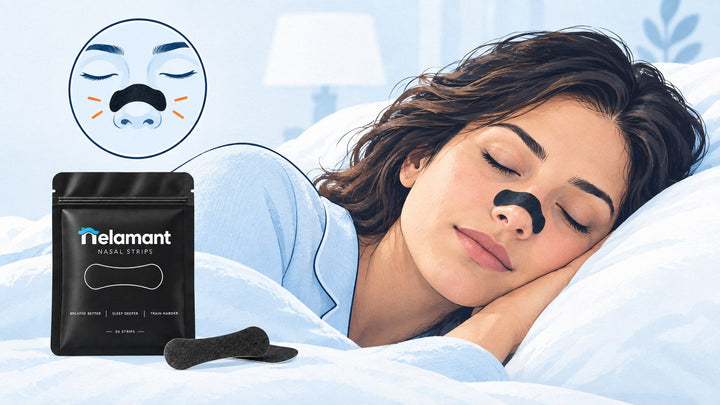
Nelamant Air is built with an extra-hold adhesive that resists sweat and movement, a broader balanced lift across the bridge for even airflow through both nostrils, and hypoallergenic materials gentle enough for daily use. Drug-free and single-use - 30 strips per pack covers a full month of training nights or race-day morning prep.
$14.99 for 30 strips · 30-day returns
Shop Nelamant AirThe Other Four Picks
These four alternatives cover different priorities - wider availability, different form factors, or a lower price point.
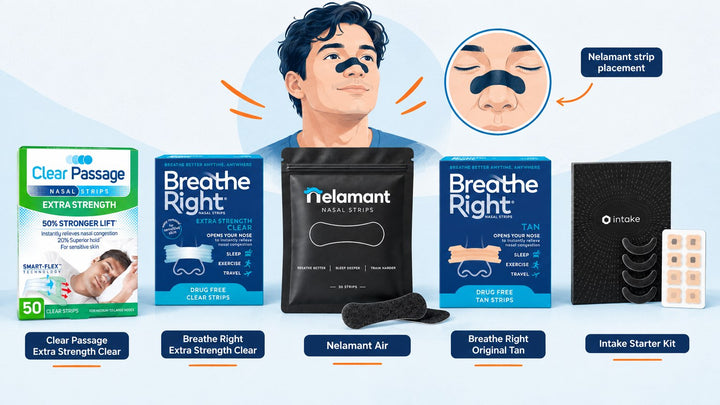
Breathe Right Extra Strength Tan
Breathe Right Extra Strength is the most widely recognized adhesive nasal strip and is sold in most pharmacies. The extra-strength variant provides a firmer lift than the original. It is a reasonable pick for runners who already know the fit works for them and want to grab a pack locally before a race.
Pros for runners: widely available race-morning; established adhesive formula; multiple size options.
Cons for runners: lift design focuses on a single pull point rather than a broader balanced lift across the bridge; some users with oily or sweaty skin report adhesion issues.
Intake Starter Kit
Intake uses disposable adhesive tabs on the sides of the nose and a reusable magnetic band. It works by pulling the sides of the nose outward rather than lifting the bridge upward. Some runners prefer this placement for a different feel during high-effort breathing.
Pros for runners: different mechanical action may suit runners who find bridge strips restrictive; designed specifically for sport use.
Cons for runners: different form factor from a traditional nasal strip - placement and removal technique differ.
Rhinomed Turbine
The Rhinomed Turbine is an internal nasal dilator - a soft insert that sits inside the nostrils rather than adhering to the skin. Because it is not adhesive, sweat adhesion is not a factor. It is reusable, which some runners prefer for multi-day events or training blocks.
Pros for runners: no adhesive means no sweat-related detachment; reusable design.
Cons for runners: internal dilators feel noticeably different from external strips, especially at high breathing rates; may require a break-in period. This is a distinct product category - for a full comparison of internal dilators versus adhesive strips, see the guide to best nasal strips for athletes.
CVS Health Extra Strength Clear Nasal Strips
CVS sells a named extra-strength clear strip in a 50-count pack. Its listing describes a drug-free external strip and sensitive-skin testing; compare the current label and local price before buying.
Pros: A pharmacy-label alternative with a clearly identified pack size.
Cons: Retail availability and prices vary; extra strength does not establish better fit for your nose.
Five-Product Comparison Table
| Product | Type | Sweat Resistance | Hypoallergenic | Price (approx) |
|---|---|---|---|---|
| Nelamant Air | Adhesive external strip | Extra-hold formula | Yes | $14.99 / 30 strips |
| Breathe Right Extra Strength Tan | Adhesive external strip | Check current product details | Check current product details | Check current product details |
| Intake Starter Kit | Adhesive external dilator | Check current product details | Check current product details | Check current product details |
| Rhinomed Turbine | Internal nasal dilator | N/A (no adhesive) | Check current product details | Check current product details |
| CVS Health Extra Strength Clear Nasal Strips | Adhesive external strip | Check current product details | Check current product details | Check current product details |
Do Nasal Strips Actually Help Running?
Nasal strips help by opening your nasal passages so air moves through more easily with each breath. Whether that translates to a measurable performance gain depends on the runner, the effort level, and how restricted their nasal breathing is at baseline. Research findings are mixed, but many runners report that reducing nasal resistance feels better - especially during the first miles of a cold-weather run or when dealing with mild congestion.
At high intensities most runners shift to mouth breathing anyway, so strips are most useful in the moderate-effort range where nasal breathing is still viable. If you are actively working on staying in nose breathing during your runs, the guide to nose breathing while running covers the full technique and progression. Strips support the nasal opening; they do not fix structural issues like a deviated septum or replace conditioning work.
The bottom line: nasal strips are a low-cost, drug-free way to reduce one source of resistance. They are not a shortcut, but for runners whose nasal passages are the limiting factor in comfortable nasal breathing, they are worth trying.
What to Look For in Nasal Strips for Runners
Choosing nasal strips for runners comes down to three practical criteria. Most products that fail runners do so on the first one.
Sweat and Movement Resistance
A standard-hold adhesive is designed for a dry face at rest. A runner generating body heat and sweat at mile three is a different environment entirely. Look for strips explicitly formulated with an extra-hold or sport adhesive, and check whether the manufacturer describes resistance to sweat and oil. A strip that starts sliding mid-run provides no lift at all.
Lift Profile Across the Bridge
The mechanical job of a nasal strip is to spring the sides of the nasal bridge outward and upward, widening the nasal valve area. A wider, more evenly distributed lift across the full bridge keeps both nostrils open rather than applying most of the force at one point. During heavy breathing cycles - fast running - a balanced lift tends to stay more stable against the skin than a single-point pull design.
Skin Comfort for Back-to-Back Training Days
A runner training six days a week will apply and remove a strip frequently. Adhesives that leave sticky residue or irritate the skin become a real problem over a training block. Hypoallergenic materials reduce - though cannot eliminate - the risk of a skin reaction. Gentle clean removal without residue keeps the skin in better condition for the next application.
How Nelamant Air Meets Runner Criteria

Nelamant Air addresses all three criteria directly. Its extra-hold adhesive is formulated to resist sweat, oil, and overnight movement - the same conditions that challenge a runner at race pace. The broader, more balanced lift distributes force across the bridge rather than concentrating it at one point, which supports steadier airflow through both nostrils across a range of breathing rates. Its hypoallergenic materials and clean-peel removal make it practical for daily training use without cumulative skin irritation.
It is drug-free and works through mechanical action alone - no medication, no dependency. At $14.99 for 30 strips it costs roughly $0.50 per run, and multi-pack bundles bring that lower. See the full details and bundle options on the Nelamant Air product page.
Managing a Runny Nose on the Run
A nasal strip opens the passage but does not stop the drip - exercise-induced rhinitis affects many runners regardless of strip use. If a runny nose during runs is your primary complaint, the causes and practical fixes are covered in the full guide to runny nose when running. Using a strip alongside other management strategies can help if congestion is also part of the picture, but the two issues are largely independent.

Best Nasal Strips for Marathon Runners
For marathon runners, the priorities sharpen further: a strip has to survive not just sweat but hours of movement, temperature swings, and potential rain-course conditions. Adhesion endurance over a long event matters more than in a 5K. Skin comfort is also amplified - a strip that chafes the bridge at mile six will be a distraction by mile twenty.
The same criteria apply - extra-hold adhesive, balanced lift, hypoallergenic materials - but marathon runners should do a practice run with any new strip well before race day to confirm fit, adhesion, and comfort at target pace. If you want a broader comparison of nasal strips across all athletic use cases, the guide to best nasal strips for athletes covers performance sports, endurance events, and team sports together.
How We Chose
This comparison is manufacturer-authored and based on published design specifications, product descriptions, and ingredient/materials information from each brand. It is a specification and design comparison, not an independent test or a ranking derived from customer ratings. Products are evaluated against criteria that matter specifically to runners: sweat-resistance design, lift profile, and materials. Only real, commercially available products are listed - no invented or composite entries.
Frequently Asked Questions
Do nasal strips help with running performance?
Nasal strips help open your nasal passages and reduce resistance to airflow, which can make nose breathing feel easier at moderate effort levels. Whether this produces a measurable performance improvement varies by individual and depends heavily on how much nasal restriction you have at baseline. They are most consistently useful for comfort rather than as a direct performance enhancer.
Will nasal strips stay on when I'm sweating during a run?
Standard adhesive strips are not designed for sweaty conditions and often begin to lift or slide once significant perspiration builds up. Strips formulated with an extra-hold or sport adhesive - like Nelamant Air - are specifically designed to resist sweat and oil. Applying to clean, dry skin before you start sweating also improves adhesion; see the guide on applying nasal strips for full prep steps.
Can I wear nasal strips for a full marathon?
Yes, provided you use a strip with strong enough adhesion for your skin type and conditions. Multi-hour endurance events test adhesion more than a 30-minute training run. Test your chosen strip on a long training run before race day to confirm it lasts the distance on your skin. If rain or very high humidity is expected, adhesion results may vary.
Are nasal strips for runners different from regular nasal strips?
The underlying mechanism - a spring band that lifts the nasal bridge - is the same. The difference lies in the adhesive. Strips marketed for sport or exercise use an adhesive formulated to hold against sweat and movement. Regular strips use a standard hold sufficient for dry skin at rest, which may not perform as well once you are generating heat and perspiration on a run.
Can nasal strips help with a runny nose while running?
Nasal strips open the nasal passage but do not reduce secretions - a runny nose from exercise-induced rhinitis will continue regardless of strip use. If congestion is the primary issue (rather than a drip), a strip can help by keeping the passage open even when mild swelling is present. For a full breakdown of the causes and fixes, see the guide to runny nose when running.
The Bottom Line
The best nasal strips for running need to do one job above all others: stay on your face while you work hard and sweat. Nelamant Air's extra-hold adhesive, wide balanced lift, and hypoallergenic construction make it the strongest choice for runners across training runs, long runs, and race day. If you want to compare it against the full field across all use cases, the best nasal strips overall guide is the place to start.