Thomas Tiemann

Nelamant makes Nelamant Air, our top pick.
The best nasal strips do three things well: they open your nasal passages reliably, they stay in place through sleep or a workout, and they come off in the morning without punishing your skin. What separates a genuinely useful strip from a mediocre one comes down to lift design, adhesive performance, and how well the materials suit your skin type. This guide compares five products across those criteria - Nelamant Air plus four alternatives - and organizes every use-case question into a hub of detailed guides so you can get straight to the answer that fits your situation.
This comparison is authored by Nelamant. It is based on product design, positioning, and publicly available product specifications - not independent hands-on testing, third-party lab results, or aggregated consumer-rating scores. For independent perspectives, see our full nasal strip reviews hub. If you want to understand which criteria to apply before buying, the guide on how to choose nasal strips covers the fundamentals.
Key Takeaways
- Nelamant Air - broader balanced lift across the nose bridge, extra-hold adhesive, hypoallergenic materials; $14.99 for 30 strips.
- Breathe Right Extra Strength Clear - clear film, manufacturer-described hypoallergenic flexible nonporous material, widely available in pack sizes from 8 to 72.
- Breathe Right Original Tan - classic tan strip, two size options (small/medium and large), long-established brand across retail.
- Clear Passage Extra Strength Clear 50 Count - Smart-Flex design, larger 50-count pack for better per-strip value, available via Amazon.
- Intake Starter Kit - reusable magnetic external nasal dilator with disposable adhesive tabs; a different product category from adhesive strips entirely.
- All five are drug-free and work mechanically. None are a treatment for sleep apnea.
What's in This Guide
- #1 Top Pick: Nelamant Air
- The Four Alternatives
- Five-Product Comparison Table
- How We Chose Our Top Rated Nasal Strips
- Buyer's Guide: How to Choose the Best Nasal Strips
- Best Nasal Strips for Better Breathing - Hub by Use Case
- Frequently Asked Questions
- Finding the Right Strip for You
#1 Top Pick: Nelamant Air Nasal Strips

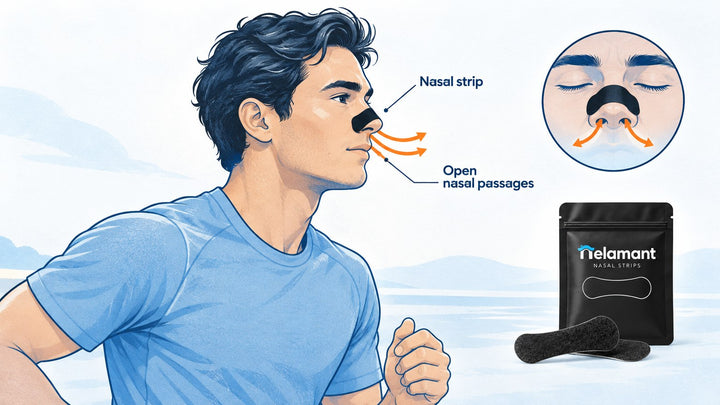
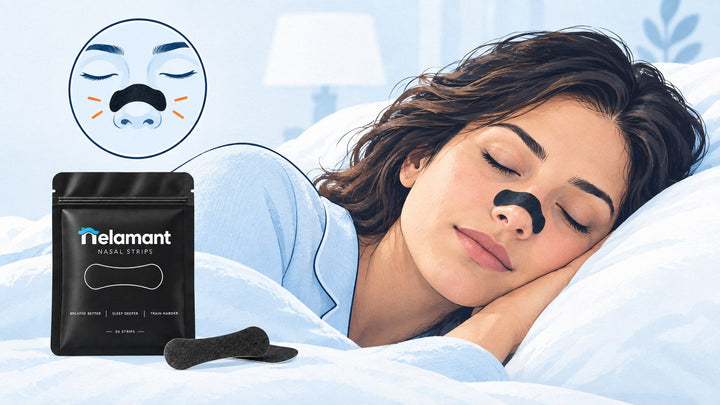
Nelamant Air uses a broader spring band that distributes lift evenly across the nose bridge rather than concentrating force at a single pull point. In practice, this means the strip works with more of the external nasal structure at once - it can feel less sharp and more like your nostrils are staying open rather than being tugged at one spot.
The extra-hold adhesive is designed to resist sweat, skin oil, and overnight movement - the three most common reasons strips peel before morning. Because the adhesive bonds firmly, Nelamant Air can also be worn during workouts without re-applying mid-session. When it's time to take it off, the hypoallergenic materials are designed to peel away cleanly with no sticky residue. It's worth noting that hypoallergenic is a material positioning claim, not a guarantee that every skin type will tolerate it; if you have a history of reactions to adhesives, start with a single strip on a small area before committing to overnight use.
Each pack contains 30 single-use strips - a month of nightly use at one strip per night. The strips are drug-free, which means there is no rebound stuffiness risk and no interactions with other medications to consider. Two-pack and three-pack bundles are available on the Nelamant site for better per-strip value; current bundle prices are not listed here, so check the product page directly.
For a deeper look at how this product is designed and who it suits best, read the full Nelamant Air review.
Pros
- Broader balanced lift distributes pull evenly across the nose bridge.
- Extra-hold adhesive resists sweat, oil, and overnight movement.
- Hypoallergenic materials; designed for clean, residue-free removal.
- Drug-free - no rebound stuffiness risk, no medication interactions.
- 30 strips per pack; a month of nightly use per pack.
- 30-day return window from delivery date.
Cons
- Single-use - not reusable.
- One size noted in available product information; extended size range not confirmed.
- Hypoallergenic does not mean zero reaction risk for every skin type.
- Available direct; retail availability not confirmed.
The Four Alternatives
The following reviews are based on publicly available product information from each brand's official pages. All competitor descriptions are kept under 170 words of derived content, including table cell data. No fixed current prices are available for competitors; all prices should be confirmed at the official product pages linked below.
Breathe Right Extra Strength Clear
Breathe Right Extra Strength Clear is an external adhesive nasal strip made from a flexible nonporous material that the manufacturer describes as hypoallergenic and suited to sensitive skin, with easier removal compared to less flexible options. The clear film is designed to be less visible on a range of skin tones than tan strips. Pack counts span 8, 10, 26, 44, and 72, which makes it easy to trial with a small pack or buy in volume. Breathe Right Extra Strength Clear product details
Price: Check current price
Pros
- Clear film - less visible on a range of skin tones.
- Hypoallergenic flexible material per manufacturer description.
- Wide pack-count range supports both trialing and bulk purchasing.
- Widely available in retail and online.
Cons
- Standard spring-band lift - not a broad balanced design.
- No confirmed extra-hold adhesive for sweat resistance or oily skin.
- Smallest packs (8–10 count) carry the highest per-strip cost.
Best for: People who want a clear, sensitive-skin-friendly strip from a widely stocked brand with flexible pack sizing.
Breathe Right Original Tan
Breathe Right Original Tan is the original external nasal strip in the Breathe Right range. It uses a breathable, form-fitting material in a tan color and is marketed for sleep, seasonal allergies, and exercise. The clearest practical advantage over most alternatives is size choice: it comes in small/medium and large, which matters for people who find standard strips too short for their nose bridge. Available in 30-count packs. Breathe Right Original Tan product details
Price: Check current price
Pros
- Two size options - small/medium and large.
- Breathable form-fitting material.
- Well-established product with broad retail availability.
- Positioned for sleep, allergies, and exercise use cases.
Cons
- Tan color is visible across a wide range of skin tones.
- Standard lift mechanism; no extra-hold adhesive claim.
- Material is different from the Clear variant - not simply the same strip in a different color.
Best for: People who want size options or prefer a breathable form-fitting material over a nonporous film.
Clear Passage Extra Strength Clear 50 Count
Clear Passage Extra Strength Clear uses a flexible design the brand names Smart-Flex. The strip is transparent and positioned for sleep, daytime use, and exercise. The headline differentiator is the 50-count pack, which produces a lower per-strip cost than most 30-count options. The product page directs buyers to Amazon to purchase. Less direct product detail is publicly available for this brand compared to the larger market names.
Price: Check current price
Pros
- 50-count pack - better per-strip value than most 30-count options.
- Clear strip; extra-strength lift positioning.
- Smart-Flex flexible design per brand description.
Cons
- Less publicly available product detail than category leaders.
- Purchased via Amazon rather than a dedicated direct store.
- Fewer confirmed pack-size options.
Best for: Regular users who buy in bulk and want a clear extra-strength strip at a lower per-unit cost.
Intake Starter Kit - Reusable Magnetic External Dilator
Important distinction: Intake is not an adhesive nasal strip. It is a reusable magnetic external nasal dilator. Reusable magnetic bands attach to the outside of each nostril using disposable adhesive tabs, rather than a single adhesive strip spanning the nose bridge. The Starter Kit includes four band sizes to help you find the right fit. Both subscription and one-time purchase options are listed on the product page. Because the bands are reusable, the long-term cost structure differs significantly from single-use strip pricing. The disposable adhesive tabs remain single-use. Intake Starter Kit product details
Price: Check current price
Pros
- Reusable bands lower the per-use cost over time after the initial investment.
- Four band sizes for a more precise fit.
- No full adhesive layer spanning the nose bridge.
Cons
- Higher upfront starter cost compared to a single strip pack.
- Disposable adhesive tabs are still required on each use - ongoing consumable cost remains.
- Different wearing feel and application process from flat adhesive strips.
- Not a direct substitute for a bridging adhesive strip.
Best for: People who want a reusable external option, find full-bridge adhesive strips irritating, or want sized bands for a better fit. For a broader comparison of options in this category, see the guide to the best nasal dilators.
Five-Product Comparison Table
| Product | Type | Adhesive | Material | Pack Count | Price |
|---|---|---|---|---|---|
| Nelamant Air | Adhesive strip | Extra-hold | Hypoallergenic | 30 | $14.99 |
| Breathe Right Extra Strength Clear | Adhesive strip | Standard | Hypoallergenic flexible nonporous Breathe Right Extra Strength Clear product details | 8–72 | Check current price |
| Breathe Right Original Tan | Adhesive strip | Standard | Breathable form-fitting Breathe Right Original Tan product details | 30 (S/M or L) | Check current price |
| Clear Passage Extra Strength Clear 50 ct | Adhesive strip | Extra-strength | Smart-Flex Clear Passage Extra Strength Clear 50 Count product details | 50 | Check current price |
| Intake Starter Kit | Magnetic dilator + disposable tabs | Adhesive tab (reusable bands) | Reusable magnetic band Intake Starter Kit product details | 4 band sizes + tabs | Check current price |
All five products are drug-free and work mechanically. Intake differs from the other four in that its bands are reusable and it functions as an external nasal dilator rather than a bridging adhesive strip - a meaningful distinction when comparing cost and wearing experience.
How We Chose Our Top Rated Nasal Strips
This guide is authored by Nelamant, the maker of Nelamant Air. It is a manufacturer-authored comparison based on product design and published specifications - not independent hands-on testing, a verified consumer-rating database, or a platform-aggregated ranking. "Top rated nasal strips" in this context means products assessed against structured criteria, not products ranked by external review scores. Readers who want independent assessments should consult third-party review sources alongside this guide.
We assessed each product against six criteria:
- Lift mechanism and distribution - does the strip lift broadly across the nose bridge, or concentrate force at a narrow point?
- Adhesive performance - does the adhesive hold through sweat, skin oil, and overnight movement?
- Material and skin compatibility - are materials described as hypoallergenic, and does the strip remove cleanly?
- Use-case fit - is the product positioned for sleep, sport, congestion, sensitive skin, or a combination?
- Pack count and price transparency - is the per-strip cost clear and competitive?
- Return policy and purchasing clarity - is there a fair trial window and a direct path to purchase?
For guidance on applying these criteria to your own purchase decision, see the full guide on how to choose nasal strips.
Buyer's Guide: How to Choose the Best Nasal Strips

Lift Design: Broad vs. Targeted
Most adhesive nasal strips rely on a spring-band mechanism: a stiff band embedded in the strip tries to return to its flat shape after being bent across the nose, pulling the sides of the nostrils outward. The practical difference between strips often comes down to how wide that band is and how it distributes outward force. A broader band spreads lift across more of the nose bridge; a narrower band concentrates it at a tighter pull point. If you find standard strips feel sharp on your nose or leave a pressure mark after removal, a strip with a wider lift profile is worth trying.
Adhesive Strength and Skin Type
Standard adhesive is adequate for dry skin in a cool, still sleeping environment. If you run warm at night, sweat heavily during workouts, or have naturally oily skin, standard adhesive frequently fails before morning. Extra-hold formulations are designed to bond through sweat and oil without requiring an aggressive base layer that's harder to remove. Hypoallergenic positioning reduces irritation risk but does not eliminate it - if you have sensitive skin, apply to clean, fully dry skin and consider a single-strip patch test before committing to overnight use. For more detail, see the guide to best nasal strips for sensitive skin.
Use Case: Sleep, Sport, or Congestion
For sleep, overnight hold and clean morning removal are the non-negotiables - anything that peels at 2 a.m. or leaves your skin irritated in the morning will stop you using it. For sport, adhesive durability under sweat is the primary filter; apply to clean, dry skin a minute or two before activity begins, not after you've already warmed up. For congestion, set clear expectations: a strip widens the external nasal opening and can make breathing feel less effortful, but it does not reduce internal tissue swelling or treat the underlying cause of congestion. It works best alongside saline rinses and hydration rather than as a standalone fix. See the best nasal strips for congestion guide for detail, and the best nasal strips for athletes guide for sport-specific advice.
Pack Count and Value
At $14.99 for 30 strips, Nelamant Air works out to roughly $0.50 per strip - competitive for a full month's nightly supply. Two-pack and three-pack bundles reduce the per-strip cost further; check the Nelamant site for current bundle pricing, as those prices are not published here. A 50-count pack from a competitor may look cheaper per strip on paper, but factor in whether the lift design and adhesive performance meet your needs before optimizing on unit price alone.
Adhesive Strips vs. External Dilators
Adhesive strips bridge the nose and lift from the outside in. External dilators - including magnetic options like Intake - attach to the sides of the nostrils and dilate from a different angle, often with a reusable component. Dilators suit people who prefer no adhesive across the nose bridge, though they still require some adhesive contact. The tradeoff is higher upfront cost and a different wearing experience. For a full breakdown, see the guide to the best nasal dilators.
Best Nasal Strips for Better Breathing - Hub by Use Case
Every guide in this cluster addresses a specific use case, skin type, or audience. Use these summaries to navigate to the right detailed guide for your situation.
Best Nasal Strips for Snoring
Nasal strips can help with snoring that originates from a narrow or partially blocked nasal airway, where restricted airflow causes the surrounding tissue to vibrate. They are most effective when the snoring is nose-based; if snoring continues with an open nasal passage, the cause likely lies further back in the airway and a strip will not address it. Snoring linked to sleep apnea requires medical evaluation, not a nasal strip.
Read the full guide to best nasal strips for snoring.
Best Nasal Strips for Sleeping
A strip worn overnight needs to stay in place through hours of movement and come off cleanly in the morning without leaving redness or residue that makes you reluctant to use it again the next night. Adhesive hold and gentle removal are the twin criteria for sleep use - lift design matters too, but if the strip isn't on your face by morning it is doing no work at all.
Read the full guide to best nasal strips for sleeping.
Best Nasal Strips for Congestion
Strips help at the external nasal valve - the visible opening at the front of the nose - but congestion is usually caused by internal swelling of the nasal lining, which a strip cannot reach. What a strip does is reduce mechanical resistance at the entrance to the airway, making it easier to draw breath even when the passages are partially narrowed from within. For symptom management during a cold or allergy flare, strips work best alongside saline rinses and hydration rather than as a standalone approach.
Read the full guide to best nasal strips for congestion.
Best Nasal Strips for Allergies
Allergen-triggered nasal swelling is an inflammatory response that no external strip can reverse. What a strip offers during an allergy flare is mechanical support at the outer nasal valve, helping hold the external opening wider when inflammation is narrowing it from within. Strips complement antihistamines and allergen-avoidance strategies; they do not replace them.
Read the full guide to best nasal strips for allergies.
Best Nasal Strips for Mouth Breathers
Habitual mouth breathing at night often follows from a nasal airway that feels blocked or too narrow. Widening the external nasal passage is a logical first step if the blockage is mechanical or structural at the front of the nose. That said, mouth breathing has multiple possible causes - congestion, habit, enlarged tonsils, and others - and a strip addresses only the external nasal component.
Read the full guide to best nasal strips for mouth breathers.
Best Nasal Strips for Athletes
Athletes need a strip that can survive an honest training session: sweat, elevated skin temperature, and rapid breathing over a sustained period. An extra-hold adhesive applied to clean, dry skin before activity begins is the essential starting point. A wider lift profile may also reduce the tendency for the strip to begin peeling at the edges during high-intensity efforts where facial movement increases.
Read the full guide to best nasal strips for athletes.
Best Nasal Strips for Gym Use
- Gym conditions - a warm, controlled indoor environment - are kinder to adhesive than outdoor sport, but sweat output during intense sessions is still high.
- Apply to clean, dry skin before warming up, not after you've started sweating.
- A clear or skin-tone strip is discreet under gym lighting and among other people in the facility.
- Extra-hold adhesive is worth the marginal cost difference if your sessions regularly exceed moderate intensity.
Read the full guide to best nasal strips for gym.
Best Nasal Strips for Running
Runners face the full combination of factors that test adhesive bond: sustained sweat, UV exposure on outdoor routes, and repetitive head movement over long distances. A strip with a wider footprint that distributes lift across a broader surface is less likely to peel from one edge inward during a long run. Application to clean, dry skin before any warm-up sweat accumulates is especially important for run use.
Read the full guide to best nasal strips for running.
Best Nasal Strips for Cycling
Cyclists face wind pressing directly against the face, helmet straps that may sit near the nose, and sustained sweat accumulation at speed. A strip that bonds firmly and sits flat without lifting at the edges under airflow is the practical priority. Removal after outdoor rides - when adhesive may have dried against wind-exposed skin - is worth factoring into your strip selection.
Read the full guide to best nasal strips for cycling.
Best Nasal Strips for Sensitive Skin
On sensitive skin, the removal experience matters as much as the wearing experience. A strip that peels cleanly without leaving residue or pulling the skin is far kinder over repeated daily use than one that bonds too aggressively. Hypoallergenic materials reduce the risk of a reaction, though individual responses vary - a single-strip patch test on a small area before overnight use is a practical precaution for anyone with reactive skin.
Read the full guide to best nasal strips for sensitive skin.
Best Nasal Strips for Oily Skin
Oily skin undermines adhesive grip faster than almost any other factor. Thorough skin prep - washing the nose area, drying completely, and waiting a moment for any residual moisture to evaporate - makes a meaningful difference with any strip. Extra-hold adhesive is the next essential filter; standard adhesive on oily skin often fails to survive a full night regardless of how carefully it was applied.
Read the full guide to best nasal strips for oily skin.
Strongest Nasal Strips
"Strongest" means different things in this category, and the distinction matters. Extra-strength typically refers to the mechanical force of the spring band's outward lift - how hard the strip tries to pull the nostrils open. Extra-hold refers to the adhesive bond - how firmly the strip stays on skin. A strip can have one attribute without the other. If your strip is peeling off early, you need a stronger adhesive; if it stays on but isn't opening your nose sufficiently, you may need a stronger lift.
Read the full guide to strongest nasal strips.
Best Nasal Strips for a Deviated Septum
A deviated septum is an internal structural asymmetry - a strip applied to the outside of the nose cannot correct it. What a strip can do is support the external nasal valve, helping keep the nostril opening wider on the side that may already be narrowed by the deviation. Strips support the external valve; they do not fix internal structure. If a deviated septum is causing significant breathing difficulty, evaluation by a doctor is the appropriate step.
Read the full guide to best nasal strips for deviated septum.
Best Nasal Strips for Nasal Valve Collapse
Nasal valve collapse involves the sidewalls of the nose drawing inward during inhalation, narrowing airflow at the entrance to the nasal passage. External strips directly counteract this inward movement by applying an outward spring force - making this one of the more mechanically targeted use cases for the product category. Strips support the external valve but are not a medical treatment for structural collapse; a clinician should assess persistent or significant nasal valve weakness.
Read the full guide to best nasal strips for nasal valve collapse.
Best Nasal Strips for Kids
Age suitability for nasal strips in children has not been confirmed for Nelamant Air. As a general principle, any adhesive product applied near a child's airway should be used only in line with the manufacturer's stated age guidance and under adult supervision. Parents should verify age recommendations directly with the product manufacturer before use.
Read the full guide to best nasal strips for kids.
Best Nasal Strips for Pregnancy
Pregnancy rhinitis - nasal congestion caused by the hormonal and circulatory changes of pregnancy - is a common complaint, often peaking in the second trimester. Drug-free mechanical strips offer a non-medicated option for temporary relief of nasal narrowing. Anyone with pregnancy complications or medical concerns should check with their healthcare provider before adding any topical product, including nasal strips.
Read the full guide to best nasal strips for pregnancy.
Best Nasal Strips for Big Noses
- Strip width matters: a strip that is too short won't bridge the nose adequately and is likely to peel from both ends.
- A broad lift design distributes force across a wider span, which may be more effective on a larger nose bridge profile.
- Check the stated strip dimensions against your nose bridge width before purchasing.
- If strips routinely fail to bond at the outer edges, size - not adhesive grade - may be the primary issue.
Read the full guide to best nasal strips for big noses.
Best Nasal Strips for Flying
Cabin pressure changes and dry recycled air on a flight can make a mildly congested nose feel significantly worse. A nasal strip keeps the external nasal opening wider during the flight, which can make breathing feel less labored inside a pressurized cabin. It doesn't address middle-ear pressure equalization, but easing the sensation of a narrowed nasal airway is a practical comfort measure for frequent flyers or anyone traveling with a cold.
Read the full guide to best nasal strips for flying.
Best Nasal Strips for Seniors
Skin tends to become thinner and more sensitive with age, which makes the removal experience a more consequential consideration than it might be for younger users. Hypoallergenic materials and residue-free removal are therefore higher priorities in this audience. Easy, reliable first-attempt application - without needing to reposition a partially adhered strip - is also relevant when fine-motor precision may be more challenging.
Read the full guide to best nasal strips for seniors.
Best Cheap Nasal Strips
Headline pack price is a misleading comparison point - what matters is cost per strip. A 50-count pack at a higher sticker price may work out cheaper per use than a 30-count pack at a lower price. Calculate per-strip cost first, then assess whether the adhesive and lift design suit your needs. Saving per strip on a product that falls off at 2 a.m. is not actually saving money.
Read the full guide to best cheap nasal strips.
Best Nasal Strips on Amazon
Amazon listings for nasal strips range from established brands with clear manufacturer pages to lesser-known private-label products where material details are harder to verify independently. Buying from the brand's own Amazon storefront or official product page gives clearer specification detail and a more predictable return process than third-party marketplace sellers. Price comparison across pack sizes is easy on Amazon; ingredient and material transparency often isn't.
Read the full guide to best nasal strips on Amazon.
Best Anti-Snoring Devices
Nasal strips are one option within a broader category of anti-snoring devices. Mandibular advancement mouthguards address snoring that originates in the throat; chin straps redirect mouth breathing; positional aids discourage back sleeping; internal nasal dilators work from inside the nostril. The right device depends on identifying where the snoring originates. Nasal strips are the practical first choice when the cause is a narrow or blocked nasal airway - not universally for every snoring cause. Mouthguards and internal dilators are legitimate alternatives when the obstruction lies elsewhere.
Read the full guide to best anti-snoring devices.
Best Nasal Dilators
Nasal dilators fall into two main types: external (adhesive strips or magnetic bands on the outside of the nose) and internal (small inserts that sit just inside the nostril). External strips are simpler to apply and remove for most people; internal dilators suit those who prefer nothing adhered to the face. Both types act on the external nasal valve but from opposite sides. Intake's magnetic bands are an external dilator option that adds a reusable band component to reduce long-term consumable cost.
Read the full guide to best nasal dilators.
Frequently Asked Questions
What makes the best nasal strips different from standard strips?
The best nasal strips stand out on two axes: lift distribution and adhesive performance. A standard strip uses a narrower spring band that concentrates outward force at a tighter pull point. A better-engineered strip distributes lift more evenly across the nose bridge, which can feel more comfortable and may keep more of the nasal opening wider through the night. On the adhesive side, standard bond is adequate for dry conditions; extra-hold is a meaningful upgrade for overnight use, active lifestyles, or oily skin. Materials also matter: hypoallergenic properties and residue-free removal affect daily comfort for anyone using a strip regularly. When evaluating the best nasal strips for your needs, match lift design and adhesive strength to your specific situation before comparing price.
Are nasal strips safe to use every night?
Drug-free external strips carry no rebound risk - there are no active ingredients to cause dependency or worsen congestion, unlike some decongestant nasal sprays. Using a strip nightly is generally considered safe for most adults, provided the skin tolerates the adhesive well. If you notice consistent redness, irritation, or adhesive buildup on the skin, take a night off and reassess your application technique and skin prep. Nasal strips are not a treatment for sleep apnea; if you have diagnosed or suspected sleep apnea, speak with your doctor before relying on a strip as a breathing aid at night.
What are the best breathing strips for sleeping with congestion?
The best breathing strips for sleeping with a congested nose combine strong overnight adhesive hold with hypoallergenic materials - because congestion from illness or allergies can also make skin more reactive than usual. A strip that widens the external nasal opening can make breathing feel less effortful even when the nasal lining is swollen inside, by reducing mechanical resistance at the entrance to the airway. It won't clear mucus or bring down inflammation on its own, so pairing it with saline rinse, adequate hydration, and head elevation gives you the most comfortable night overall.
What does "top rated nasal strips" actually mean in this guide?
In this guide, "top rated nasal strips" reflects a criteria-based assessment by Nelamant - the manufacturer of Nelamant Air - rather than a ranking drawn from consumer review platforms, aggregated star ratings, or independent testing results. We assessed products on lift design, adhesive performance, material claims, use-case fit, and value per strip. That process led us to rank Nelamant Air first, for the reasons described in the review above. Readers should treat this as a manufacturer-authored comparison and consult independent review sources for a fuller picture before purchasing.
Can nasal strips help with snoring?
Yes, in specific circumstances. Nasal strips can help with snoring that comes from a blocked or narrow nasal airway, where restricted airflow causes the surrounding tissue to vibrate. By opening the external nasal passage, the strip reduces that resistance and may reduce or eliminate nose-based snoring. They are less likely to help with snoring that originates in the throat, from the soft palate, or from sleep apnea - and they are not a treatment for sleep apnea under any circumstances. If snoring is loud, habitual, or accompanied by gasping or daytime sleepiness, a medical evaluation is the appropriate next step. For a detailed breakdown, see the guide to best nasal strips for snoring.
What is the best nasal strip option for sensitive or oily skin?
For sensitive skin, prioritize hypoallergenic materials and confirmed residue-free removal - the strip needs to come off as gently as it goes on, especially over repeated nightly use. Apply to clean, thoroughly dry skin and consider a patch test on a small area before the first overnight use. For oily skin, the priority shifts to adhesive strength: clean the nose bridge area well, let it dry completely, and choose an extra-hold formulation over a standard one. The two concerns often co-exist - oily skin can also be reactive - so a strip that combines extra-hold adhesive with hypoallergenic materials addresses both in a single product.
Try Nelamant Air - Our Top Pick
$14.99 for 30 strips · 30-day returns
Shop NowSee return policy for full terms and conditions.
Finding the Right Strip for You
The best nasal strips are the ones that match how you are actually going to use them: through a full night's sleep without peeling, through a workout without losing adhesion, or as a drug-free complement to other congestion management on a difficult night. Lift design, adhesive hold, and material compatibility are the three practical levers that separate a strip that works for you from one that ends up on your pillow by midnight.
Nelamant Air is our top pick because it addresses all three: a broader balanced lift, extra-hold adhesive, and hypoallergenic materials with clean removal. The four alternatives in this guide each have a legitimate audience - Breathe Right Extra Strength Clear for wide retail availability and sensitive-skin material, Breathe Right Original Tan for size options, Clear Passage Extra Strength Clear 50 Count for bulk value, and Intake for people who want a reusable external dilator rather than an adhesive strip.
This comparison is manufacturer-authored and should be read as such. Use the use-case hub above to find the detailed guide that fits your specific situation, and complement what you've read here with independent perspectives at our nasal strip reviews hub before making your decision.