Thomas Tiemann

Disclosure: Nelamant makes Nelamant Air, our top pick in this comparison. The other products are included to give you a complete, honest picture of what is available.
The best nasal strips for snoring are ones that open your nasal passages wide enough to reduce the restriction causing the noise, then stay put all night. If your snoring originates in your nose - from congestion, narrow nasal passages, or poor airflow through the nostrils - an adhesive nasal strip placed across the bridge is one of the simplest, drug-free ways to address it. For a broader look at how all the top-rated strips compare across every use case, see the best nasal strips guide.
- Nasal strips can reduce snoring caused by nasal narrowing or congestion; they do not address throat-based or sleep-apnea snoring.
- Lift width and overnight adhesive strength are the two most important design factors for snorers.
- Nelamant Air is our top pick for its broader, balanced lift and extra-hold adhesive that resists overnight movement.
- Four real alternatives are included below so you can match the right product to your nose, skin, and budget.
- If snoring is loud, gasping, or associated with daytime fatigue, talk to a doctor before relying on strips alone.
Do Nasal Strips Actually Reduce Snoring?
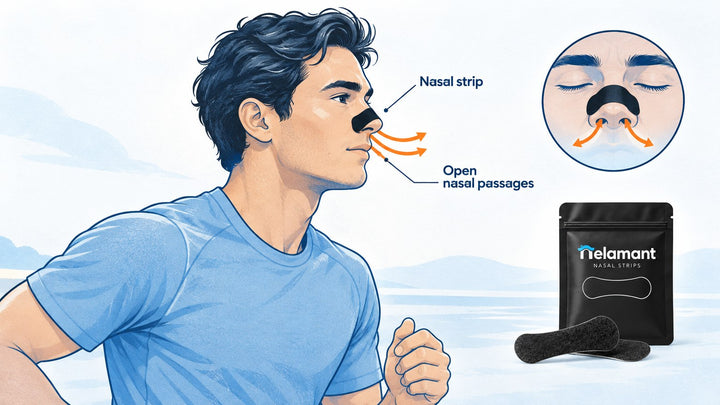
Nasal strips work by gently pulling the sides of the nose outward, which widens the nasal valve and reduces airflow resistance through the nostrils. When a narrowed or congested nose forces you to breathe harder, the turbulence that results can produce or amplify snoring. Opening that passage mechanically - without any drug - can lower that resistance and quiet the noise.
The key qualifier is where the snoring comes from. Strips act on the nose only. If your snoring is nasal in origin - blocked passages, nighttime congestion, or a naturally narrow nasal valve - they are a reasonable first tool. If the snoring comes from vibrations further back in the throat, tongue position, or jaw, a strip on the nose will not solve it. Read whether nasal strips help snoring for the full breakdown of how they affect snoring physiology, and see nose snoring vs. mouth snoring to work out which type you are dealing with before you buy.
Anti snoring nasal strips are also single-use, non-medicated, and require no fitting or charging - which makes them a practical starting point before investing in more expensive devices.
Our Top Pick: Nelamant Air Nasal Strips
🏅 #1 Top Pick
Nelamant Air Nasal Strips
Nelamant Air uses a wider spring band that delivers a broader, more balanced lift across the bridge of the nose rather than a single sharp pull point. That even lift keeps both nostrils open through the night, which matters most for snorers who need continuous airflow while they sleep.
The extra-hold adhesive is formulated to resist sweat, skin oils, and overnight movement - problems that cause many strips to loosen and lose lift just when you need them most. The materials are hypoallergenic and designed for sensitive skin, and the strip peels off cleanly in the morning without leaving a sticky residue.
Each pack contains 30 strips - a full month of nightly use - and the formula is entirely drug-free, making it suitable day or night, for sleep or congestion relief. Single-use only.
- Best for: Nose-based snoring, congestion-driven snoring, sensitive skin
- Lift style: Broad, balanced lift across the nasal bridge
- Adhesive: Extra-hold; resists sweat and oil
- Pack size: 30 strips / $14.99; 2-pack and 3-pack bundles available
- Returns: 30 days from delivery
The Four Alternatives Worth Knowing
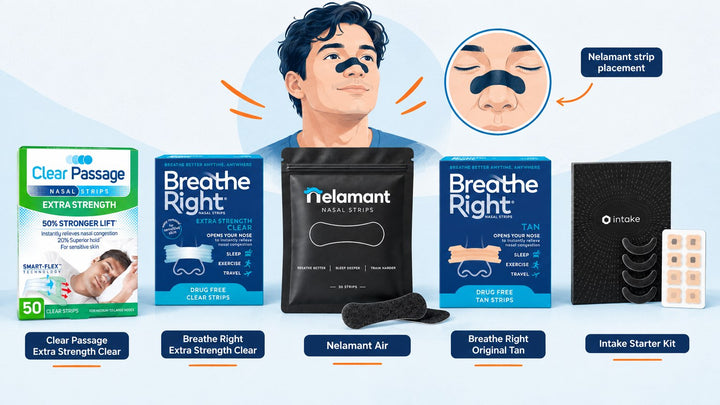
The products below cover the main design and price variations in the adhesive nasal strip market. Each has a legitimate use case; the right choice depends on your lift preference, skin type, and how long you need the strip to hold.
Breathe Right Extra Strength
Breathe Right Extra Strength is the most widely recognized name in nasal strips and uses a stronger spring band than the original version. The extra-strength variant is designed for people who find standard strips do not open their nose enough. It is widely available in pharmacies and is a reasonable fallback if you want a product with long market history. Skin sensitivity reports are more common with this version than with the original, so those with reactive skin may want to test on a small area first.
- Pros: Strong lift, easy to find in stores
- Cons: Single lift point may feel less even; adhesive can irritate sensitive skin
Breathe Right Original
The original Breathe Right strip uses a lighter spring and a gentler adhesive than the extra-strength version. It suits people who want a moderate amount of lift without the stronger pull or who have found the extra-strength adhesive too aggressive on their skin. For heavy snorers who need a firm, all-night hold, the original may not deliver enough lift through a full eight hours.
- Pros: Widely available, gentler adhesive
- Cons: Lower lift force; may loosen before morning for oily or combination skin
Intake Breathing
Intake Breathing uses a rigid external dilator design that attaches to the sides of the nose rather than a flexible strip across the bridge. The claimed advantage is a more targeted opening of the nasal valve. Because the shape and attachment method differ substantially from a traditional spring-band strip, fit varies more by nose shape. It is worth considering if you have tried conventional spring strips and found the lift direction unsatisfactory.
- Pros: Different mechanical approach may suit some nose shapes better
- Cons: Higher per-unit cost; less familiar application method; fit is more variable
Clear Passage Extra Strength Clear
The Clear Passage extra-strength range includes clear adhesive strips in several pack sizes. Compare the clear format if you want an external strip rather than a device inside your nostrils.
Pros: Several pack sizes to compare for regular use.
Cons: Still requires fresh adhesive strips for each use; try the fit before buying in bulk.
Five-Product Comparison Table
| Product | Lift Style | Adhesive Strength | Skin-Friendly | Pack Size | Price |
|---|---|---|---|---|---|
| Nelamant Air | Broad, balanced across bridge | Extra-hold; sweat/oil resistant | Hypoallergenic; clean removal | 30 strips | $14.99 |
| Breathe Right Extra Strength | Strong single-point lift | Strong | May irritate sensitive skin | Check current product details | Check current product details |
| Breathe Right Original | Moderate lift | Standard | Gentler adhesive | Check current product details | Check current product details |
| Intake Breathing | Rigid external dilator | Check current product details | Check current product details | Check current product details | Check current product details |
| Clear Passage Extra Strength Clear | Extra-strength spring | Strong overnight hold | Check current product details | Check current product details | Check current product details |
How We Chose These Picks
This comparison is manufacturer-authored and design-specification based, not derived from independent laboratory testing or a customer-rating algorithm. Products were selected by evaluating publicly available design and specification information against the criteria that matter most for snoring: lift width and evenness, adhesive hold duration, skin-compatibility claims, and product availability.
Nelamant Air is included as the top pick because its design directly addresses the two biggest failure points for snorers - insufficient lift evenness and adhesive that loosens overnight. The four alternatives represent meaningfully different design approaches or market positions, not variations of the same product.
Buyer's Guide: What to Look for in Anti Snoring Nasal Strips
Not all nasal strips are built to the same standard, and the differences matter more at night than during the day. Here are the design factors worth checking before you buy.
Lift Design: Width and Evenness
A wider strip that lifts across more of the nasal bridge opens both nostrils more evenly. Strips that concentrate their pull at a single point may open one side of the nose more than the other, which can limit the total airflow improvement. For snorers, even bilateral opening tends to be more effective than a strong but narrow lift.
Adhesive Strength and Overnight Hold
Snorers move during sleep. A strip that holds at 11 pm but peels away by 3 am is not solving the problem. Look for adhesives specifically described as sweat- and oil-resistant. If you have naturally oily skin or tend to sweat at night, this is the single most important factor to check. Cleaning and thoroughly drying the nose bridge before application also helps any strip hold longer - see the guide on how nasal strips help snoring for application tips specific to overnight use.
Sensitive or Reactive Skin
Adhesive sits on facial skin for six to eight hours. Stronger adhesives mean better hold but also a higher chance of redness or irritation for people with sensitive skin. Hypoallergenic materials reduce that risk, though hypoallergenic does not mean zero chance of a reaction for everyone. If you have experienced irritation from adhesive bandages or plasters, patch-test any new strip on your forearm before wearing it on your face overnight.

When a Nasal Strip Is Not Enough for Snoring
Nasal strips support the nasal opening. They do not affect the soft palate, the tongue, the jaw position, or the throat - all of which can generate snoring independently of nasal airflow. If you have confirmed that your snoring is nasal in origin and strips are not making a noticeable difference after a week of consistent use, the source of the noise is likely further back in the airway than a strip can reach.
In that case, other tools are worth considering. The best anti-snoring devices guide covers mouthguards, mandibular advancement devices, chin straps, and internal nasal dilators - all of which act on different parts of the airway and suit different snoring patterns.
If your snoring is loud, includes gasping or choking sounds, or leaves you unrefreshed despite a full night in bed, those are signs that the snoring may be a symptom of something that needs medical evaluation rather than a product solution. Read snoring vs. sleep apnea to understand where the line is and when to see a doctor.

Frequently Asked Questions
Can nasal strips stop snoring completely?
They can significantly reduce snoring that originates from nasal narrowing or congestion - meaning less airflow resistance through the nose produces less turbulence and less noise. However, "completely" depends on whether the nose is actually the source. If snoring has multiple causes, or is primarily throat-based, the best nasal strips for snoring will only address the nasal component, and other sounds may persist.
What makes nasal strips effective for heavy snoring?
For heavy snorers, the key factors are lift force and how long it lasts. A wider strip delivers more even lift across both nostrils, and an extra-hold adhesive keeps that lift active through eight or more hours of sleep and movement. If a standard strip gives you some improvement but not enough, moving to a higher-lift or extra-hold design - rather than a different product category - is a sensible next step for nasal-origin heavy snoring.
Are anti snoring nasal strips safe to use every night?
Adhesive nasal strips are generally considered safe for regular nightly use. The main considerations are skin tolerance - some people experience mild redness at the adhesion site - and ensuring the nasal passages are the actual source of the snoring rather than a symptom of an untreated condition. If you are using strips nightly and still snoring loudly, that is a signal to investigate the underlying cause rather than simply continuing with strips indefinitely.
How do I know if my snoring is nasal or throat-based?
A simple home test: close your mouth and breathe through your nose. If you can breathe reasonably freely, your nasal passages are open and the snoring is more likely throat-based. If you feel significant resistance or blockage, nasal narrowing is a likely contributor and strips are more likely to help. The full guide to nose snoring vs. mouth snoring walks through this in more detail, including other indicators to look for.
Do nasal strips work better than mouthguards or chin straps for snoring?
They work on completely different parts of the airway, so the comparison is really about matching the device to the snoring type rather than one being universally better. Nasal strips address nostril-level restriction; mouthguards and mandibular advancement devices reposition the jaw and tongue; chin straps discourage mouth breathing. The best anti-snoring devices guide compares all of these so you can match the right tool to your snoring pattern.
The Bottom Line
For snoring driven by nasal congestion or a naturally narrow nasal passage, a well-designed strip remains one of the most straightforward, drug-free options available. The best nasal strips for snoring combine a wide, even lift with an adhesive that holds through a full night of sleep. Nelamant Air was designed with both of those priorities in mind - broader lift across the bridge and an extra-hold formula that resists sweat and overnight movement. If you already know your snoring is nasal in origin, it is a practical place to start.