Thomas Tiemann

Disclosure: Nelamant makes Nelamant Air, our top pick in this guide.
This article is for general information, not medical advice.
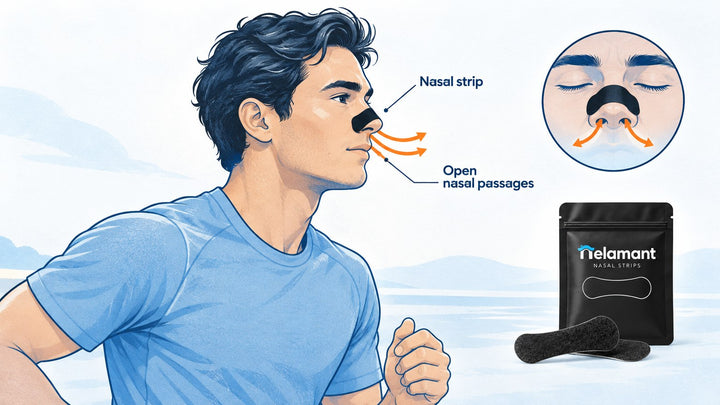
If your nostrils pull inward when you breathe in, making each breath feel pinched or restricted, nasal valve collapse is a likely culprit. The best nasal strips for nasal valve collapse work by gently pulling the alar wall outward, widening the nasal valve and reducing that inward collapse with every inhale. They cannot correct underlying cartilage or structural problems, but for many people they make a real difference to airflow during sleep, exercise, or congestion flare-ups. Our top pick is Nelamant Air, which uses a wider, balanced lift designed to spread support evenly across the bridge rather than applying tension at one narrow point.
- Nasal strips for nasal valve collapse work mechanically - they pull the alar wall outward to widen the nasal passage; they do not fix cartilage or structural anatomy.
- Lift width matters: a wider strip distributes tension across more of the nose, which suits a valve that collapses over a broader area.
- Extra-hold adhesive is important - a strip that lifts for two hours but peels off by midnight doesn't help with sleep.
- Hypoallergenic materials reduce the risk of skin irritation for people using strips nightly.
- If nasal obstruction is severe or getting worse, strips are a comfort aid, not a substitute for evaluation by a clinician.
For a broader comparison of every style, strength, and audience, see the complete guide to the best nasal strips. To understand exactly what nasal valve collapse is and why it narrows your airway, the detailed explainer on nasal valve collapse is a good starting point before choosing a strip.
The 5 Best Nasal Strips for Nasal Valve Collapse
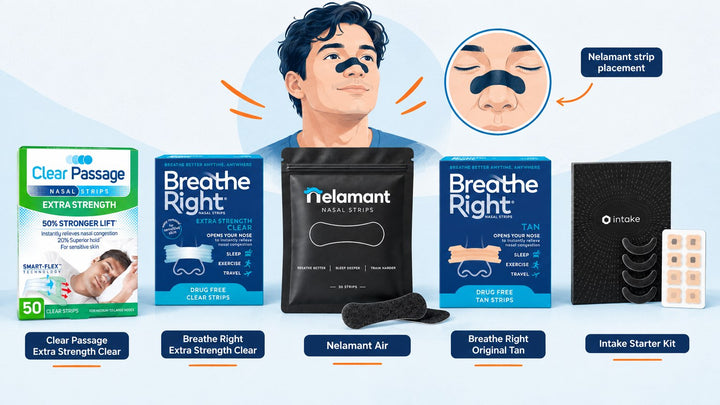
This comparison covers external adhesive strips and Intake's magnetic band-and-tab system. Internal dilators and mouthguards work differently and are not reviewed in this guide. Each product below is assessed on design and specification as a manufacturer-authored comparison, not on independent lab testing or user ratings.
#1 Nelamant Air - Top Pick
⭐ Top Pick: Nelamant Air Nasal Strips
Wider balanced lift across the nasal bridge · Extra-hold adhesive · Hypoallergenic · 30 strips per pack
$14.99 for 30 strips · 30-day returns
Shop Nelamant AirNelamant Air earns the top spot specifically for nasal valve collapse because of how its lift is engineered. Where a narrow strip concentrates tension at a single point - which can feel uncomfortable and still leave parts of the alar wall unsupported - Nelamant Air spreads its lift across a wider surface area of the bridge. For a nose whose valve tends to collapse inward on inhale, that even outward pull keeps more of the nasal passage open throughout the breath cycle.
The extra-hold adhesive is formulated to resist sweat, skin oil, and overnight movement, which matters because nasal valve collapse is most disruptive during sleep, when you can't manually reopen a strip that has shifted. The hypoallergenic materials make nightly use more comfortable for people with reactive skin, and the strip peels off cleanly without leaving a sticky residue behind. Nelamant Air is drug-free and single-use - one strip per night, 30 per pack.
Pros for this audience: wider lift suits broader valve collapse; strong overnight adhesion; gentle on skin with regular use; available in bundles for consistent nightly use.
Cons: single-use only, so cost adds up; external strips support the nasal opening but cannot correct cartilage anatomy; not recommended for use over broken or irritated skin.
#2 Breathe Right Extra Strength
Breathe Right Extra Strength is the most widely recognised adhesive nasal strip on the market. Its band delivers a firm spring tension, which some people with valve collapse find effective at holding the alar wall open through the night. The adhesive is well established, though some users with oily or sensitive skin find it less forgiving to remove than softer-adhesive options. Available in most pharmacies, which makes it easy to trial before committing to a multi-pack.
Pros: strong lift tension; widely available; familiar, tested design.
Cons: narrower lift footprint than Nelamant Air; some users report skin redness on removal; may feel rigid on narrower nose bridges.
#3 Breathe Right Original / Clear
The lighter sibling to Extra Strength, Breathe Right Original uses a lower-tension band and a clear strip that is less visible on skin. For mild nasal valve collapse - where the nostril closes only partially under breathing effort - the Original may provide enough lift without the firmer pull of the Extra Strength version. Less suitable if your valve collapses significantly under exercise breathing or deep sleep-breathing.
Pros: clear strip is discreet; lighter adhesive is easier to remove; accessible price point.
Cons: lower spring tension may be insufficient for moderate-to-significant collapse; adhesive may loosen more readily through the night for oily skin types.
#4 Intake Starter Kit
Intake Breathing takes a different structural approach, with a wider tab design intended to attach further down the sides of the nose rather than solely across the bridge. This placement may suit people whose collapse is lower on the alar wall rather than at the top of the nasal valve. Because placement is less standard than a traditional across-the-bridge strip, there is more of a learning curve for getting it positioned correctly each time.
Pros: different lift geometry may suit specific collapse anatomy; reusable version available.
Cons: placement requires practice; pricing and availability; less familiar to first-time strip users.
Clear Passage Extra Strength Clear
The Clear Passage extra-strength range includes clear adhesive strips in several pack sizes. Compare the clear format if you want an external strip rather than a device inside your nostrils.
Pros: Several pack sizes to compare for regular use.
Cons: Still requires fresh adhesive strips for each use; try the fit before buying in bulk.
Comparison: Nasal Strips for Collapsed Nostrils at a Glance
| Strip | Lift Width | Adhesive Hold | Sensitive Skin | Single-Use | Price / 30 |
|---|---|---|---|---|---|
| Nelamant Air | Wide, balanced | Extra-hold | Hypoallergenic | Yes | $14.99 |
| Breathe Right Extra Strength | Check current product details | Firm | Check current product details | Yes | Check current product details |
| Breathe Right Original / Clear | Check current product details | Moderate | Check current product details | Yes | Check current product details |
| Intake Breathing | Check current product details | Check current product details | Check current product details | Check current product details | Check current product details |
| Clear Passage Extra Strength Clear | Check current product details | Check current product details | Check current product details | Check current product details | Check current product details |
How We Chose These Nasal Strips
This guide is a manufacturer-authored design and specification comparison, not an independent consumer test or a user-rating ranking. Products were selected based on whether they are real, available adhesive external nasal strips - not internal dilators, mouthguards, or magnetic devices, which work through different mechanisms.
For this specific audience, selection focused on three design factors: lift geometry (wider strips distribute outward tension more evenly, which suits a nasal valve that collapses over a broad area), adhesive durability (a strip that won't survive a full night's sleep is not useful for the primary complaint), and skin compatibility (nightly users need materials that won't cause cumulative irritation).

Buyer's Guide: What to Look for in Nasal Strips for Collapsed Nostrils
Choosing a nasal strip when your specific problem is nasal valve collapse calls for a slightly more targeted assessment than picking a general-purpose strip.
Lift Width and Geometry
The nasal valve - the narrowest part of the nasal airway - can collapse along a narrow point or across a wider section of the alar wall depending on your anatomy. A strip with a wider lift footprint supports more of that wall at once. If you've tried a standard narrow strip and found it helpful but not quite enough, a wider design is a logical next step.
Adhesive Strength
Nasal valve collapse tends to be most disruptive during sleep, and deep breathing during sleep creates continuous outward force on the adhesive. A strip that holds firmly through sweating, movement, and pillow contact is essential. "Extra hold" formulations are generally preferable here over standard-strength options.
Skin Compatibility
Nightly use means your skin is being bonded and unpeeled every day. Hypoallergenic materials reduce - though do not eliminate - the risk of reactions. People with known adhesive sensitivities should trial a single strip on a small area first, regardless of which product they choose. Hypoallergenic does not mean nobody can react.

Strip Length and Bridge Fit
A strip that extends beyond the bridge onto areas of the nose that flex more actively during breathing may peel at the edges overnight. Look for a strip length that sits stably on the flatter part of the bridge while still reaching far enough down to support the valve area.
How Nasal Strips Differ from Deviated Septum Support
Nasal valve collapse and a deviated septum both narrow the airway, but in different locations and through different mechanisms. A strip addresses alar wall collapse - the outer wall pulling inward. A deviated septum is an internal midline structural issue that strips sit above and outside. If your obstruction is primarily septal, the advice for nasal strips is somewhat different:
- Strips can still reduce overall nasal resistance even with a deviated septum, but they won't straighten the septum.
- Some people have both conditions simultaneously.
- Placement matters more with septal deviation - centering the strip on the bridge rather than angling it helps.
For a full breakdown of strip use with a deviated septum, see the guide to best nasal strips for deviated septum.
When to See a Doctor
Nasal strips support the nasal opening from the outside. They do not repair cartilage, reposition the lateral wall structurally, or treat the underlying anatomy that causes the valve to collapse. If nasal valve collapse is significantly affecting your breathing, sleep quality, or ability to exercise, a clinician - typically an ENT specialist - can assess whether you are a candidate for a structural intervention such as functional rhinoplasty, alar batten grafting, or another procedure designed to address the valve directly.
Specific signs to prompt an appointment:
- Nostril collapse visible when you inhale moderately, not just under heavy breathing effort.
- Persistent significant airway obstruction that strips reduce only partially.
- Symptoms worsening over time rather than staying stable.
- Snoring or disrupted sleep that hasn't responded to nasal support measures - snoring has many causes, and nasal restriction is only one of them.
- Any nasal obstruction that developed suddenly or is accompanied by pain, bleeding, or facial pressure.
For guidance on when nasal breathing symptoms warrant professional evaluation, see when to see a doctor for nasal congestion.
Frequently Asked Questions
Can nasal strips actually help nasal valve collapse?
Yes, within limits. An adhesive nasal strip bonds to the skin over the alar cartilage and uses a spring-action band to pull the nostril wall gently outward. This mechanically widens the nasal valve and reduces the inward collapse that happens under breathing effort. Strips do not repair or reposition the cartilage itself - the effect lasts only while the strip is worn. Many people with mild to moderate nasal valve collapse find meaningful airflow improvement from strips, particularly during sleep or exercise, even though the underlying anatomy remains unchanged.
What's the difference between a nasal strip for nasal valve collapse and a regular nasal strip?
All adhesive external nasal strips work by the same basic mechanism: bonding to the nose bridge and lifting the alar wall. The difference is in design detail. For nasal valve collapse specifically, a wider strip that distributes lift across more of the alar wall tends to be more effective than a narrow strip that applies tension at a single narrow point. A stronger adhesive also matters more for this use case, since most nasal valve obstruction is worst during sleep, when you cannot manually reapply a strip that shifts.
Do nasal strips work on both sides of a collapsed nostril?
A single strip placed across the bridge applies outward force to both sides of the nose simultaneously, since the band anchors at both alar walls. This can benefit bilateral collapse (both nostrils). For unilateral collapse (one nostril only), the same strip still helps because both sides are lifted - but the strip's placement may need to be slightly adjusted toward the collapsing side to maximise lift where it's needed. Some people with asymmetric anatomy find that strip positioning requires some trial and adjustment to find the most effective site.
How do nasal strips for nasal valve collapse compare to internal dilators?
Internal nasal dilators (small inserts worn inside the nostrils) work from inside the nasal passage, pushing the walls outward from within. External adhesive strips work from outside, pulling the alar wall outward. Both approaches can open the nasal valve, but through opposite directions of force. Internal dilators can be repositioned precisely inside the nostril but require comfort with having a device inside the nose during sleep. External strips are generally easier to apply and better tolerated for skin contact, but depend on adhesive bond strength. Neither approach corrects underlying anatomy.
Should I use nasal strips instead of nasal valve surgery?
Nasal strips are a non-invasive, temporary support option - they are not a surgical alternative and do not produce the structural correction that procedures like alar batten grafts or functional rhinoplasty can achieve. For people with mild nasal valve narrowing or collapse that responds well to external lifting, strips may be a fully adequate long-term management tool. For people whose collapse is structural and significant enough to warrant repair, strips can be useful in the interim or as a complement, but the decision about surgery is one to discuss with an ENT specialist who can evaluate your anatomy directly. Strips do not eliminate the need for that conversation if your symptoms are severe.
Nelamant Air is designed for adult use.
The Right Strip Makes a Measurable Difference
For nasal valve collapse, the best nasal strips for nasal valve collapse are the ones wide enough to support the alar wall evenly, adhesive enough to hold through the night, and gentle enough to use consistently. Nelamant Air meets those criteria in a single strip at a straightforward price. If adhesive external strips alone aren't providing sufficient relief, or if symptoms are progressing, professional evaluation is the appropriate next step - strips are a support tool, not a ceiling on what's possible.