Thomas Tiemann

Disclosure: Nelamant makes Nelamant Air, our top pick. Other products are included for honest comparison. This page contains links to purchase.
The best nasal strips for sensitive skin should fit your nose, support easier nose breathing, and release cleanly on removal. Check the listed materials and adhesive; no strip guarantees irritation-free wear. If ordinary strips have pulled at your skin, left sticky patches, or triggered a reaction at the adhesive line, the formulation - not the strip itself - is usually the problem. Switching to a strip built specifically for sensitive skin typically solves it.
For a broader look at how all the top options compare across every use case, see the best nasal strips overall guide.
- Check the listed materials and adhesive, and confirm any latex-free claim if you have a latex allergy.
- Adhesive formulation and removal method cause most skin complaints, not the strip band itself.
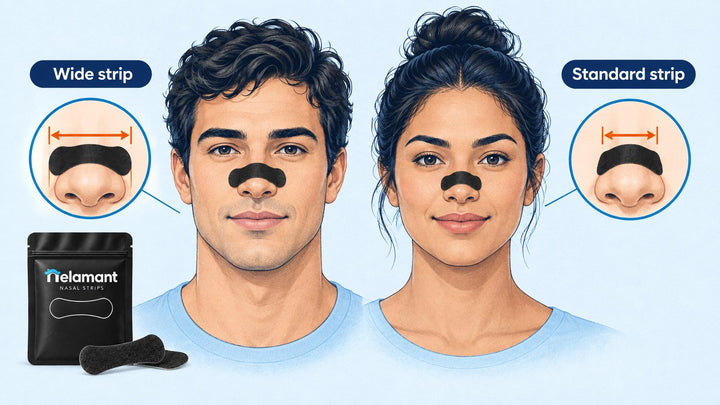
- A wider lift band distributes tension across the nose bridge, reducing edge-peel irritation.
- Nelamant Air is our top pick: materials, extra-hold adhesive that resists overnight movement, and a clean peel-off removal.
- If you also deal with oily skin, see our guide to the best nasal strips for oily skin - adhesive grip becomes an additional variable there.
Our Top Pick: Nelamant Air Nasal Strips
⭐ #1 Top Pick - Nelamant Air Nasal Strips
Nelamant Air is designed with materials and an extra-hold adhesive that stays put overnight without harsh chemistry. The wider band delivers a broader, more balanced lift across the nose bridge rather than a single sharp pull point, which means less concentrated stress on one patch of skin. It peels off cleanly with no sticky residue - a meaningful advantage if your skin reacts to the removal process as much as the adhesive itself. Drug-free, single-use, suitable for sleep, workouts, and congestion relief day or night.
For general safety considerations with any nasal strip, see are nasal strips safe.
Four Other Options Worth Considering
These products appear regularly in searches for latex-free nasal strips. Where exact specifications were unavailable at time of writing, a
Breathe Right Original Clear
Breathe Right's sensitive-skin variant is one of the most widely available options at drugstores. The strip uses the brand's standard spring-band mechanism, and the adhesive is. Strip width is narrower than Nelamant Air's, which can concentrate lift force at a smaller contact area - something to factor in if your skin reacts to tension at the adhesive edges. Price per strip tends to be slightly higher than value-tier options. A useful fallback if you want shelf availability over optimization.
Pros: Widely available; long track record; recognizable brand.
Cons: Narrower lift band; pack sizes vary by retailer.
CVS Health Extra Strength Clear Nasal Strips
CVS sells a named extra-strength clear strip in a 50-count pack. Its listing describes a drug-free external strip and sensitive-skin testing; compare the current label and local price before buying.
Pros: A pharmacy-label alternative with a clearly identified pack size.
Cons: Retail availability and prices vary; extra strength does not establish better fit for your nose.
Related reading: Nelamant Air design comparison.

Intake Starter Kit
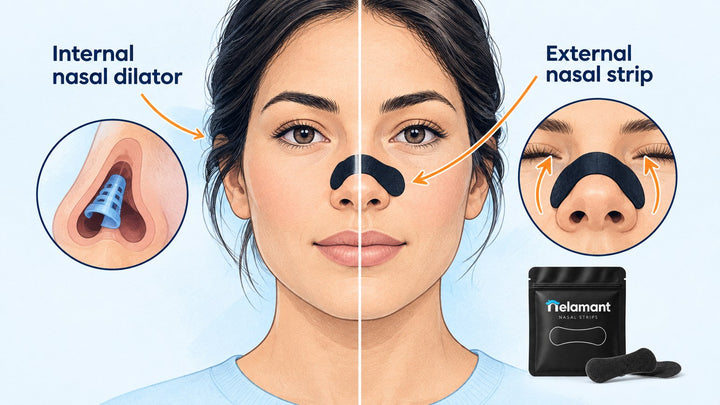
Intake combines adhesive tabs on the sides of your nose with a reusable magnetic band. It is an external dilator, not a conventional one-piece nasal strip.
Pros: A reusable band offers a different external-support format.
Cons: The tabs are disposable, and the system involves more pieces than a single strip.
Related reading: nasal strip safety considerations.
Clear Passage Extra Strength Clear
The Clear Passage extra-strength range includes clear adhesive strips in several pack sizes. Compare the clear format if you want an external strip rather than a device inside your nostrils.
Pros: Several pack sizes to compare for regular use.
Cons: Still requires fresh adhesive strips for each use; try the fit before buying in bulk.
Five-Product Comparison
| Product | Latex-Free | Lift Style | Residue Risk | Price / Strip |
|---|---|---|---|---|
| Nelamant Air | Not specified | Wide, balanced | Low (clean peel) | ~$0.50 |
| Breathe Right Original Clear | Check current product details | Narrower, single pull | Check current product details | Check current product details |
| CVS Health Extra Strength Clear Nasal Strips | Check current product details | Varies by brand | Check current product details | Lower |
| Intake Starter Kit | Check current product details | Check current product details | Check current product details | Check current product details |
| Clear Passage Extra Strength Clear | Check current product details | Check current product details | Check current product details | Check current product details |
Price per strip calculated from standard pack sizes at time of writing.
How We Chose These Strips
This list is a manufacturer-authored design and specification comparison, not an independent test or consumer-rating ranking. Selection criteria:
- Any adhesive can cause skin irritation. Is it confirmed or claimed latex-free? Does the brand disclose adhesive components?
- Lift mechanism: Does the strip distribute force broadly across the nose bridge or concentrate it at a narrow contact point?
- Removal behavior: Does the adhesive release cleanly at body temperature, or does it grip the skin aggressively enough to cause micro-trauma on peel-off?
- Known use-case fit: Does the product have a documented sensitive-skin variant rather than just a general-purpose strip sold to all audiences?
- Real products only: Every entry is a confirmed commercial product with an identifiable manufacturer or retailer. No invented options.
Buyer's Guide: Materials and Skin Sensitivity
Adhesive Chemistry and Skin Sensitivity
The adhesive is almost always the source of a skin reaction to a nasal strip - not the plastic or foam spring band above it. Two separate issues can occur: an allergic contact reaction to a chemical in the adhesive (more common with latex-containing or acrylate-based formulations) and mechanical irritation from an adhesive that grips too aggressively and resists clean removal.
Check the manufacturer's listed materials rather than relying on a skin-comfort claim. When it is labeled latex-free, it means the adhesive contains no natural rubber latex. Any adhesive can cause skin irritation.
Lift Design and Strip Width
A wider strip that spans more of the nose bridge spreads mechanical lift force across a larger skin surface. That means no single small zone of skin bears the full adhesive tension overnight - which matters when you're wearing a strip for six to eight hours. A narrower strip with a single central pull point concentrates stress at the adhesive perimeter, which is where edge-lifting and the micro-abrasion that causes redness tends to originate.
This is one reason lift geometry shows up in a sensitive-skin comparison at all: it is not purely about adhesive chemistry. Strip shape and contact area are part of the picture.
Residue-Free Removal
How a strip comes off is as important as how it goes on. An adhesive that is not designed to release cleanly can pull surface skin cells away, cause redness, or leave a sticky film that requires rubbing to remove - and rubbing is its own irritant. Strips designed for sensitive skin should peel away in one motion without requiring oil, solvent, or sustained pulling.
For detailed step-by-step guidance on minimizing skin irritation at removal, the guide to how to remove nasal strips covers the right technique regardless of which brand you use.
If oily skin is also a factor - either because sweat loosens the strip mid-sleep or because your skin type affects adhesion in general - see the best nasal strips for oily skin guide. The two concerns often overlap, and adhesive grip versus gentle release pulls in opposite directions.

Where Nelamant Air Fits in This Category
Nelamant Air is built around the combination that matters most for sensitive-skin users: materials and a wider adhesive footprint that distributes lift rather than concentrating it. The extra-hold adhesive is formulated to resist sweat and overnight movement without needing an aggressive chemical grip - a meaningful design distinction from strips that achieve hold by bonding more forcefully to the skin surface. The result is a strip that stays on through the night and still peels off cleanly in the morning.
It supports easier nose breathing mechanically, without drugs, and is suitable for sleep, congestion, or workout use.
Frequently Asked Questions
Does a skin-comfort claim mean latex-free?
Not automatically. A skin-comfort claim does not establish that a product is latex-free. Latex-free is a separate claim. If latex sensitivity is a concern, look for an explicit latex-free statement, or contact the manufacturer directly to confirm adhesive composition. When in doubt, check the ingredients list on the packaging rather than relying on front-of-pack marketing language alone.
Can nasal strips irritate or tear sensitive skin on removal?
They can, particularly if the strip is pulled away quickly, removed dry, or uses an adhesive designed for maximum grip rather than clean release. The risk is higher at the adhesive perimeter - the edges of the strip where adhesive is thinnest and the strip begins to lift. Strips built for sensitive skin use a gentler adhesive formula and often benefit from a slower, deliberate removal. The how to remove nasal strips guide has the full technique.
What makes a nasal strip adhesive gentle enough for sensitive skin?
Three factors: the absence of latex and high-reactivity acrylates in the formulation; an adhesive strength calibrated to hold overnight without gripping aggressively; and a release behavior that allows the strip to peel away cleanly at body temperature without requiring mechanical scrubbing. Wider strips also help by spreading adhesive contact over a larger area, which reduces per-unit-area stress on the skin.
Can I use nasal strips if I have eczema or rosacea on my nose?
This depends on the current state of your skin, not just the strip formulation. Applying an adhesive over broken, inflamed, or actively flaring skin is generally not recommended regardless of how gentle the adhesive is. Even a strip can worsen disrupted skin barrier. If your eczema or rosacea is well-controlled and the affected area does not extend to the nose bridge, a latex-free strip may be tolerable - but confirming with a dermatologist before ongoing daily use is reasonable if your skin condition is active. For general safe-use information, see are nasal strips safe.
How do I remove a nasal strip without redness or skin damage?
Wet the strip edges with warm water for 20–30 seconds before peeling to soften the adhesive bond. Then peel from one end slowly toward the other, pressing lightly on the skin ahead of the peel to support it rather than letting the strip pull the skin upward. Avoid ripping or pulling perpendicular to the skin surface. Full step-by-step guidance is in the how to remove nasal strips guide.
Choosing the Right Strip for Your Skin
The best nasal strips for sensitive skin are those that open your nasal passages effectively and come off in the morning without leaving a mark. Any adhesive can cause skin irritation.
For the full landscape of top-rated strips across all use cases, the best nasal strips roundup is the place to start.