Thomas Tiemann

If you sleep on your side, the best nasal strips for side sleepers are the ones that stay centered, keep their grip through overnight wear, and feel comfortable when your face presses into the pillow. Side sleeping changes facial pressure and can shift a strip out of alignment, so the right choice is less about marketing claims and more about fit, adhesive hold, and how the strip interacts with your skin and pillow contact.
Product comparison
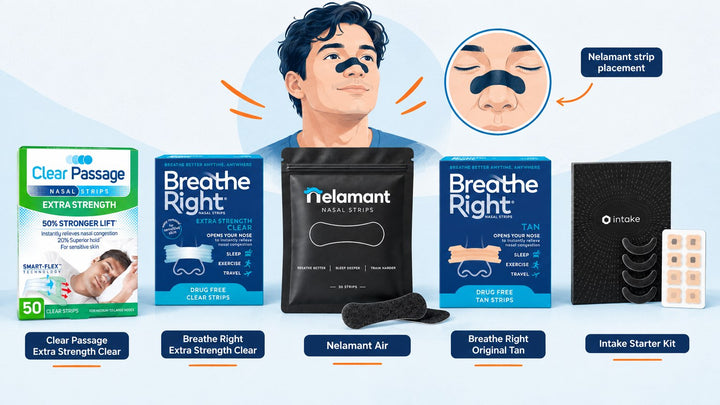
5 Products Compared for Side Sleepers
For side sleepers, compare fit, hold, material, device style, and the manufacturer's intended use. A stronger or more complex design is not automatically better; the useful choice is the one that fits comfortably and addresses resistance near the front of the nose.
How to read this table. Transparency: Nelamant is our product and is listed first. The other notes are editorial assessments based on current official manufacturer specifications, not paid placements, independent lab rankings, or claims that we personally tested every product.
| Rank | Product | Best for | Editorial assessment |
|---|---|---|---|
| 1 |

Nelamant Air Nasal Strips
External adhesive nasal strip
|
Simple external support through the night | Our adhesive strip is the simplest external option in this group: apply it to clean, dry skin and remove it gently in the morning. It supports nasal-valve opening but does not treat sleep apnea. |
| 2 |

Breathe Right Extra Strength Clear
Clear extra-strength external strip
|
A clear extra-strength bedtime option | A clear, extra-strength strip with manufacturer guidance emphasizing hypoallergenic material and easier removal. It is useful when visibility and a firmer pull both matter. |
| 3 |

Clear Passage Extra Strength
Extra-strength external strip
|
Extra-strength adhesive-strip shoppers | A conventional extra-strength strip range with multiple formats. It is a sensible alternative for people comparing adhesive-strip fit before trying an internal or magnetic device. |
| 4 |

Intake Breathing Starter Kit
Magnetic band with adhesive tabs
|
A magnetic external setup | The magnetic band can provide a different kind of external pull, while disposable tabs anchor it to the nose. Expect more setup than a one-piece strip. |
| 5 |

Rhinomed Mute
Adjustable reusable internal dilator
|
An adjustable internal sleep dilator | Mute is a reusable internal dilator designed specifically for sleep and offers adjustable sizing. It avoids bridge adhesive, but comfort with an internal device is highly personal. |
Product details were checked against the linked official manufacturer pages on September 22, 2026. Packaging, availability, directions, and formulations can change; verify the current label before use.

What side sleepers should prioritize first
For side sleeping, the main goal is stable placement. A strip works by mechanically lifting the skin over the external nasal valve, which may reduce the feeling of anterior nasal resistance for some people. That effect depends on where the strip lands and whether it stays attached through the night. If the strip slides upward, peels at one edge, or sits too close to the nostrils, it is less likely to feel comfortable or stay effective.
Side sleepers should focus on four things: strip placement, adhesive hold, skin comfort, and how the strip behaves under pillow contact. A strip that feels fine on your back may fail once your cheek presses into the pillow. The best option is usually the one that keeps the bridge area supported without creating pressure points or tugging when you turn.
How nasal strips work at the front of the nose
External nasal strips do not open the whole airway. Their main action is at the front of the nose, where they can support the lateral nasal wall and help the external nasal valve stay more open. That can change the sensation of nasal airflow for some users, especially if the front of the nose feels narrow or collapses inward during inhalation.
Research on external nasal dilator strips shows that response varies. People with higher baseline nasal resistance may notice more benefit than people whose nasal passages are already relatively open. In other words, the same strip can feel helpful for one person and barely noticeable for another. That is why fit and comfort matter so much: if the strip is not positioned well, you may not get the mechanical support it is designed to provide.
What the strip can and cannot do
- It can mechanically lift the skin over the external nasal valve.
- It may help stabilize the lateral vestibule wall at the front of the nose.
- It may improve the feeling of airflow for some users.
- It does not treat infection, allergic inflammation, a deviated septum, throat collapse, or sleep apnea.
Fit: the most important factor for side sleeping
Fit is the difference between a strip that stays aligned and one that peels after the first turn. Side sleepers should look for a size and shape that spans the bridge of the nose without extending too far onto the cheeks. If the strip is too wide, pillow contact can catch an edge. If it is too narrow, it may not support the external nasal valve evenly.
Good fit also means the strip sits on clean, dry skin and follows the natural contour of the nose. A strip that bridges over oily skin, lotion, or dampness is more likely to lift overnight. If you have a smaller nose bridge, a flexible strip may sit more naturally. If your nose is broader, a longer strip may distribute tension more evenly.
Strip placement tips for side sleepers
- Place the strip across the bridge so the center sits over the upper part of the nose, not down on the nostrils.
- Press from the center outward to reduce trapped air and improve contact.
- Check that both ends are equally secure before bed.
- After applying, turn your head to each side and notice whether the strip shifts or lifts.
- If the strip creases when you smile or talk, it may be too low or too wide.
Adhesion: why pillow contact changes the equation
Nighttime adhesion matters more for side sleepers because the pillow can create repeated friction on one side of the strip. Even a strong adhesive can fail if the edge is exposed to rubbing. The goal is not the strongest possible stick; it is the right balance of hold and skin comfort.
In short-term studies of nasal strips in healthy adults, users were evaluated for comfort, removal, and dermal tolerability. That matters because a strip that stays on but irritates the skin is not a good long-term choice. If your skin becomes red, itchy, or tender after removal, the adhesive may be too aggressive for nightly use.
How to improve nighttime adhesion
- Wash and fully dry the nose before application.
- Avoid moisturizers, oils, and heavy skincare on the bridge area before bed.
- Apply the strip at least a few minutes before lying down so the adhesive can settle.
- Choose a shape that does not extend too far onto the cheek, where pillow friction is higher.
- Replace a strip if the edges start lifting before sleep.
Skin comfort: what to look for if you wear strips often
Skin comfort is not just about whether the strip feels soft. It also includes how the adhesive behaves during removal and whether the skin tolerates repeated overnight wear. If you plan to use nasal strips regularly, pay attention to redness, itching, dryness, and any lingering marks after removal.
Some users do better with a gentler adhesive and a strip that spreads tension across a wider area. Others prefer a firmer hold because it reduces shifting during side sleeping. The best choice depends on your skin and how much movement you have at night. If you have sensitive skin, test the strip on a short evening wear before committing to a full night.
Signs the strip is not a good match
- Redness that lasts into the next day
- Burning, itching, or stinging during wear
- Skin lifting or flaking when you remove it
- Repeated peeling at the same edge
- Pressure marks that are painful rather than mild and temporary
Comparison table: what side sleepers should compare
| Feature | Why it matters for side sleeping | What to look for |
|---|---|---|
| Strip width | Too wide can catch on the pillow; too narrow may not support the valve well | Balanced coverage across the bridge without reaching too far onto the cheeks |
| Adhesive hold | Pillow contact can loosen one edge overnight | Secure but not harsh; stays in place through turning |
| Flexibility | Helps the strip follow facial contours | Enough bend to sit flat without wrinkling |
| Skin comfort | Nightly wear can irritate sensitive skin | Low irritation, easy removal, minimal residue |
| Placement guide | Correct alignment supports the external nasal valve | Clear center point and easy positioning |

How to test a strip before you commit
A simple trial can tell you more than product claims. Start with one night when you can pay attention to how the strip feels as you fall asleep and after you wake up. If possible, compare two options on separate nights under similar conditions.
- Apply the strip to clean, dry skin.
- Lie on your side and notice whether the edge lifts against the pillow.
- Check whether the strip stays centered after you change sides.
- Remove it slowly in the morning and note any skin reaction.
- Repeat only if the first wear feels comfortable and stable.
If a strip improves comfort but keeps peeling, the fit is probably wrong. If it stays on but irritates your skin, the adhesive may be too strong for your use case. The best nasal strips for side sleepers usually solve both problems at once.
When to be cautious or get medical guidance
Use brief safety guidance here: if you have persistent one-sided blockage, recurrent nosebleeds, chest symptoms, exercise dizziness, or suspected sleep apnea, get medical evaluation rather than trying to solve the problem with a strip. Children should not use nasal strips unsupervised. Pregnancy and severe snoring also deserve clinician guidance, especially if symptoms are new, worsening, or paired with daytime sleepiness.
Also seek care if nasal blockage is accompanied by fever, facial pain, or discharge that suggests illness, or if you notice swelling, rash, or worsening irritation from the adhesive. A strip is a comfort tool, not a diagnosis or treatment for underlying disease.
Where Nelamant Air fits
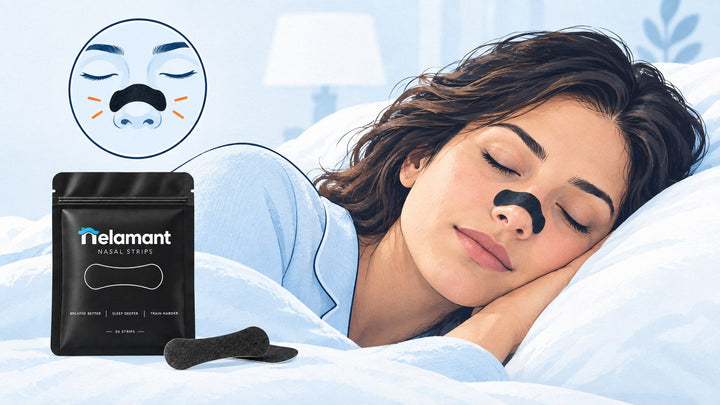
Nelamant Air fits this use case as a non-medicated, non-invasive external nasal-valve support option for people who want a simple strip-style approach for nighttime wear. It may be a good match if your main priorities are stable placement, comfortable adhesion, and a design that works with side sleeping. Its limits are important: it is not a treatment for sleep apnea, infection, allergic inflammation, a deviated septum, or throat collapse, and results can vary based on nasal anatomy and baseline nasal resistance.