Thomas Tiemann

You can cut a nasal strip, but it will almost certainly perform worse - and may not stick at all. Nasal strips work by springing outward across the bridge of your nose, and that force depends on the full width of the band. Trim it, and you reduce the spring tension, compromise the adhesive edge, and lose much of the lift the strip was designed to deliver. Before you reach for scissors, there's a better fix: check whether you're using the right size.
- Cutting a nasal strip shortens its spring arm and noticeably weakens the outward lift.
- A raw cut edge frays, peels, and loses adhesion faster than a factory-finished edge.
- If a strip feels too wide, sizing down is a more effective solution than trimming.
- Strips designed with a broader lift profile can feel better-fitted without any modification.
How Nasal Strips Generate Lift
A nasal strip is not just a sticky bandage. It contains a stiffened spring band - typically a plastic or composite splint - embedded between two adhesive layers. When you press the strip across your nose, that band resists being held flat. Its natural tendency is to spring back toward its original curved shape, and that outward force gently opens the nasal passages. The wider and more balanced the band, the more evenly that force is distributed across both sides of your nose.
For a full explanation of the mechanics behind this, read the complete guide to how nasal strips work and why the design matters.
What Happens When You Cut a Nasal Strip
Trimming nasal strips seems like a logical fix - the strip looks too wide, so you cut it down. In practice, you're working against the physics that make the strip useful.
The Lift Mechanism Relies on Full Width
The spring band's outward force is proportional to its length. Think of it like a flexible ruler held flat: the longer it is, the more force it exerts when it tries to spring back. Cut that ruler shorter and it becomes easier to keep flat - which is the opposite of what you want. A shortened spring arm generates less pull on each side of the nose, reducing how much the nostrils open. Cut unevenly, and one side pulls harder than the other, making the strip sit crooked and work asymmetrically.

The Adhesive Edge After Cutting
Nasal strips are manufactured with sealed, finished edges. Scissors create a raw cross-section that exposes the adhesive layer to air, fraying, and uneven contact with skin. That exposed edge is more likely to lift away from your nose within the first hour, especially overnight when your skin moves and oils build up. Removal can also become messier - adhesive that has partially detached mid-wear tends to grab skin in unpredictable ways rather than peeling cleanly from the edge the way an intact strip does.
When Fit Is the Real Problem - Try Sizing First
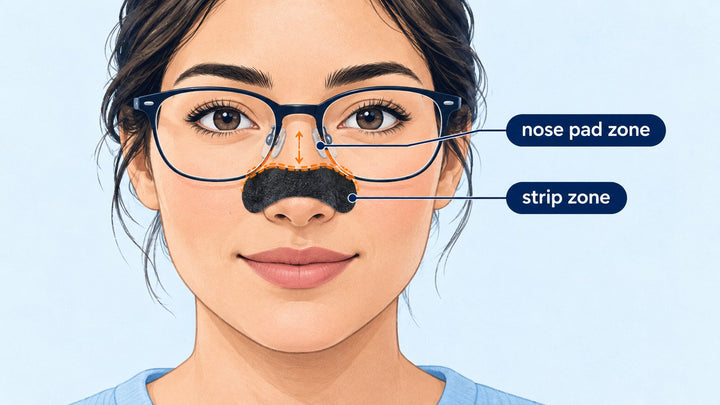
The most common reason people consider cutting a strip is that it seems to hang past the edges of their nose bridge. Before modifying anything, it's worth confirming you're using the correct size. Most brands offer at least two or three sizes - typically small/medium and large - and choosing the wrong one is a straightforward fix.
- Strips that extend past your nostrils aren't necessarily the wrong size; the ends are designed to anchor on the flatter skin beside the nostrils.
- If the strip genuinely overlaps cartilage or curves around your nose uncomfortably, you may be in a size up from what suits you.
- Width and length both vary by product line, so comparing dimensions rather than just label sizes helps.
For a detailed breakdown of dimensions and how to match them to your nose, see the full guide to nasal strip sizes.

A Wider Lift Profile Can Reduce the Urge to Trim
Some strips concentrate their pull at a single narrow point, which can feel tight or uneven - exactly the kind of sensation that makes someone want to modify the strip. A strip with a broader, more balanced lift spreads that force more evenly across the bridge, so it sits more naturally without feeling like it's pulling from one spot.
Nelamant Air nasal strips are designed with that wider, even lift in mind. The extra-hold adhesive is also built to stay through sweating and overnight movement, so the strip stays flush from edge to edge - which is part of why the adhesive line holds better than a scissored edge ever would. If fit discomfort has been your reason for reaching for scissors, a strip matched to your bridge width is a more effective solution.
Frequently Asked Questions
Can you cut nasal strips to make them shorter?
Technically yes, but shortening the strip reduces the length of the spring band, which directly weakens the outward lift it delivers. A shorter strip may open your nose noticeably less than the same strip left intact.
Will trimming nasal strips damage the adhesive?
Cutting through the strip creates a raw edge that is not sealed or reinforced the way the factory edges are. That cut edge is more prone to lifting away from skin, peeling mid-wear, and leaving uneven residue when you remove the strip.
Can you cut nasal strips lengthwise to make them narrower?
A lengthwise cut would compromise the spring band along its structural axis, effectively destroying its ability to generate consistent outward force. The result would be a floppy strip with poor adhesion on at least one side. Sizing down to a narrower product is a far better option.
What should I do if nasal strips feel too wide for my nose?
Check the size range available for your chosen product and try a smaller size. Also review whether the strip is positioned correctly - the center pad should sit over the bridge, with the ends anchoring on the flat skin beside your nostrils, not wrapping around curved cartilage. The guide to nasal strip sizes covers how to measure and match sizes accurately.
The Short Answer
Cutting nasal strips to fit undermines the two things they rely on: spring tension and a sealed adhesive edge. If a strip feels oversized, the right move is choosing the correct size, not trimming down. Understanding how nasal strips work makes it clear why the full band width isn't negotiable - it's what creates the lift in the first place.