Thomas Tiemann

Most adults wear a medium nasal strip and get a good fit - but if your strip keeps peeling at the edges, gaps in the middle, or feels like it's pulling unevenly, the size is probably wrong. Nasal strip sizes refer to the width and length of the rigid spring band inside the strip, which determines how much of your nose bridge it contacts and how evenly it lifts. Getting that match right is the single fastest fix for strips that don't seem to work.
Understanding how nasal strips work and why the design matters gives useful context here: the spring band only creates lift where it makes full contact with the skin. A strip that doesn't span your bridge properly can't do its job.
- Medium fits the majority of adult noses and is the safe starting point.
- Large or extra-large suits a wider or longer nose bridge; small suits narrower bridges.
- The strip should span your bridge fully - no edge gaps, no wrinkles or bunching.
- Wrong size is the most common reason strips peel early or feel weak.
- If your bridge width is borderline, size up rather than down.
Why Nasal Strip Size Matters for Fit and Lift
A nasal strip works by adhering to the skin on either side of the nose bridge and then springing outward, gently widening the nasal passages. That spring action depends entirely on the strip making full, flat contact across your bridge. If the strip is too short, the ends sit over the curved sides of your nose instead of the flatter bridge, the adhesive grips poorly, and the spring tension works against the skin angle rather than with it. If it's too wide, the strip bunches or folds, which kills even lift.
Size also affects how long the strip stays on. A strip that fits correctly distributes adhesive pressure evenly, so it is less likely to lift at one corner during the night - or mid-run.
Small, Medium vs Large Nasal Strips: What's Different
Brands differ slightly on exact dimensions, but the general tiers follow consistent logic. When you're deciding between options, the broader guide on how to choose nasal strips covers the full picture beyond sizing alone.
Small
Small strips are designed for a narrower or shorter nose bridge - common in smaller adult faces, some anatomical nose shapes, and occasionally recommended for teenagers. If a standard medium leaves visible overhang on both sides or bunches in the center when you press it flat, small is worth trying. Small strips are less common on pharmacy shelves but are available from most major brands.
Medium (Standard)
Medium is the default size and fits the widest range of adult noses. Most single-size products - including many store-brand strips - are cut to medium dimensions. If you've never sized a strip before and your nose bridge is average width, medium is the right starting point. It covers enough of the bridge to create meaningful lift without excess material on the sides.
Large / Extra-Large
Large strips are proportionally wider and sometimes longer, intended for a broader nose bridge. If medium strips consistently leave a gap between the strip ends and your skin on either side, or you feel the lift is concentrated in just the center, you likely need a large. People with a wider bridge often report that medium strips simply don't stay adhered at the edges through the night. For more on finding the best fit for a wider nose, see the guide on nasal strips for bigger noses.
How to Measure Your Nose for the Right Nasal Strip Size
You don't need a ruler for this - a simple finger-width check and a visual test with one strip will tell you what you need to know.
- Find your bridge width. Place your index finger horizontally across the flattest part of your nose bridge - the area between your eyes where a strip would sit. Note how much of your finger that zone covers. A narrow bridge covers roughly half your index finger; an average bridge covers most of it; a wide bridge reaches past it.
- Check brand size guides. Most brands publish a width range for each size in millimeters. Match your estimated bridge width to that range as a starting point.
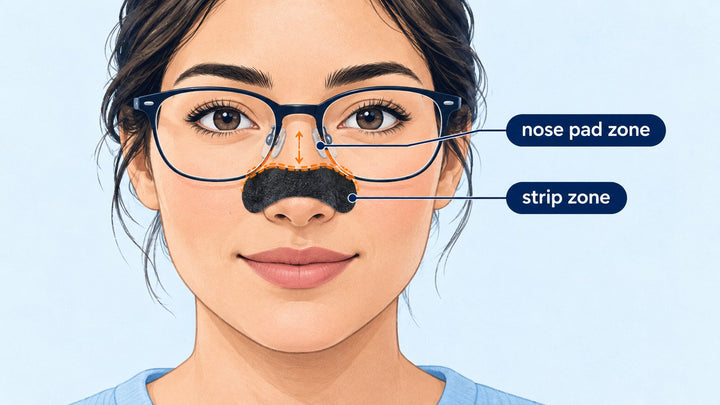
- Do a placement test. Press a strip flat onto your dry bridge without activating the adhesive fully - just lay it on and look in a mirror. The strip should reach the fleshy part of both nostrils on each side without curling over the curve. If it falls short of the flare on both sides, go larger. If it wraps around the side or bunches in the middle, go smaller.
- Check after one night. A correctly sized strip leaves clean adhesive contact across its full length and peels off in one piece without major edge lifting. If one or both ends have pulled away from the skin overnight, the size is wrong - usually too small.
Quick-Reference Size Comparison
| Size | Typical bridge width | Best fit for | Common issue if wrong size |
|---|---|---|---|
| Small | Narrower than ~25 mm | Narrower or shorter bridges, smaller adult faces | Bunching or wrinkles in the center |
| Medium | ~25–32 mm | Most adult noses; safe default | Edge gaps if bridge is too wide |
| Large / XL | ~32 mm and above | Wider or flatter nose bridges | Overhang or curling if bridge is too narrow |
All width figures are approximate and vary by brand. Check the packaging or brand size guide for exact ranges.
What Happens When You Wear the Wrong Size
A strip that's too small for your bridge will peel at the edges first - usually within a few hours of application or after you start sweating. The ends have nowhere to grip because they're sitting on the curved side of the nose rather than the flatter bridge surface. The lift feels uneven because the spring tension concentrates in the center. This is also one of the most common reasons people assume nasal strips don't work, when the real problem is fit. If your strips keep losing adhesion, the guide on nasal strips not sticking walks through the full set of reasons - size is one, but skin prep matters too.
A strip that's too large has the opposite problem: the excess material folds or wrinkles at the sides, which means part of the spring band can't exert tension in the right direction. The lift becomes uneven and the adhesive makes inconsistent contact, so one corner tends to lift overnight. You also get that uncomfortable feeling of material pressing across your cheekbones rather than sitting cleanly on the bridge.

When a Different Size Isn't the Answer
Size solves most fit problems, but not all of them. A few situations call for a different approach:
- Your bridge is between sizes. When you're on the boundary, size up. A slightly larger strip that still reaches both sides of the bridge will perform better than a smaller one that leaves gaps.
- The strip works but doesn't quite reach the flare of one nostril. Repositioning the strip slightly lower on the bridge - closer to the nostrils - often fixes this without changing size. Placement technique is covered in the full guide on how to choose nasal strips.
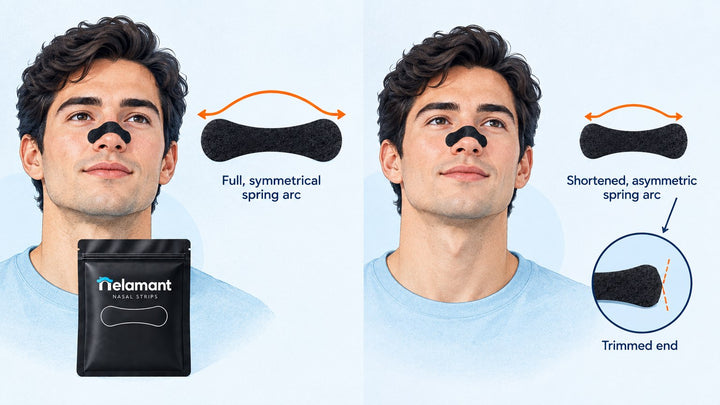
- You want to trim a strip to a custom fit. Some people do cut strips lengthwise or at the ends. Before you try it, read the dedicated article on whether you can cut nasal strips - trimming can affect how the spring band functions.
- Your nose bridge is consistently wider than large strips cover. See the specific roundup on nasal strips for bigger noses, which addresses fit strategies for wider nose anatomy beyond just sizing up.

Nelamant Air Nasal Strips and Sizing
Nelamant Air is designed with a wider spring band that creates a broader, more balanced lift across the nose bridge rather than a single sharp pull point at the center. That design means the strip needs to make full contact across a reasonable width to work as intended - which makes getting the right size even more relevant. The extra-hold adhesive resists sweat and overnight movement, but that adhesive works best when the strip is sized correctly in the first place. If you're unsure which size suits your bridge, the placement test described above is a reliable way to check before committing to a pack.
Frequently Asked Questions
What size nasal strip do most adults need?
Medium fits the majority of adults and is the standard size stocked by most brands. If you have no reason to think your nose bridge is unusually narrow or wide, start with medium. You can refine from there after one or two nights based on how the edges hold.
How do I know if my nasal strip is too small or too large?
Too small: the strip ends don't reach the flare of your nostrils, edges peel away from the skin overnight, or lift feels concentrated in one spot. Too large: the strip wrinkles or folds at the sides, or the material extends onto your cheeks rather than staying on the bridge. A correctly sized strip sits flat, spans the full bridge, and peels off in one clean piece.
Do all brands use the same small, medium, and large dimensions?
No. Size names are consistent in concept but the actual millimeter dimensions vary between brands. Always check the specific brand's size guide or packaging rather than assuming your medium in one brand equals medium in another.
Which nasal strip size should I use for a wide nose bridge?
Start with large. If large still leaves gaps at the edges or doesn't span your bridge fully, see the guide on nasal strips for bigger noses for fit strategies specific to wider nose anatomy, including strip positioning and alternative lift approaches.
Can I cut a nasal strip to make it fit better?
It's possible but not straightforward - cutting the strip can change how the internal spring band distributes tension. The full breakdown of what works and what doesn't is in the article on cutting nasal strips to size.
Getting Nasal Strip Sizes Right
Nasal strip sizes aren't complicated once you know what to look for. The right size spans your full bridge, contacts the skin evenly on both sides, and gives the spring band the surface it needs to create a balanced lift. Most adults do well with medium, but if your strips keep peeling at the edges or feel uneven, trying a different nasal strip size - usually larger - is the simplest fix before changing anything else.