Thomas Tiemann

Both nasal strips and nasal dilators open your nasal passages mechanically - no drugs, no sprays. The core difference is where the force comes from: strips apply an outward spring lift from outside the nose, while dilators expand the nostrils from the inside. For most people who want a dead-simple, disposable option that works through the night or during a workout, a nasal strip is the easier starting point. If you prefer a reusable device and don't mind something sitting inside your nostril, a dilator is worth a look.
- Nasal strips are external, adhesive, single-use, and require no insertion.
- Nasal dilators are either internal (inserted into nostrils) or external non-adhesive frames - most are reusable.
- Strips tend to suit sleep, sweaty workouts, and sensitive-skin users better; dilators appeal to people who want a reusable option and are comfortable with something inside the nose.
- Neither type treats the underlying cause of congestion or snoring - they support easier nose breathing mechanically.
- The right choice depends on your use case, skin sensitivity, and whether you want disposable or reusable.
What Are Nasal Strips?
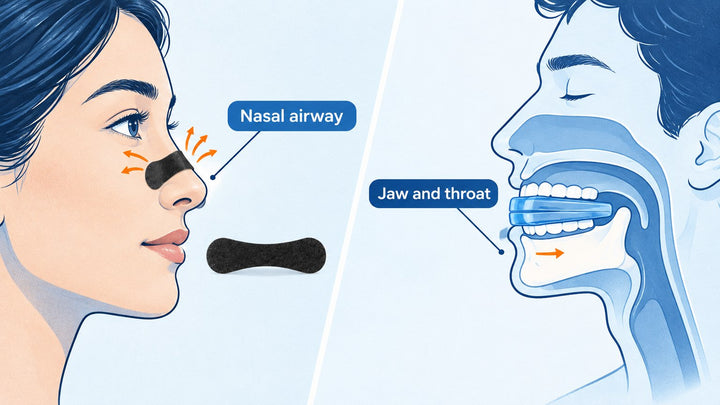
A nasal strip is a flexible, adhesive band you press across the bridge of your nose. Embedded spring tabs inside the strip want to straighten back out, and because they're stuck to your skin, that force gently lifts the sides of the nose outward - widening the nasal valve and reducing airflow resistance. Once the adhesive gives out (or you peel it off), the strip goes in the bin. There's nothing to rinse, store, or reinsert.
Strips come in a range of sizes, formulations, and lift strengths. Some are designed for sensitive or oily skin; others are made for higher-sweat situations like running. For a full breakdown of what's available, see the guide to types of nasal strips. For head-to-head takes on specific brands and formats, the nasal strip reviews hub covers the main options in one place.
What Are Nasal Dilators? Internal vs External Types
The word "dilator" gets used loosely, so it helps to separate the two main categories before comparing them to strips.
Internal Nasal Dilators (Nose Vents)
Internal dilators - often called nose vents, nasal cones, or nasal inserts - are small soft or semi-rigid devices you place inside the nostrils. They work by bracing against the nasal wall and holding the airway open from within. Most are made from medical-grade silicone and come in a few sizes to match different nostril widths. They are typically reusable: you rinse them, let them dry, and use them again. Because there's no adhesive, they leave zero residue on your skin. The trade-off is that some users find insertion uncomfortable at first, and fit varies significantly between individuals and brands.
External Frame Dilators (Non-Adhesive)
A smaller category sits between strips and internal vents: external frame dilators that clip onto or around the nostrils without adhesive. These use a rigid or semi-rigid arch to press lightly on the outside of the nostrils and hold them open. They're less common than either adhesive strips or internal vents, and sizing tends to be more critical for them to stay in place. For a curated look at the leading nasal dilator products - including how internal and external dilator designs compare - the best nasal dilators guide is the dedicated reference.
How They Compare: A Side-by-Side Look
The table below maps the practical differences across the situations most readers care about.
| Factor | Nasal Strips | Nasal Dilators |
|---|---|---|
| How it works | Spring-tab adhesive lifts nose bridge outward | Internal brace or external clip holds nostrils open |
| Application | Peel and press onto dry skin | Insert into nostrils or clip on externally |
| Reusability | Single-use | Reusable (rinse and dry) |
| Skin contact / residue | Adhesive on nose bridge; good strips peel cleanly | No adhesive; internal contact with nostril walls |
| Cost per use | Ongoing (per strip); lower per-unit at volume | Higher upfront; lower per-use over time |
| Portability | Flat pack, easy to carry | Small case needed; must be kept clean |
| Sleep use | Stays on if adhesive is strong; no awareness while wearing | Can shift or feel noticeable; fit is critical |
| Exercise / sweat | Extra-hold versions made for sweat; standard may slip | No adhesive to fail; internal fit unaffected by sweat |
| Congestion | Opens the valve; does not clear mucus | Opens the valve; does not clear mucus |
| Hygiene | Disposed after each use; no cleaning | Requires regular rinsing and drying |
Choose Nasal Strips If…
Strips are the more straightforward option for most situations. Consider them first when:
- You want zero maintenance. Peel, apply, sleep, peel off in the morning. Nothing to rinse, dry, or store in a case.
- You have sensitive skin. a strip with a gentle adhesive causes less irritation than a device pressing against nostril walls all night. Any adhesive can cause skin irritation.
- You sweat during exercise. An extra-hold strip designed for sweat and oil resists movement through a full workout in a way that a press-on external dilator frame may not.
- You travel and want minimal kit. A flat strip pack takes up almost no space and needs no cleaning accessories.
- You want to try nasal breathing support without inserting anything. There's no insertion learning curve with a strip.
- You need reliable overnight adhesion. A strong adhesive holds position through pillow movement in a way that internal vents, which can shift as you move, may not match for every user.
Nelamant Air Nasal Strips are a solid example of this format done well - extra-hold adhesive, materials, and a broader lift across the bridge rather than a single pull point. At $14.99 for 30 strips, that's a month of nightly use. See Nelamant Air on the product page if you want to start with the strip side of this comparison.
Choose a Nasal Dilator If…
Dilators have a genuine case for certain users. Consider them when:
- You want a reusable, lower-per-use cost option and are comfortable with a short adjustment period to find the right size and fit.
- Adhesive is a problem for you. If any adhesive irritates your skin - even formulations - an internal vent avoids that issue entirely, though it introduces a different one (nostril-wall contact pressure).
- You want to evaluate nasal breathing support before committing to a disposable routine. A single dilator purchase lets you gauge whether opening the nasal valve helps you before you subscribe to a monthly supply of strips.
- You exercise in very wet conditions (open-water swimming, heavy rain) where any adhesive will fail regardless of formulation.
The main dilator products on the market - including Mute, Turbine, and WoodyKnows - have their own design trade-offs. If you're comparing Nelamant Air specifically against a dilator you've been considering, the Nelamant vs Mute nasal dilator comparison covers that matchup directly. The best nasal dilators guide covers the category more broadly.
Where Nasal Strips Fit in the Bigger Picture
Nasal strips and dilators are both nose-specific, mechanical tools that address the nasal valve. They're one part of a wider range of breathing and snoring aids - none of which are interchangeable, because they target different parts of the problem:
- Mouthguards (mandibular advancement devices) move the lower jaw to keep the throat open - a different mechanism aimed at a different anatomy than nasal strips or dilators.
- Chin straps encourage mouth closure, not nasal opening.
- Nasal sprays reduce mucosal swelling chemically rather than mechanically.
- Mouth tape redirects breathing through the nose but does nothing to open the nasal passage itself.
For a full map of where nasal strips sit among all the anti-snoring options, the nasal strip reviews and comparisons hub is the best starting point. If you're weighing whether a mouthguard might be more appropriate for your situation, the separate guide on best nasal dilators and anti-snoring devices discusses how these categories divide up.

Nelamant Air: Our Top Pick Among Nasal Strips
If you've landed on nasal strips as the right format for you, Nelamant Air is designed to address the two most common strip complaints: adhesive that fails overnight and a single-point lift that feels uneven. Nelamant Air uses a wider, more balanced spring design to distribute the lift across the bridge rather than concentrating it at one point. The extra-hold adhesive is built to resist sweat, oil, and overnight movement, and the materials are formulated for gentle removal - no sticky residue pulled off with the strip.
Each pack contains 30 strips - a month of nightly use - and bundles are available if you want to stock up. Drug-free, mechanical action means nothing enters your system. It works for sleep, congestion, and exercise.

Frequently Asked Questions
Can I use a nasal dilator and nasal strips at the same time?
There's no known safety reason you couldn't, but there's also no practical benefit to layering both - each device is designed to open the same nasal valve, and one well-fitted option should do the job. If you find one type isn't giving you enough airflow improvement, that's more likely a fit or sizing issue than a signal to add a second device on top of it.
Are internal nasal dilators comfortable to sleep in?
Comfort varies significantly by person, nostril anatomy, and brand sizing. Some users adapt quickly; others find internal vents distracting or prone to shifting during sleep. Many dilator brands include multiple sizes precisely because fit drives comfort more than the material does. A nasal strip, by contrast, sits entirely outside the nostril and is generally less noticeable once in place - though the adhesive is its own variable.
Do nasal strips or dilators work better for snoring?
Both can help if the snoring is caused or worsened by restricted airflow at the nasal valve - narrowing at the nostrils or nasal bridge that forces turbulent or effortful breathing. Neither will have any effect on snoring that originates from throat vibration, tongue position, or soft palate movement unrelated to nasal obstruction. For a fuller picture of snoring causes and which tools address which, the guide on nasal strip reviews and snoring comparisons covers the main distinctions.
Which is more cost-effective - nasal strips or reusable dilators?
Reusable dilators have a lower per-use cost over time once the upfront cost is spread across enough uses - assuming the device stays clean, intact, and well-fitted. Nasal strips have a steady ongoing cost per strip, but no upfront investment and no maintenance. At $14.99 for 30 strips, a month of nightly use with Nelamant Air comes in at around $0.50 per night. Whether a dilator beats that depends on how long it remains usable and how reliably it fits.
Are nasal dilators safe for nightly use?
Most reusable dilators are designed for regular use, but keeping them clean is essential - any device inserted into the nose needs to be rinsed and dried thoroughly between uses to avoid introducing bacteria or irritants. Follow the manufacturer's care instructions for your specific product. If you notice nostril-wall irritation, soreness, or any unusual symptoms, stop using and check the sizing or material fit.
The Bottom Line
The nasal strips vs nasal dilators question doesn't have one universal answer - it comes down to what you'll actually stick with. Strips win on simplicity, adhesion through sweat and sleep, and zero insertion learning curve. Dilators win on reusability and no-adhesive skin contact. Most people trying this category for the first time find a strip the lower-friction entry point. If you're ready to explore the strip side, the nasal strip reviews hub has the full comparison landscape, and Nelamant Air is available to try with 30-day returns.