Thomas Tiemann

This article is for general information, not medical advice.
Nasal strips and decongestant nasal sprays both help you breathe through your nose more easily, but they work in completely different ways and suit different situations. Nasal strips are a drug-free, mechanical option you can use every night; decongestant sprays are a short-term pharmaceutical tool. Knowing which fits your situation - or whether you need both - comes down to what is actually blocking your nose.
- Nasal strips lift the sides of your nasal passage open mechanically - no drug, no dose limit, no rebound risk.
- Decongestant sprays shrink swollen tissue chemically - they act fast but should not be used for more than three consecutive days.
- Strips suit congestion from narrow nasal anatomy, nighttime stuffiness, snoring, or ongoing use. Sprays suit short, acute congestion from a cold or allergy flare.
- Using a decongestant spray beyond the label limit can cause rebound congestion - a cycle that is harder to break than the original stuffiness.
- For a full comparison of how nasal strips perform across different needs, see nasal strip reviews and comparisons.
How Each One Works
How nasal strips open the airway
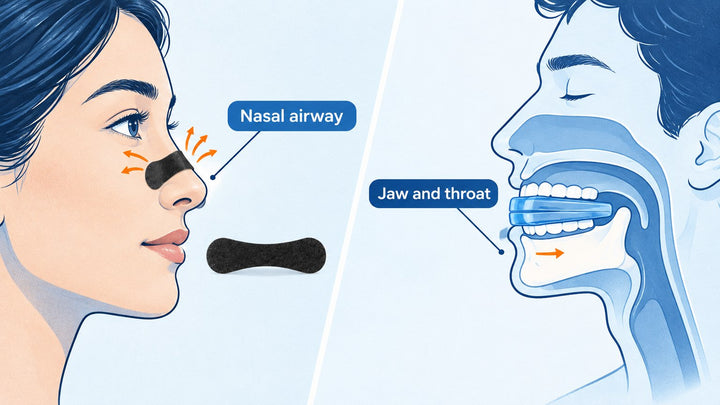
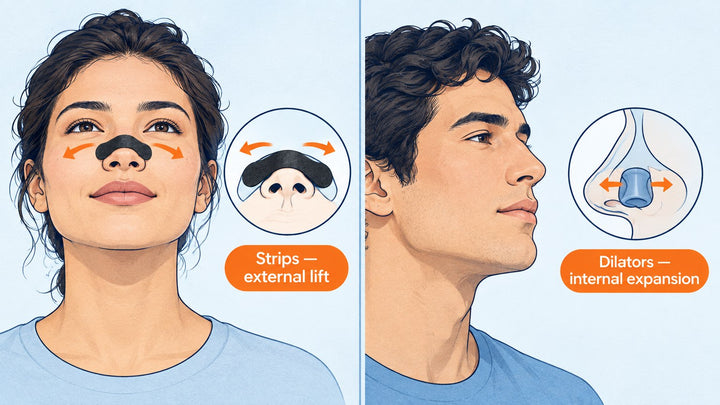
A nasal strip is a small, spring-loaded adhesive band placed across the bridge of your nose. The band's built-in tension pulls gently outward on the sides of your nose, widening the nasal valve - the narrowest point of the nasal passage just inside the nostrils. That wider opening reduces airflow resistance so you can draw air in more easily. Nothing enters your body; the entire effect is mechanical and stops when you remove the strip. Because there is no active drug, there is no ceiling on how many nights in a row you can use one.
How decongestant nasal sprays work
Most over-the-counter decongestant nasal sprays contain an active ingredient such as oxymetazoline or xylometazoline. These are vasoconstrictors - they narrow the blood vessels inside the nasal lining, reducing the swelling of the turbinates (the tissue shelves inside your nose that swell when you are congested). The effect is fast, often within minutes, and can last several hours. However, the medication label typically limits use to three days in a row. Exceeding that limit carries a real risk of rebound congestion, discussed in its own section below.
Key Differences at a Glance
| Feature | Nasal Strip | Decongestant Nasal Spray |
|---|---|---|
| Mechanism | Mechanical - lifts nasal wall outward | Chemical - shrinks swollen tissue |
| Onset | Immediate on application | Minutes after use |
| Duration | While the strip is worn | Several hours per dose |
| Drug-free | Yes | No |
| Rebound congestion risk | None | Yes, if used beyond label limit |
| Daily use limit | No stated limit for healthy adults | Typically 3 consecutive days maximum |
| Addresses swollen tissue | No - opens the valve, not the lining | Yes - directly reduces swelling |
| Best for | Snoring, ongoing stuffiness, narrow nasal valve, nightly use | Short-term acute congestion (cold, allergy flare) |
When Nasal Strips Are the Better Choice
A nasal strip is the stronger choice when the blockage comes from the structure of your nasal passage rather than swollen tissue - or when you need something you can use night after night without any limit.
Ongoing nightly stuffiness. If you wake up congested most mornings and the problem is not tied to a specific illness or allergy flare, a decongestant spray is the wrong long-term tool. A strip keeps your nasal valve propped open while you sleep without any pharmaceutical dependency risk.
Snoring linked to nasal obstruction. Snoring that originates from restricted nasal airflow - not throat or soft-palate vibration - can be reduced when the nasal passage is kept wider overnight. A strip supports that without any drug interaction concerns.
Narrow nasal valve anatomy. Some people have naturally narrow nasal valves that make breathing feel labored regardless of congestion. No spray can physically widen that opening; a strip can. For more on what nasal strips can and cannot do for congestion specifically, see whether nasal strips help with congestion.
Sensitive groups who want to avoid medication. Pregnant people, those on certain medications, or anyone who prefers to avoid active drugs have a clear reason to reach for a strip first. Always check with your doctor if you are pregnant or managing another condition before using any nasal product.
Workouts and daytime use. Strips stay on during exercise, require no dosing, and carry no systemic effects - making them practical for activity as well as sleep.
Nelamant Air nasal strips are designed with a wider, more balanced lift across the nasal bridge rather than a single sharp pull point, which can make them more comfortable to wear through the night. The extra-hold adhesive is formulated to resist sweat and oil. If you have sensitive skin, the materials peel off cleanly without leaving sticky residue.
When a Decongestant Spray Is the Better Choice
There are situations where a decongestant spray does something a nasal strip simply cannot: it addresses swollen nasal tissue directly.
Acute cold or viral congestion. When your nasal lining is actively inflamed and swollen from a virus, the nasal valve may be blocked not by structure but by tissue bulk. A spray shrinks that tissue. A strip can still help by widening the valve on top of whatever relief the spray provides, but if you can only pick one for a bad-cold night, a spray typically delivers faster relief.
Severe allergy flare. A significant allergic reaction can swell the nasal lining enough that a strip alone gives limited benefit. A short course of a decongestant spray - used within the label instructions - clears the acute phase while your allergy treatment takes hold.
Before a flight. Rapid pressure changes during takeoff and landing can be painful when the eustachian tubes are congested. A decongestant used according to its label shortly before boarding may ease that pressure. A strip is a useful addition but does not address the tube pressure directly.
The three-day rule and rebound congestion. This is the single most important fact about decongestant sprays: using them beyond three consecutive days can make your congestion significantly worse once you stop. The blood vessels in the nasal lining can lose their ability to constrict on their own, leaving you more blocked than before - a condition called rhinitis medicamentosa, more commonly known as rebound congestion. If you find yourself reaching for the spray every day to keep breathing, that is a sign to stop the spray and speak to a doctor.

Can You Use Both Together?
Yes, and for some situations it makes sense. During a bad cold, a short course of decongestant spray can reduce the tissue swelling enough to let a nasal strip do its structural job more effectively. The spray addresses the inflamed lining; the strip keeps the valve open. Once the acute illness passes, you can stop the spray and continue with strips alone for as many nights as you need.
The caution is the same as when using a spray alone: keep spray use within the label limit regardless of whether you are combining it with a strip. A strip does not cancel or reduce the rebound risk from overused spray.
If congestion persists well beyond a typical cold - two weeks or more - that is a reason to see a doctor rather than continue stacking remedies. For a broader look at other options alongside nasal strips, the nasal strip reviews and comparisons hub covers mechanical alternatives and how they compare.
Nelamant Air: A Drug-Free Option for Nightly Use
Try Nelamant Air Nasal Strips - Drug-Free, Night After Night
Nelamant Air uses a wider, balanced lift design, extra-hold adhesive that resists overnight movement, and materials gentle enough for sensitive skin. 30 strips per pack - a month of nightly use with no dose limits and no rebound risk.
$14.99 for 30 strips · 30-day returns
Shop Nelamant Air
When to See a Doctor
Nasal strips and decongestant sprays are both self-care tools, and neither is a substitute for medical evaluation when something more is going on.
See a doctor if:
- Congestion lasts more than ten to fourteen days without improvement, or is accompanied by facial pain and fever (possible sinusitis).
- You have been using a decongestant spray daily for more than three days and cannot stop without your congestion returning - this is likely rebound congestion and a doctor can help you break the cycle.
- Nasal blockage is one-sided and persistent, particularly without a recent cold or allergy history.
- You snore loudly, stop breathing during sleep, or wake repeatedly - these can be signs of sleep apnea, which nasal strips and sprays do not treat. For guidance on telling snoring from sleep apnea, see the article on snoring vs sleep apnea.
- You have any doubt about whether a decongestant is safe alongside your current medications or health conditions.
For a full guide on when nasal congestion warrants professional attention, see when to see a doctor for nasal congestion.
Frequently Asked Questions
Can I use a nasal strip instead of a decongestant spray every night?
Yes, for most healthy adults. Nasal strips have no dose limit and carry no rebound risk. If your nightly stuffiness is driven by narrow nasal anatomy, snoring, or mild chronic congestion rather than active tissue swelling, a strip is generally the more sustainable nightly option. If tissue inflammation is the core problem - for example, from untreated allergies - addressing the underlying cause with a doctor's guidance gives better long-term results than any nightly product.
Do nasal strips work as fast as a decongestant spray?
The onset is immediate for both in different ways. A nasal strip widens the valve the moment you apply it - you will feel the change straight away. A decongestant spray takes a few minutes to act as the tissue responds to the vasoconstrictor. The spray's effect on swollen tissue can feel more dramatic if inflammation is the main cause of blockage; a strip's effect feels more subtle but is also present the instant it goes on.
What is rebound congestion, and can nasal strips cause it?
Rebound congestion - medically called rhinitis medicamentosa - happens when the nasal lining becomes dependent on a vasoconstrictor spray and swells more than before once the spray wears off. It is caused by overuse of decongestant sprays, not by nasal strips. Because strips work mechanically with no drug, they carry no rebound risk and can be used to support breathing while you taper off an overused spray. The full explanation is in the guide to rebound congestion.
Is it safe to use a decongestant nasal spray while pregnant?
This is a question for your doctor or midwife, not a product label. Some decongestant ingredients are generally avoided during pregnancy, particularly in the first trimester. A nasal strip is drug-free and widely considered a lower-risk option for nasal stuffiness during pregnancy, but always confirm any product use with your healthcare provider when pregnant.
Which is better for snoring - a nasal strip or a decongestant spray?
If snoring is driven by restricted nasal airflow, a nasal strip is the more appropriate ongoing tool because it physically props the nasal valve open throughout the night without any daily-use limit. A decongestant spray may reduce snoring temporarily during a cold or allergy flare by clearing swollen tissue, but it is not suitable for regular nightly use for snoring. It is also worth noting that snoring has multiple causes - nasal, throat, and structural - and strips only address the nasal component. If snoring is persistent or severe, see a doctor to rule out sleep apnea.
Choosing Between Nasal Strips and Decongestant Spray
The core distinction is simple: a decongestant spray treats swollen tissue and belongs in your short-term toolkit for colds and acute flares; a nasal strip supports the physical opening of your nasal passage and belongs in your nightly routine. When tissue swelling and a narrow nasal valve are both present - which is common - using both within their respective limits makes sense. When the illness passes, the spray stops and the strip continues. Understanding that difference takes the guesswork out of nasal strips vs nasal spray.