Thomas Tiemann

You can absolutely learn to breathe through your nose while running - the catch is that you almost certainly need to slow down first. Nose breathing while running demands more from your respiratory system than mouth breathing does, and the most common reason people give up on it is that they try it at their current pace instead of dialing back their effort to match what their nose can handle.
- Nose breathing while running is a trainable skill, not a natural talent - most runners need 4–8 weeks of deliberate practice.
- Slowing to a conversational pace (zone 2) is the entry point; trying to nose breathe at race effort usually fails.
- Your nose filters, humidifies, and warms air in ways your mouth cannot, which has real benefits for airways and recovery.
- A runny nose mid-run is a separate issue from nasal breathing technique - the two problems have different fixes.
- Nasal strips can help when airflow resistance is the limiting factor, especially if your passages feel narrow during effort.
For a broader look at nasal breathing during all types of exercise, see nasal breathing during exercise and why athletes use nasal strips.
Why Nasal Breathing While Running Is Worth the Effort
Your nose is not just a passageway - it's an air-conditioning and filtration system built into your face. Breathing through it during a run means the air arriving at your lungs is warmer, more humid, and cleaner than the air that comes straight through your mouth. That matters when you're covering miles, especially in cold, dry, or polluted conditions.
The broader case for nasal breathing extends well beyond running. A few of the most relevant points:
- Filtration: Nasal hairs and mucous membranes trap particulates, allergens, and pathogens before they reach the lower airways.
- Humidification and warming: Air reaching the lungs through the nose is closer to body temperature and near 100% relative humidity, reducing airway irritation.
- Diaphragm engagement: A deliberately slower breathing pattern can help you notice diaphragm movement.
For a full explanation of what your body gains from breathing nasally day and night, read the complete guide to the benefits of nasal breathing.
What your nose does that your mouth can't
One often-cited reason runners experiment with nose breathing is nitric oxide. Your nasal passages and sinuses produce nitric oxide, a molecule that plays a role in dilating blood vessels and may support oxygen uptake in the lungs. When you breathe entirely through your mouth you bypass that source. The detail of how nitric oxide interacts with nasal breathing mechanics is covered in the dedicated article on nasal breathing and nitric oxide - worth reading if you want the full picture before committing to a training change.
The Main Obstacle - and How to Clear It
Most runners who try nose breathing give it about four minutes, decide it's impossible, and go back to mouth breathing. That's not a failure of willpower. It's a mismatch between pace and capacity.
Your nose has a smaller cross-sectional area than your open mouth, which means airflow resistance is higher. At easy effort, your body doesn't need massive air volumes and the nose can keep up. At threshold or race pace, your demand for oxygen spikes and the nose simply can't move enough air fast enough without training and adaptation. Trying to nose breathe at hard effort before you've built the habit is like learning to juggle and starting with five balls.
The fix is straightforward: drop the pace until nose breathing feels sustainable, then build back up gradually over weeks.
Pace is the problem, not your nose
Zone 2 training - low-intensity aerobic running where you could hold a conversation - is the natural home for nose breathing practice. At zone 2 effort, cardiac and respiratory demand is low enough that the nose can handle the load. Many runners find that nose breathing actually serves as a built-in ceiling for zone 2 effort: if you can't maintain it through your nose, you've gone too hard.
If you're new to zone 2 as a training concept and want to understand how nasal breathing maps onto it, the guide on zone 2 nasal breathing goes deeper into pacing strategy and how to use your breathing as a real-time intensity gauge.
Step-by-Step: How to Train Yourself to Nose Breathe While Running
Building nose-breathing capacity for running is a progressive process. Work through these steps in order rather than jumping ahead.
- Start with walking, not running. Spend one to two weeks breathing exclusively through your nose on every walk. This builds the habit and strengthens the sense of nasal airflow before you add the cardiovascular demand of running. If you struggle even at walking pace, your nasal passages may be congested - address that first.
- Run at a pace slower than feels necessary. On your first nose-breathing runs, drop to a pace where conversation is easy - slower than your normal easy run. Your ego will protest. Your respiratory system will thank you. Expect the first sessions to feel awkward and slightly effortful even at low speed.
- Use the talk test as your real-time guide. If you can say a full sentence out loud without gasping, your pace is right for nose-breathing practice. The moment you can't get a sentence out without catching a breath, slow down or shift to a walk-run pattern until your breathing settles.
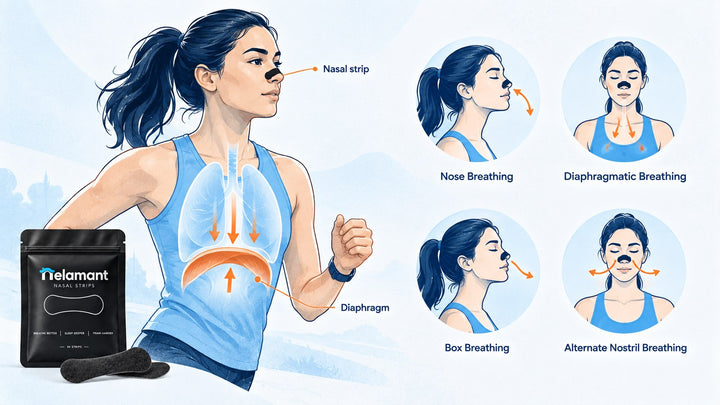
- Adopt a rhythmic breathing pattern. Many runners find a 3:2 or 4:3 inhale-to-exhale ratio (steps per breath cycle) helpful for rhythm. Experiment to find what feels natural. Even breathing, rather than irregular gasps, is the goal. Breathing out fully through the nose - not just in - is part of the technique many beginners miss.
- Run in shorter nose-breathing blocks. Rather than committing an entire run to nose breathing from day one, start with 5–10 minute blocks of nose-only breathing within a longer run. Switch to mouth breathing if you feel lightheaded, strained, or genuinely breathless, then return to nasal breathing once you've recovered.
- Add pace gradually as tolerated. Once 20–30 minutes of continuous easy-run nose breathing feels unremarkable, start experimenting with slightly faster paces. Most runners find progression is non-linear - some days feel harder than others based on temperature, fatigue, and nasal congestion. Build patience into the timeline.
The talk test as a simple readiness check
The talk test is the most practical real-time tool you have. If you can speak a full sentence comfortably - not in gasps - you're in the right zone for nose breathing practice. If you can't, slow down. This test costs nothing and works on any terrain, any day, with no wearable required.
Cadence and rhythm patterns that help
Some runners find that focusing on cadence - the number of foot strikes per minute - helps them find a breathing rhythm. A higher cadence at a slower speed naturally reduces vertical oscillation and can make nasal breathing feel less labored. Experiment with a metronome app or a playlist with a consistent BPM and notice whether your breathing settles into a cleaner rhythm. There's no single correct breathing cadence ratio; the right one is the one you can sustain without forcing.
When Mouth Breathing During a Run Is Fine
Hard intervals, race finishes, hill repeats at effort, and any session where your target intensity genuinely demands maximum oxygen delivery - these are not the moments to insist on nose breathing. Mouth breathing at high intensity is not a failure; it's physiology. The goal of nose-breathing training is to expand the pace range where your nose can handle the load, not to permanently seal your mouth during every run.
A reasonable long-term target for most recreational runners is to sustain nasal breathing through easy and moderate aerobic runs (roughly 60–70% of their weekly mileage) while breathing freely through the mouth during hard efforts. That's a meaningful shift, not a rigid rule.
Dealing with a Runny Nose Mid-Run
Exercise-induced rhinitis - a runny or drippy nose that shows up during a run - is a distinct issue from nasal breathing technique, and it trips up a lot of runners who are trying to breathe nasally. When your nose is actively producing excess mucus, airflow resistance goes up and the temptation to switch to mouth breathing is strong.
Key points to know:
- Exercise-induced rhinitis is triggered by changes in temperature, humidity, and increased blood flow to nasal tissue, not just allergies.
- It tends to ease after the first 10–15 minutes of a run as the body equilibrates.
- Warm-up pacing and nasal rinsing before a cold-weather run can reduce the severity.
For a full breakdown of causes and practical fixes, the guide on dealing with a runny nose when running covers everything from triggers to pre-run prep.

Can a Nasal Strip Help You Nose Breathe While Running?

If your nasal passages feel like they're working against you - not because you're going too fast, but because even at easy pace your nose feels narrow or restricted - a nasal strip can make a real difference. Nasal strips work mechanically: they gently lift the sides of the nose outward, widening the nasal valve area and reducing airflow resistance without any drug or spray.
Nelamant Air is designed with a broader, more balanced lift across the nose bridge rather than a single pull point, which can feel more stable during the head movement of running. The extra-hold adhesive is formulated to resist sweat, so it stays in place through a full run rather than peeling off when your skin heats up. Check the listed materials and adhesive before regular use.
A strip won't replace the pace adjustment and gradual training described above - if your nose can't handle the air demand of the effort you're running at, widening the passage slightly helps but doesn't fix a pace mismatch. Think of it as removing one friction point so you can focus on the technique work. For a side-by-side look at which strips hold up best during runs, see the full guide to the best nasal strips for running.
Frequently Asked Questions
How slow do you have to go to nose breathe while running?
Slow enough that you could hold a conversation - what most training plans call an easy or zone 2 pace. For many runners that's 60–90 seconds per mile slower than their comfortable everyday pace, though it varies considerably by fitness level and how accustomed your nose is to the demand. Start there and build up over weeks rather than trying to force it at your current training pace.
Is it better to breathe through your nose or mouth when running?
It depends on the intensity. At easy and moderate effort, nasal breathing offers real benefits: filtration, air conditioning, and potential nitric oxide production. At hard efforts - intervals, hills, race-pace segments - mouth breathing (or combined nose-and-mouth breathing) is the pragmatic choice because demand outpaces what the nose can deliver. The goal is expanding the pace range where your nose can handle the work, not eliminating mouth breathing entirely.
How long does it take to get comfortable with nasal breathing running?
There is no established 4–6 or 8–12 week adaptation schedule for recreational runners. Progress is faster when you do it regularly - several runs per week - rather than occasionally. Cold, dry, or high-altitude environments add difficulty and may slow adaptation.
Can nose breathing while running improve endurance?
There is ongoing research interest in whether nasal breathing training improves aerobic efficiency and endurance. The evidence is not yet settled enough to make a strong claim either way. Nasal breathing can serve as an informal effort cue, but it does not reliably identify your zone 2 threshold.
Should I force myself to nose breathe even when I'm out of breath?
No. If you genuinely feel breathless, dizzy, or strained, switch to mouth breathing immediately. Forcing nasal breathing when your body is signaling real distress is counterproductive and potentially unsafe. The point of the training progression is to gradually expand your capacity, not to override your body's distress signals. If breathlessness during easy running is a recurring problem outside of nose-breathing practice, speak with a doctor.
Wrapping Up
Nose breathing while running rewards patience more than willpower. Drop the pace, build the habit in blocks, and give your respiratory system the weeks it needs to adapt. Most runners who stick with the process for 6–8 weeks are surprised at how quickly a nasal-only easy run starts to feel unremarkable. Start on your next easy day, bring the pace down further than feels necessary, and focus on the quality of each breath rather than the speed on your watch.