Thomas Tiemann

Disclosure: Nelamant makes Nelamant Air, our top pick in this guide. We have compared it against alternatives based on manufacturer-published design and specification information.
The best nasal strips for athletes need to do three things ordinary strips often fail at: hold firmly through sweat, deliver a wide enough lift to meaningfully open the nasal passage, and peel off cleanly without wrecking your skin. If a strip slides off mid-run or leaves a red welt after a hard session, it is not the right tool for sport. This guide compares the top options so you can choose with confidence before your next workout.
- Sweat resistance is the single most important spec for sport use - a strip that won't stay on is worthless at mile three.
- A wide, balanced lift across the nasal bridge works better during hard breathing than a narrow pull-point design.
- Hypoallergenic materials matter more during exercise because sweating increases skin sensitivity.
- Drug-free, mechanical strips are legal for competition and leave no residue in the body.
- Nelamant Air is our top pick; four real alternatives are reviewed below for different athlete needs and budgets.
For the full overview of every nasal strip category - sleeping, congestion, snoring and more - see the best nasal strips guide.
Why Athletes Use Nasal Strips
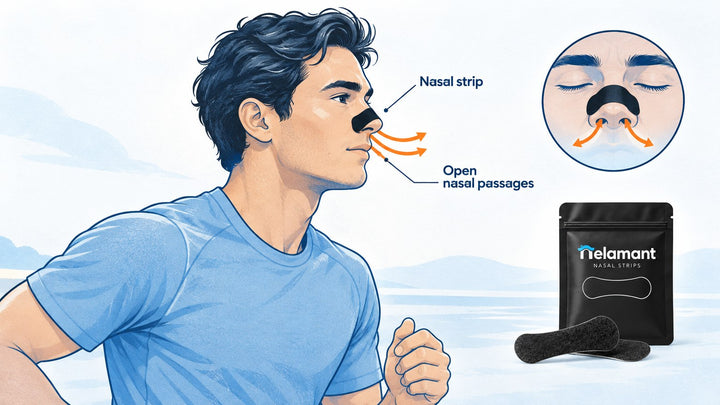
During exercise your breathing rate climbs sharply, and the nose becomes a limiting factor for many people. The nasal passage is narrower than the mouth, and at high intensities the airway can feel pinched - especially for athletes who train in cold air, have naturally narrow nasal valves, or deal with mild congestion. A nasal strip works by gently springing the side walls of the nose outward, reducing resistance at the nasal valve and letting more air through with each breath.
That mechanical action is exactly why sports nasal strips became popular on the football field and at road races long before they were a sleep product. They add no drugs, no stimulants and no banned substances. The strip does its job for as long as the adhesive holds, then you peel it off.
For a deeper look at what happens physiologically when you breathe through your nose during training, read the full guide to nasal breathing during exercise.
What Makes a Nasal Strip Good for Sport
Not every strip on the shelf is built for movement. Here is what to evaluate before you buy:
- Adhesive strength under sweat and oil. Standard skin adhesives lose grip quickly when the skin becomes wet or oily. Look for strips that specifically state sweat resistance or extra-hold formulation.
- Lift width and balance. A wide band that spreads lift evenly across the bridge maintains its effect better during the repeated micro-movements of running or cycling than a strip with a single tension point.
- Hypoallergenic materials. Sweating during exercise can amplify skin reactions. A strip designed for sensitive skin reduces the risk of redness or irritation after repeated daily use.
- Strip size and fit. A strip that is too short for your nose bridge will shift. Check whether the brand offers size options or a size that covers the widest part of your nasal cartilage.
- Clean removal. After a hard workout the last thing you want is to scrub adhesive residue off an already-warm face. Strips that peel cleanly matter as much as strips that stick well.
- Single-use hygiene. Reusing strips after a sweaty session transfers bacteria and loses adhesion. Fresh-strip-per-use is the right approach for athletes.
Our Top Pick: Nelamant Air Nasal Strips
⭐ #1 Top Pick - Nelamant Air Nasal Strips
Best overall for athletes who train hard and need adhesion that lasts through sweat.
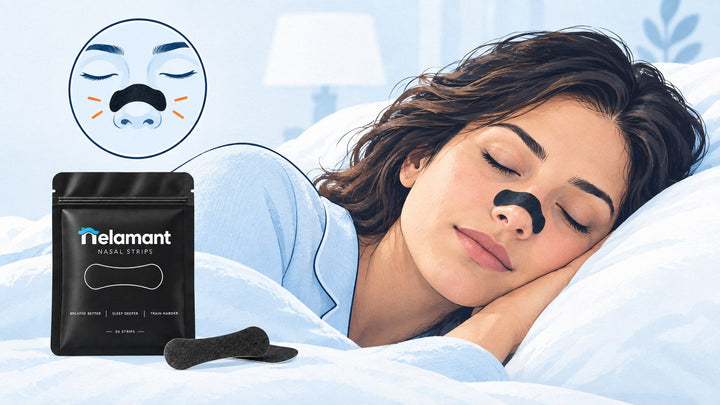
- Adhesive: Extra-hold formula designed to resist sweat, oil and overnight movement
- Lift style: Broader, more balanced lift across the full nasal bridge
- Materials: Hypoallergenic, gentle on sensitive skin, peels off cleanly
- Action: Drug-free, mechanical - no banned substances, no residue
- Pack size: 30 strips - a month of daily use or one strip per workout session
Best for: Endurance athletes, gym goers, anyone training outdoors in variable conditions.
Honest limitation: Like all external nasal strips, Nelamant Air supports the nasal opening. It does not fix a structurally collapsed nasal valve or treat underlying congestion - it works by keeping the passage open while the condition or effort persists.
Nelamant Air's extra-hold adhesive is the core reason it earns the top spot for sport. Most standard nasal strips are formulated primarily for dry skin during sleep. When sweat and body heat enter the picture, those adhesives soften and the strip edges start to lift. Nelamant Air's formulation is specifically built to resist those conditions. Paired with a wider lift footprint, it maintains contact across the bridge rather than pulling from a narrow center point - which also means it is less likely to torque sideways when you turn your head or shift your breathing rhythm at high intensity.
The hypoallergenic materials hold up well for athletes who wear strips session after session without skin problems building over days of training.
Try Nelamant Air for Your Next Training Block
$14.99 for 30 strips · 30-day returns
Shop Nelamant Air →Four Alternatives to Consider
These are four established products athletes commonly reach for. Specifications and prices are drawn from manufacturer and retailer information and marked where verification is needed.
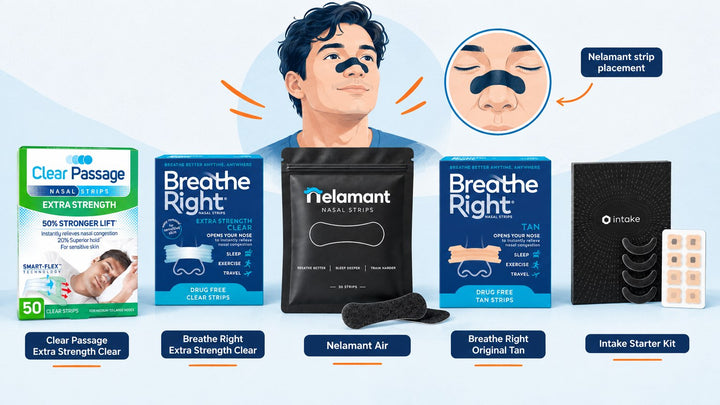
Breathe Right Extra Strength
Breathe Right Extra Strength is the most widely distributed sports nasal strip on the market and the one most athletes have tried first. The extra-strength variant uses a stiffer spring band than the original, which delivers more lifting force. It is available in large and small/medium sizes.
Pros for athletes: Easy to find in grocery stores and pharmacies before a race; well-known lift mechanism; two size options.
Cons for athletes: The adhesive is not specifically formulated for sweat resistance - in humid conditions or heavy sweating, edge lift is a common complaint. The tan and clear variants differ slightly in adhesive. Price per strip is competitive but the lift profile is narrower and more centralized than Nelamant Air's broad band.
Intake Breathing
Intake Breathing takes a different structural approach. Rather than a flexible band bonded to the skin with adhesive across its length, Intake uses a rigid frame with adhesive pads at anchor points only. This design aims to deliver stronger lift from a stiffer arch.
Pros for athletes: The rigid structure can hold its shape well even as adhesive pads warm up; marketed directly at athletic use.
Cons for athletes: The anchor-point adhesive system means the strip depends on a smaller contact area staying stuck - if those pads fail, the whole strip lifts. Higher price point per strip than adhesive-band options. Some athletes find the rigid frame uncomfortable at high breathing rates or during contact sports.
Breathe Right Sport
Breathe Right has at times offered a sport-specific variant with a tan, flexible adhesive strip marketed for sweat resistance. Availability varies by market.
Pros for athletes: Familiar brand, sweat-resistance marketing claim, flexible band.
Cons for athletes:; if discontinued, Extra Strength is the nearest substitute. Lift profile is similar to Extra Strength - centralized rather than wide-bridge.
Store-Brand / Generic Extra-Strength Strips
Most major pharmacy chains sell a store-brand nasal strip in an extra-strength formulation at a lower per-strip cost than name brands. The mechanism is the same flexible spring band, and the adhesive is broadly comparable to standard Breathe Right.
Pros for athletes: Lowest cost option; widely available; adequate for occasional or low-intensity workouts in dry conditions.
Cons for athletes: Adhesive performance under heavy sweat is generally the weakest of the group. Strip dimensions and spring stiffness vary by manufacturer, making it harder to predict fit and lift consistency. Not specifically marketed or formulated for sport conditions.
Comparison Table: Sports Nasal Strips at a Glance
| Product | Adhesive claim | Lift style | Hypoallergenic | Price / pack |
|---|---|---|---|---|
| Nelamant Air | Extra-hold; resists sweat and oil | Wide, balanced across full bridge | Yes | $14.99 / 30 |
| Breathe Right Extra Strength | Standard adhesive; no sweat-specific claim | Centralized, stiffer spring | Check current product details | Check current product details |
| Intake Breathing | Anchor-pad system; rigid frame | High-arch rigid lift | Check current product details | Check current product details |
| Breathe Right Sport | Sweat-resistance claim | Centralized band | Check current product details | Check current product details |
| CVS Health Extra Strength Clear Nasal Strips | Standard; varies by brand | Standard band | Varies | Check current product details |
How We Chose These Sports Nasal Strips
This comparison is manufacturer-authored. We evaluated products based on publicly available design and specification information: adhesive formulation claims, lift mechanism design, material descriptions and published pricing. We did not conduct independent laboratory adhesion testing or athlete trials. Where we could not confirm a specification from manufacturer or retailer sources, we have marked it.
Selection criteria for this list:
- Product must be an adhesive external nasal strip - internal dilators and mouthguards are different categories and are not included here.
- The product must be a real, commercially available item - no invented or placeholder products.
- At least one specification or design feature must be relevant to athletic or active use (adhesive strength, sweat claim, rigid-frame design, or sport marketing).
- Price and pack data are noted where verifiable; all unconfirmed figures carry a tag.

Buyer's Guide: Choosing Sports Nasal Strips for Your Training Style

The right strip depends on what kind of athlete you are and how hard you push. Here is how to match the choice to your training:
High-Sweat Endurance Training (Running, Cycling, Rowing)
Sweat resistance is non-negotiable. You need an extra-hold adhesive that can survive 45 minutes to several hours of elevated body temperature and continuous perspiration. Clean removal matters too - arriving at a post-race crowd with adhesive welt marks is unpleasant. Nelamant Air's sweat-resistant extra-hold adhesive and hypoallergenic formula are designed specifically for this scenario. For more detail on strip choice for running specifically, see best nasal strips for running.
Gym and Strength Training
Gym sessions typically involve shorter bursts of intense effort, changes in body position, and a controlled environment. Sweat output is high but the session duration is often shorter than endurance training. The key need here is a strip that holds through position changes - deadlifts, overhead press and floor work all shift the skin on the nose bridge. A wide, balanced lift band is less likely to torque sideways than a narrow strip. For a dedicated gym-focused breakdown, see best nasal strips for the gym.
Outdoor and Cold-Weather Training
Cold air causes nasal congestion in many athletes, narrowing the airway at exactly the moment you most need it open. A strip with strong adhesive is important here too - cold can make skin slightly oilier as the body tries to protect it, and wind can catch a poorly adhered edge. Start with a clean, dry face for best adhesion regardless of conditions.
Sensitive Skin After Repeated Daily Use
Athletes who wear nasal strips every training day - sometimes twice on double-session days - accumulate adhesive exposure that can irritate skin over time. Hypoallergenic materials reduce this risk significantly. Note that hypoallergenic does not mean zero reaction is possible for every person; if persistent redness develops, give the skin a rest day between sessions.
Competition and Race Day
Drug-free mechanical strips are permitted in essentially all athletic competition. Carry a backup strip in your kit bag - a strip that comes loose mid-race cannot be re-stuck. Apply to clean, dry skin at least five minutes before the start so the adhesive fully bonds before sweat begins.
Do Nasal Strips Actually Help Athletic Performance?
This is the question most athletes arrive with. The short answer is that external nasal strips reduce nasal airflow resistance - how much that reduction translates to measured performance improvement is less settled. Strips reliably open the nasal passage, which makes nasal breathing more accessible at moderate intensities. At very high intensities most athletes naturally shift to mouth breathing anyway, and a strip cannot change that ceiling.
Where strips show the clearest value is in the middle zone: hard aerobic work where nasal breathing is still possible but feels constricted, and in recovery between sets or intervals where nasal breathing helps the system reset faster. Athletes with naturally narrow nasal valves or mild exercise-induced congestion tend to notice the most benefit.
For the full breakdown of evidence and mechanisms, read the guide to whether nasal strips improve athletic performance.
Nelamant Air - Built for Athletes Who Sweat
$14.99 for 30 strips · 30-day returns
Shop Nelamant Air →Frequently Asked Questions
Can you wear nasal strips during a race or competition?
Yes. Adhesive external nasal strips are drug-free and mechanical, and are permitted in essentially all athletic competitions including road running, cycling, triathlon, and field sports. Always check the rules of your specific governing body if you compete at an elite or sanctioned level, but no major sports organization prohibits them. Apply them to clean, dry skin before your warm-up so the adhesive has time to bond firmly before sweat starts.
Will nasal strips stay on when you're sweating heavily?
It depends on the strip. Standard nasal strips formulated primarily for sleep use a gentle adhesive that often loosens under heavy sweat. Strips with an extra-hold or sweat-resistant adhesive - like Nelamant Air - are specifically designed to maintain contact during exercise. Skin preparation also matters: wash and dry your nose bridge before applying, and avoid applying sunscreen, moisturizer or skin oil to that area before putting the strip on.
Are sports nasal strips safe for sensitive skin?
Hypoallergenic strips are the safest choice for athletes with sensitive skin, because repeated daily adhesive exposure and sweating both raise the risk of skin reaction. Hypoallergenic does not guarantee no reaction is possible for anyone, but it significantly reduces the likelihood. If you notice persistent redness or irritation at the adhesive line, take a rest day and consider whether a different strip or a short break is needed.
How long does each strip last during a workout?
A well-adhered strip on clean, dry skin should last the duration of a standard training session - typically one to three hours for most athletes. Very long endurance events (multi-hour rides, marathon-plus races) may push the adhesive further, particularly in hot and humid conditions. Each strip is single-use; do not attempt to re-apply a strip that has come partially off, as the adhesive will no longer bond effectively.
Can nasal strips replace nasal breathing training for athletes?
They are not the same thing. A nasal strip reduces physical airflow resistance at the nasal valve - it helps the passage stay open. Nasal breathing training builds the habit and tolerance for nose breathing under increasing effort, which is a behavioral and physiological adaptation. Many athletes use both together: the strip supports the passage while the training builds capacity. They complement each other rather than one replacing the other.
The Bottom Line
For most athletes the best nasal strips for athletes come down to one decisive factor: will the adhesive survive your sweat? Nelamant Air's extra-hold formula and wide, balanced lift make it the strongest all-round choice for training and competition. If budget or availability drives you toward an alternative, prioritize any strip that makes an explicit sweat-resistance claim and check the lift design - wide and balanced outlasts narrow and centralized when breathing gets hard. Thirty strips at $14.99 covers a full month of daily training; for returns and order details see the Nelamant Air product page.