Thomas Tiemann

This article is for general information, not medical advice.
Disclosure: Nelamant makes Nelamant Air, our top pick in this comparison.
The best nasal strips for a deviated septum are ones that produce a wide, even lift across the nasal bridge-opening both nostrils rather than applying a single sharp pull at one point. A deviated septum shifts the wall between your nostrils off-center, narrowing one side and increasing airflow resistance, especially when you lie down. Nasal strips address that restriction by supporting the outer nasal wall mechanically; they do not correct the septum's position. For a fuller explanation of the anatomy and what it means for your breathing, see the deviated septum guide. For the broader category, our best nasal strips overview covers every major audience and use case.
- Nasal strips open the outer nasal walls wider to ease airflow; they cannot move or straighten a deviated septum.
- A wide, distributed lift across the full bridge matters most when one nostril already carries the restriction.
- Extra-hold adhesive is worth prioritizing-mouth breathing from restricted nasal airflow generates more facial moisture and movement that can loosen a strip.
- If symptoms are severe, persistent, or worsening, a clinical evaluation is the right step; strips manage airflow comfort, not anatomy.
Our Top Pick: Nelamant Air Nasal Strips
#1 Top Pick - Nelamant Air Nasal Strips
Best for: broad even lift, overnight wear, sensitive skin
$14.99 for 30 strips · 30-day returns
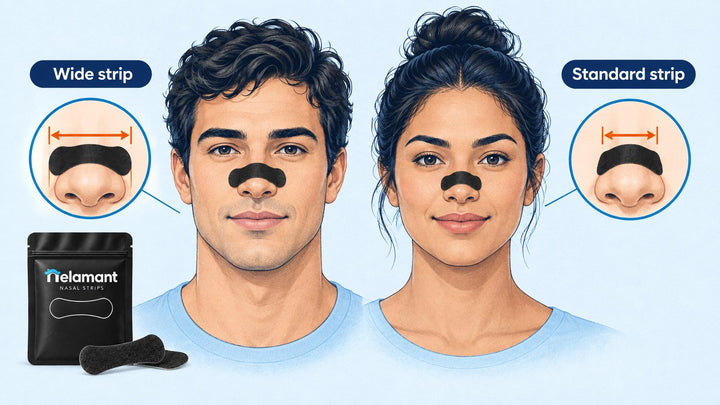
Shop Nelamant AirNelamant Air is built around a broader, more balanced lift across the bridge of the nose. Rather than concentrating spring tension at a single central point, the design distributes lift across a wider area of the nasal bridge, pulling both nasal walls outward more evenly. When one nostril is already narrowed by a displaced septum, that even distribution means you are not relying entirely on one side of the strip to do the work.
The extra-hold adhesive is formulated to resist sweat, skin oil, and overnight movement-an important detail when restricted nasal breathing causes you to sleep with your mouth open, which shifts facial moisture and muscle tension in ways that can loosen a lighter adhesive before morning. Materials are designed to peel off cleanly without sticky residue or skin irritation after a full night's wear. Nelamant Air is drug-free and works by mechanical action only.
Each pack contains 30 strips-a month of nightly use-at $14.99. Two-pack and three-pack bundles are available if you use them regularly. Returns are accepted within 30 days of delivery; see the full return policy for terms and eligibility details.
| Pros for deviated septum users | Honest limitations |
|---|---|
| Wide, even lift distributes across both nostrils | Single-use; recurring cost for nightly users |
| Extra-hold adhesive resists sweat and overnight movement | Addresses airflow restriction, not septum position itself |
| peels off cleanly | Not suitable for broken, sunburned, or actively irritated skin |
#2 Breathe Right Extra Strength
Breathe Right Extra Strength is among the most widely recognized adhesive nasal strips available. It uses a spring-band design to pull the nostrils outward and is widely stocked in pharmacies. The Extra Strength version offers a stronger adhesive hold than the original Breathe Right.
For a deviated septum, the strip's outward lift can partially offset the narrowed side's restriction. The design applies lift from a central band position rather than distributing it across a wider bridge area, which may matter if your restriction spans a broader section of the nasal opening. Sizing options are available.
| Pros for deviated septum users | Honest limitations |
|---|---|
| Widely available in pharmacies and online | Lift geometry concentrated at single band point |
| Established extra-strength adhesive option | Any adhesive can cause skin irritation. |
| Strong overnight adhesive hold | Price per strip may run higher than store-brand alternatives |
Price and pack size:
#3 Intake Breathing
Intake Breathing is an adhesive external nasal strip with a different placement approach from a traditional bridge strip. It uses a tab-and-wing architecture that positions lower on the nose and pushes the nostrils outward from a different angle than a mid-bridge band. This can be relevant when a deviated septum causes its tightest restriction lower in the nasal passage rather than at the upper bridge.
Intake is particularly associated with athletic use, and its adhesive is marketed for wear during exercise and sweating. For overnight deviated-septum users, the key practical question is whether its placement site corresponds to where your narrowing is most significant.
| Pros for deviated septum users | Honest limitations |
|---|---|
| Alternative placement may suit lower-nostril restriction | Design and fit specifics require before confirming claims |
| Marketed for sweat resistance during active use | Less widely stocked in pharmacies than Breathe Right |
| Drug-free mechanical action | Price per strip |
Price and pack size:
#4 Mute Nasal Dilator by Rhinomed
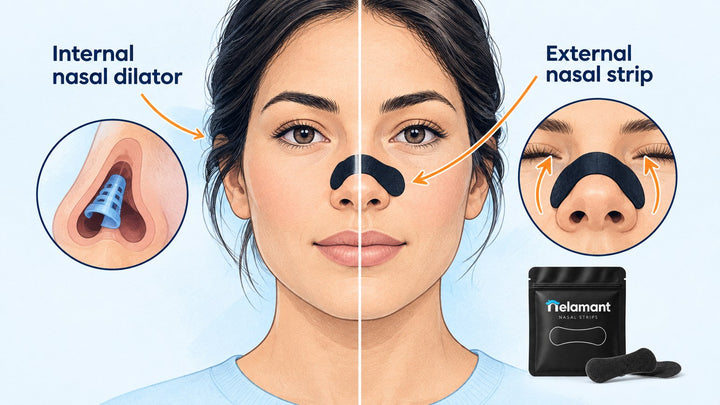
Note: Mute is an internal nasal dilator, not an adhesive strip. It sits inside both nostrils and holds the nasal passages open by pressing gently outward from within. It is reusable across multiple nights and is available in multiple sizes to accommodate different nasal widths.
For a deviated septum, an internal dilator applies its support from inside the nasal passage rather than from the skin surface outside. Whether it reaches the specific point where the septum causes the most narrowing will depend on individual anatomy. No adhesive is involved, which makes it worth considering if your skin reacts to adhesives or if sweat causes external strips to slip before morning. Some people find an internal device less comfortable to sleep with than an external strip.
| Pros for deviated septum users | Honest limitations |
|---|---|
| No adhesive-suits skin that reacts to strips | Internal fit; some find less comfortable for sleep |
| Reusable; lower ongoing cost per night | Septum-specific fit not guaranteed by design |
| Multiple sizes available | Requires cleaning between uses |
Price and pack size:
#5 WoodyKnows Super Enhanced Nasal Dilator
Note: WoodyKnows Super Enhanced is also an internal nasal dilator, not an adhesive strip. It uses a flexible frame inserted into both nostrils to hold the airway open from the inside. Like Mute, it leaves no adhesive residue on the skin and is designed for reuse. The "super enhanced" version is claimed to provide greater internal lift than the standard WoodyKnows model.
For someone whose deviated septum causes significant narrowing that an external strip does not fully address-perhaps because the site of restriction is further inside the passage-an internal option like this is a practical alternative to explore. Fit varies considerably across individuals, and sizing guidance from the brand is worth consulting before purchasing.
| Pros for deviated septum users | Honest limitations |
|---|---|
| No adhesive; no residue on skin | Internal fit varies significantly by anatomy |
| Reusable design | Not universally comfortable for overnight sleep use |
| Claims higher internal lift vs. standard model | All design specifications require |
Price and pack size:
How These Five Products Compare

| Product | Type | Lift Style | Adhesive | Price | Best For |
|---|---|---|---|---|---|
| Nelamant Air | External adhesive strip | Wide, even across full bridge | Extra-hold, sweat-resistant | $14.99 / 30 strips | Overnight use, sensitive skin, even bilateral lift |
| Breathe Right Extra Strength | External adhesive strip | Central band outward pull | Extra strength | Check current product details | Pharmacy convenience; familiar design |
| Intake Breathing | External adhesive strip | Lower-placement tab/wing | Sweat-resistant | Check current product details | Active users; lower-nostril restriction |
| Mute (Rhinomed) | Internal dilator | Internal outward press | None | Not specified | Adhesive-sensitive skin; reusable preference |
| WoodyKnows Super Enhanced | Internal dilator | Internal frame lift | None | Not specified | Reusable preference; deeper-passage restriction |

How We Chose
This is a manufacturer-authored comparison. Nelamant evaluated these products based on publicly available design and specification information, not independent lab testing or consumer-rating rankings. Products were selected to represent meaningfully different approaches-external adhesive strips with varying lift geometries, and internal dilators for readers who cannot or prefer not to use adhesives-so you have a genuinely useful range to consider rather than five variations of the same thing.
Selection criteria for this audience focused on: how lift is distributed across the nasal bridge relative to one-sided restriction; adhesive durability for a full night of mouth-breathing movement; whether materials are described as and availability of design details specific enough to compare.
What to Look for in Nasal Strips for a Deviated Septum
Lift Width and Distribution
A deviated septum typically narrows one nostril more than the other. A strip that spreads its spring tension across a wider section of the bridge-rather than concentrating it at a single central point-is more likely to open the restricted side adequately without over-pulling the already-open side. When comparing strips, look for language about broad or balanced lift rather than maximum pull force.
Adhesive Durability for Overnight Wear
Restricted nasal airflow often leads to mouth breathing during sleep, which increases facial moisture and movement. A lighter adhesive that works fine for a 30-minute workout can loosen by 3 a.m. if you're sleeping open-mouthed. Prioritize strips described as extra-hold, sweat-resistant, or formulated specifically for overnight use.
Skin Compatibility Over Time
Nightly use means the same patch of skin gets adhesive applied and removed every day for months. Any adhesive can cause skin irritation. If your skin is prone to redness or sensitivity, test a strip for several nights before committing to a bulk purchase.
External Strip vs. Internal Dilator
External strips lift the outer nasal wall from the skin surface. Internal dilators press the walls open from inside the nostrils. Neither type repositions the septum; both widen the functional airway opening. External strips are generally more comfortable for sleep and easier to apply correctly. Internal devices suit people who react to adhesives or whose restriction sits deeper in the passage than an external strip can reach from the bridge.
Nasal Valve Collapse: A Related Condition Worth Knowing About
Some people have both a deviated septum and nasal valve collapse-where the lateral walls of the nose lack sufficient structural support and collapse inward during inhalation. External nasal strips address both conditions by lifting the outer nasal wall. The symptoms overlap significantly, and it is not always obvious from sensation alone which is the primary cause:
- Nasal valve collapse involves the lateral walls caving inward under the negative pressure of breathing in
- A deviated septum shifts the central wall, reducing cross-sectional area on one side
- Both reduce total nasal airflow and worsen when lying down
- The same external strip design that helps a deviated septum typically helps nasal valve collapse as well
- A clinician can distinguish between them through direct examination if you are unsure which applies to you
For a full breakdown of the valve-specific picture, read our guide to the best nasal strips for nasal valve collapse.
When to See a Doctor
Nasal strips are a comfort aid for mild to moderate airflow restriction. They do not treat a deviated septum and are not a substitute for medical evaluation when symptoms are significant. Consider seeing a doctor if:
- One or both nostrils feel completely or near-completely blocked despite strip use
- You experience frequent nosebleeds, facial pressure, or recurrent sinus infections
- Breathing restriction is noticeably affecting your sleep quality or daytime alertness
- You snore heavily and are not sure whether the cause is nasal obstruction or something involving the throat or airway-strips support the nasal opening and do not open an obstructed throat
- Symptoms have been worsening over time rather than remaining stable
Surgical correction (septoplasty) is the only way to change the position of a deviated septum; a nasal strip manages the airflow symptom, not the underlying anatomy. For a clear list of the congestion and nasal symptoms that warrant a clinical visit, see our guide to when to see a doctor for nasal congestion.
Frequently Asked Questions
- Can nasal strips fix a deviated septum?
- No. A nasal strip mechanically lifts the outer nasal wall to widen the airway opening. It does not move, reposition, or correct the septum. Only surgical correction-septoplasty-addresses the anatomy itself. Strips are useful for managing the airflow restriction a deviated septum causes, not for resolving its structural cause.
- Will a nasal strip help if only one nostril is blocked?
- In many cases, yes. A strip producing a wide, even lift across both sides of the bridge will open the narrower side along with the already-open one. One-nostril restriction caused by a displaced septum is a clear use case for an external strip, provided the restriction is at or near the nasal opening rather than deeper in the airway or in the throat, where a strip has no effect.
- Is it safe to use nasal strips every night with a deviated septum?
- External adhesive nasal strips are drug-free and generally appropriate for nightly use. The main practical concern is skin tolerance with daily application and removal. If you notice cumulative redness, shift placement slightly or take a night off. There is no drug dependency risk or systemic effect involved.
- What is the difference between nasal strips for a deviated septum and nasal strips for nasal valve collapse?
- The external strip is essentially the same product; the difference is in the underlying anatomy being addressed. A deviated septum reduces airspace by displacing the central wall. Nasal valve collapse reduces airspace because the lateral walls lack structural support and bow inward under inhalation pressure. Both conditions respond to the same outward-lifting strip action. If you are unsure which is your primary issue, a clinician can examine and differentiate. Our full guide to the best nasal strips for nasal valve collapse covers the valve-specific picture in more detail.
- When should I see a doctor instead of relying on nasal strips?
- If nasal blockage is severe, accompanied by facial pain or pressure, linked to recurrent sinus infections, or causing meaningful sleep disruption that strips aren't resolving, a medical evaluation makes sense. Strips ease mild to moderate airflow restriction; they are not a treatment for significant anatomical narrowing. Our guide to when to see a doctor for nasal congestion outlines the specific symptoms that indicate a clinical visit is warranted.
The best nasal strips for a deviated septum deliver a wide, even lift across the nasal bridge, hold reliably through a night of mouth-breathing movement, and use materials gentle enough for skin that's wearing them every night. Nelamant Air is designed around exactly those priorities-broad lift distribution, extra-hold adhesive, and materials-which is why it's our top pick for this audience. If external strips don't reach the site of your restriction, an internal dilator like Mute or WoodyKnows gives you a no-adhesive alternative worth exploring. And when symptoms go beyond what a strip can address, a conversation with a clinician about the septum itself is the straightforward next step.