Thomas Tiemann

This article is for general information, not medical advice.
Rebound congestion happens when you use an over-the-counter decongestant nasal spray for more days in a row than the label recommends, and your nose becomes more blocked the moment the spray wears off than it was before you started. The medical name for this is rhinitis medicamentosa, and the fix is to stop the spray - which is harder than it sounds because withdrawal temporarily makes congestion worse. The good news is that recovery is possible with a plan to stop the decongestant.
If you want broader drug-free strategies for a blocked nose, the full guide on how to unblock your nose covers those alongside this topic.
- Rhinitis medicamentosa is caused specifically by decongestant sprays (oxymetazoline, xylometazoline, phenylephrine) - not saline or steroid sprays.
- The rebound cycle is physiological, not a character flaw; your blood vessels have adapted to the drug.
- The label limit of three consecutive days exists for this exact reason.
- A gradual taper, saline support, and drug-free nasal opening aids can make stopping more manageable.
- If congestion has lasted weeks or you suspect an underlying structural or allergy issue, see a doctor before attempting a self-managed taper.
What Is Rebound Congestion?
Rhinitis medicamentosa (RM) is a form of drug-induced nasal congestion caused by prolonged use of topical nasal decongestants. It is not an allergy or infection - it is your nose's physiological response to a medication it has come to rely on.
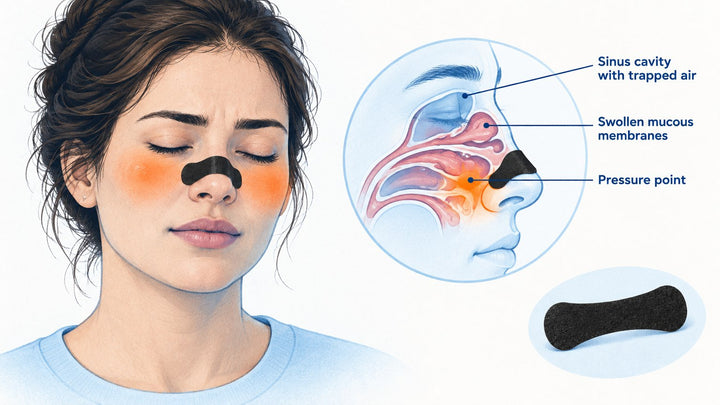
Decongestant sprays work by constricting the blood vessels (vasoconstrictors) inside the nasal lining, which reduces swelling and opens the airway quickly. That relief is real and useful in the short term. The problem arises when the effect wears off: the blood vessels respond by dilating more than they did before the spray, producing congestion that feels equal to or worse than the original blockage. You reach for the spray again. The cycle deepens.
Why the Rebound Cycle Happens
With repeated use, the nasal tissue becomes tolerant to the vasoconstricting effect - meaning you need the spray just to feel baseline normal, not to feel better than baseline. Receptors in the nasal mucosa down-regulate in response to constant stimulation, so the tissue's resting tone shifts toward congestion. This is what people mean when they call it nasal spray addiction - though "dependence" is the more precise clinical term, since the mechanism is pharmacological adaptation rather than craving-driven behavior.
Most product labels warn against using decongestant sprays for more than three consecutive days. That limit is not arbitrary: overuse increases the risk of rebound congestion.
Which Nasal Sprays Cause Rebound Congestion?
Not every nasal spray carries this risk. The culprits are topical nasal decongestants - specifically those containing:
- Oxymetazoline (found in products such as Afrin )
- Xylometazoline (common in products sold in Europe and available in some US formulations )
- Phenylephrine (less common in topical form, more often oral; )
These are not the same as:
- Saline nasal sprays - no active drug, no rebound risk, safe to use as often as needed.
- Intranasal corticosteroid sprays (e.g., fluticasone, budesonide) - these reduce inflammation and do not cause rebound congestion; they are sometimes used to treat RM. These require separate guidance from a clinician or pharmacist.
- Antihistamine nasal sprays - different mechanism; rebound congestion is not an established concern.
If you are unsure which type of spray you have, check the active ingredient on the packaging. The article on nasal strips vs. nasal spray walks through how the two approaches differ and when each is appropriate.

How to Stop Nasal Spray Dependence: Step by Step
The goal is to let your nasal tissue reset its baseline vascular tone without suffering through days of complete blockage. There are two main strategies: cold turkey and a gradual taper. Cold turkey works for some people but produces the worst short-term congestion. A clinician can help you choose a taper that fits your use.
- Track your current use. For two or three days before you taper, note exactly how many times per day you use the spray and in which nostril. This gives you a baseline and lets you recognize improvement.
- Discuss a gradual taper. Ask your clinician whether a one-nostril approach is appropriate. Follow the agreed dose-reduction plan rather than using more as needed. If that approach is advised, agree when to stop the spray in the second nostril.
- Use saline spray as directed. Saline nasal spray or a saline rinse moistens the nasal lining, removes irritants, and can reduce some of the uncomfortable rawness during withdrawal. Follow the saline product's directions. For guidance on rinse technique and safe water preparation, the article on how to unblock your nose covers saline rinse steps in detail, including the need to use sterile, distilled, or previously boiled-and-cooled water.
- Consider a steroid nasal spray bridge (with guidance). An intranasal corticosteroid spray can reduce the inflammation that makes rebound congestion so uncomfortable, and some clinicians recommend a short course specifically to support RM withdrawal. Do not switch from a decongestant spray to a steroid spray without understanding the difference - they are not interchangeable.
- Stop completely. Complete the stopping plan agreed with your clinician. The first full day off will likely feel difficult; improvement may take longer than a few days. Keep saline handy.
How Long Does Withdrawal Last?
Symptoms may take a few days to several weeks to ease after stopping. If congestion is no better after two weeks off the spray, something else - allergies, a structural issue, or a different nasal condition - is likely also at play, and a doctor's assessment is appropriate.
Drug-Free Ways to Relieve Congestion While You Taper
Getting through the taper is easier when you reduce congestion through other means at the same time. None of these will match the instant effect of a decongestant spray, but they can take the edge off:
- Sleep with your head slightly elevated. Lying flat allows more blood to pool in the nasal lining. A second pillow or a small wedge under the head of the mattress can help. The article on whether nasal strips help congestion explains why positioning and airflow support work together.
- Use a humidifier. Dry air irritates swollen nasal tissue. A clean humidifier - clean it regularly per the manufacturer's instructions to prevent mold growth - adds moisture that can ease discomfort. Do not use steam from boiling water bowls or direct steam inhalation, which carries a burn risk.
- Stay hydrated. Systemic hydration keeps nasal secretions thinner and easier to clear.
- Try a saline rinse. A neti pot or squeeze bottle rinse with sterile or distilled water can flush irritants and reduce swollen tissue more than a spray alone. Always use sterile, distilled, or boiled-and-cooled water - never unfiltered tap water - and clean your rinsing device after every use.
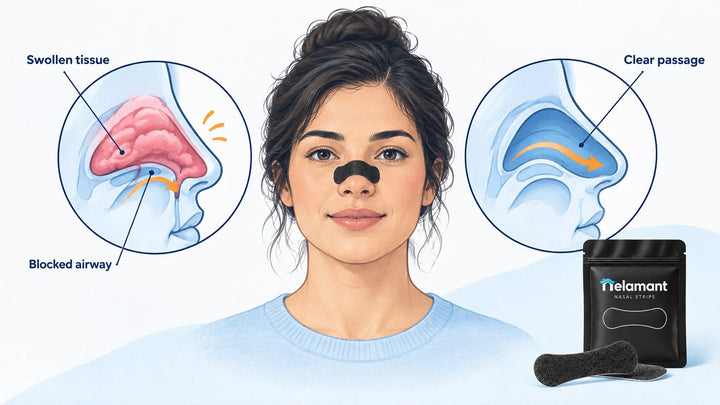
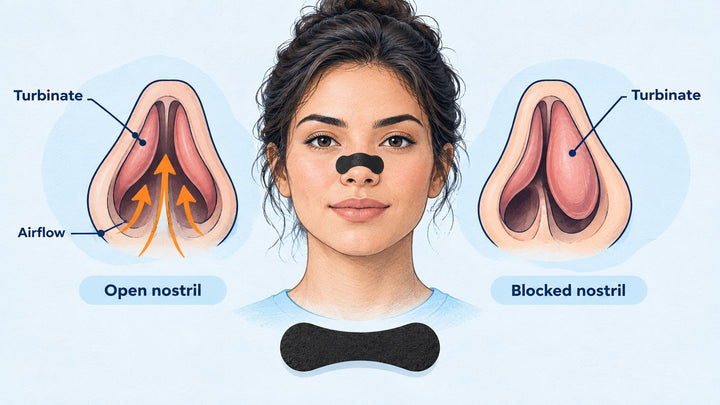
- Use an external nasal strip at night. A nasal strip works mechanically - it gently lifts the sides of the nose to widen the nasal valve and support airflow. It does not treat swollen tissue or replace any medication, but it can help keep the passage open while your nasal lining recovers. Check the listed materials and adhesive before regular use. Since they are drug-free, there is no concern about compounding the rebound effect. See the full comparison of nasal strips vs. nasal spray if you want to understand how these two approaches differ mechanically.

When to See a Doctor for Rebound Congestion
Most cases of rhinitis medicamentosa resolve with the self-managed approach above, but there are situations where a doctor's input is the right move before or during your taper:
- You have been using a decongestant spray daily for several months or longer - longer dependence may need supervised withdrawal.
- You have tried stopping before and the congestion has not resolved, suggesting an underlying cause (allergies, enlarged turbinates, deviated septum, nasal polyps) that needs its own treatment.
- You have significant one-sided congestion that was present before the spray use began.
- You have other symptoms - persistent facial pain, pressure, fever, colored discharge - that suggest sinusitis or another condition.
- You are pregnant. Some treatments used in RM management are not appropriate in pregnancy; get specific guidance.
- You are considering a steroid nasal spray bridge and want confirmation it is appropriate for you.
For a full guide to deciding when a blocked nose warrants professional assessment, see when to see a doctor for nasal congestion.
Frequently Asked Questions
How long does rebound congestion last after stopping nasal spray?
Rebound congestion can take a few days to several weeks to resolve after stopping. People with longer dependence or an underlying nasal condition may take longer, and a clinician's input is useful if there is no improvement after two weeks off the spray.
Is nasal spray addiction the same as rhinitis medicamentosa?
They describe the same condition. "Rhinitis medicamentosa" is the clinical term; "nasal spray addiction" or "nasal spray dependence" is the informal description. The mechanism is pharmacological - your nasal blood vessels have adapted to the drug - rather than a behavioral addiction, though the compulsion to keep using to breathe can feel just as difficult to break.
Can you use a steroid nasal spray to treat rebound congestion?
Intranasal corticosteroids are sometimes recommended by clinicians to reduce the inflammation that makes RM withdrawal uncomfortable, and they do not cause rebound congestion themselves. Whether a steroid spray is appropriate for you depends on your health history and what caused your congestion in the first place; ask a pharmacist or doctor before starting one specifically for this purpose. Do not stop a prescribed nasal medication without guidance from the prescriber.
Do saline nasal sprays cause rebound congestion?
No. Saline sprays contain no active vasoconstricting drug, so they do not trigger the receptor adaptation behind rhinitis medicamentosa. They are safe to use as frequently as needed and are a helpful support during an RM taper. The same applies to most nasal saline rinses (neti pots, squeeze bottles), provided you use sterile or distilled water.
Can nasal strips help while I'm getting off decongestant spray?
A nasal strip cannot treat the swollen tissue that causes rebound congestion - it works by physically widening the nasal valve opening rather than reducing inflammation. That said, the mechanical support can make it easier to breathe through your nose during the recovery period, particularly at night when congestion tends to worsen. For a detailed look at how strips and sprays compare as congestion tools, see the guide on whether nasal strips help congestion.
The Takeaway on Breaking the Rebound Cycle
Rebound congestion is a well-understood, fixable response to overusing decongestant nasal spray - it is not a permanent condition and it is not your fault for not knowing the three-day limit applied to you. The structured taper approach, backed up with saline, humidity, and drug-free airflow support, can support a plan to stop the spray. If the congestion does not clear or you suspect something structural is going on, that is the moment to get a proper evaluation rather than reaching for the spray again.