Thomas Tiemann

This article is for general information, not medical advice.
If one nostril always feels blocked, you are almost certainly experiencing the nasal cycle - a normal, automatic process in which your nose alternates airflow from one side to the other roughly every two to six hours. Most people never notice it, but once you do, it can feel alarming. In most cases it is completely harmless. The question worth asking is whether what you are feeling is the nasal cycle at work or a structural issue that deserves attention.
- The nasal cycle is a normal physiological rhythm that deliberately restricts one nostril while the other does most of the work.
- Switching sides every two to six hours is typical; you may feel one side of your nose is blocked without any infection or allergy present.
- Certain positions - especially lying on your side - amplify the blocked feeling because gravity affects turbinate blood flow.
- Structural causes like a deviated septum can make one side consistently more restricted than the other, on top of the cycle.
- If blockage is one-sided, persistent, or accompanied by other symptoms, it warrants a medical evaluation.
What Is the Nasal Cycle?
Your nose is not a passive tube. The tissue lining the inside of each nostril - particularly the inferior turbinates - is richly supplied with blood vessels that can swell or shrink on demand. Your autonomic nervous system orchestrates a slow, rhythmic pattern: it directs more blood into the turbinate tissue on one side, causing that side to narrow, while the vessels on the opposite side constrict to open that passage wider. After a few hours, the sides reverse.
This is the nasal cycle, and suggests it operates in the majority of healthy people. It is not a malfunction. The leading explanation is that the alternating pattern gives each side of the nose a period of rest and recovery - the mucous membranes can regenerate, stay moist, and maintain their filtering function more effectively than if both sides ran at full capacity all the time.
How Alternating Congestion Works
The turbinates are the main control valves. When turbinate tissue fills with blood, it physically narrows the airway on that side. You perceive this as the feeling of one side of your nose being blocked even though there is no mucus, no infection, and no inflammation - just normal vascular congestion doing its job. The dominant side handles the bulk of airflow, warms and humidifies the incoming air, and filters particles efficiently. The resting side is not fully closed; it still passes some air, but enough less that many people notice the difference.
For a broader look at what else can cause a blocked nose and how to address it quickly, see the full guide to how to unblock your nose.
Why One Side of Your Nose Feels Blocked More Than the Other
The nasal cycle alone creates a temporary, alternating blockage. But many people notice that one specific side - usually the same side - feels blocked far more often than the other, or that the blockage on one side is noticeably more severe. Several factors account for this asymmetry.
| Factor | How it affects one side | Typically reversible? |
|---|---|---|
| Nasal cycle (normal) | Alternates every 2–6 hours | Yes - switches on its own |
| Sleeping position | Gravity pools blood in the lower turbinate | Yes - rolls over and it clears |
| Deviated septum | Narrows one passage structurally | No - structural |
| Enlarged turbinates | Chronically reduces space on one or both sides | Partially - medications may help |
| Allergen or irritant exposure | Triggers swelling, often both sides | Yes - resolves when exposure ends |
| Nasal polyp or growth | Physically occupies space on one side | No - needs evaluation |
One common experience: you wake up after sleeping on your right side, and your right nostril feels stuffy while the left is clear. Roll onto your left side and within a few minutes the sides swap. That is gravity acting on turbinate blood flow, overlapping with whichever phase of the nasal cycle you happen to be in. It is expected and normal.
If your nose consistently feels blocked on one side but there is no mucus, no cold, and no obvious allergy trigger, the guide to a nose that feels blocked but has no mucus covers the likely explanations in detail.

When the Nasal Cycle Is Normal vs. Something Else
The nasal cycle produces a blocked sensation that shifts sides, clears on its own within hours, does not cause pain or pressure, and does not come with other symptoms. If what you are experiencing fits that description, it is almost certainly the cycle doing its job.
The following patterns suggest something beyond the normal cycle and are worth evaluating:
- One side of the nose is always the blocked side, without any switching, for weeks or months.
- The blockage is accompanied by facial pain, pressure, or swelling.
- You notice a change in your sense of smell, particularly on one side only.
- There is blood-tinged discharge or visible asymmetry inside the nostril.
- The blockage started suddenly after an injury to the nose or face.
Deviated Septum and Structural Causes
The nasal septum is the wall of cartilage and bone that divides your two nostrils. A deviation - a bend or shift to one side - is extremely common; estimates suggest the majority of people have at least a minor one. A significant deviation narrows the passage on the deviated side regardless of which phase of the nasal cycle you are in. The result is that the nasal cycle's normal restriction lands on top of an already narrower passage, making that side feel perpetually blocked while the other side always feels relatively open.
A deviated septum cannot be corrected by external strips or sprays, though opening the nasal valve can make breathing more comfortable. For a full explanation of causes, symptoms, and when surgery is considered, read the dedicated guide to deviated septum.
Enlarged Turbinates and Other Structural Factors
Turbinates that have chronically enlarged - due to long-term allergies, chronic rhinitis, or other causes - can reduce the available airway space on one or both sides well beyond what the normal nasal cycle creates. Nasal polyps, foreign bodies (particularly relevant in young children), and rarely tumors are other structural reasons for persistent one-sided blockage. Any of these warrant a clinician's evaluation rather than self-management alone.

How to Get Relief When One Nostril Is Blocked
If the blockage is the nasal cycle or positional, it will resolve on its own. That said, there are practical ways to ease the feeling while it lasts.
Quick Positional Tricks
Because turbinate congestion is vascular, position has an immediate effect. If your left nostril is blocked while you are lying on your left side, rolling to your right side will often clear it within a few minutes as blood drains out of the left turbinate. Sitting upright or standing also helps: gravity reduces blood pooling in the turbinate tissue across both sides, which is why a blocked nose often feels less severe when you get out of bed.
Sleeping position affects not just congestion but overall nighttime breathing comfort. The guide to the best sleeping position for breathing covers how to position yourself to keep airways more open through the night.
Nasal Strips for One-Nostril Congestion
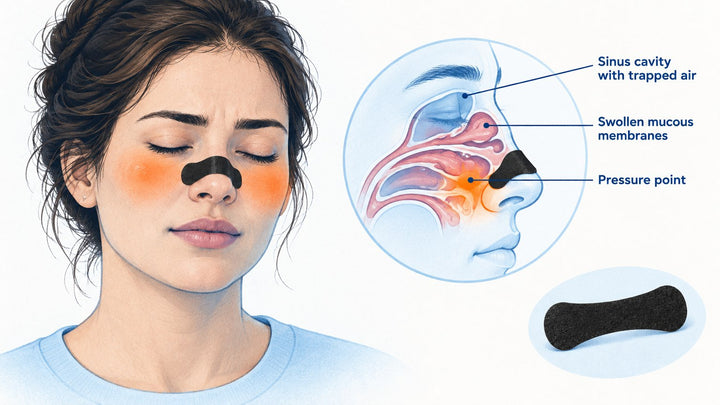
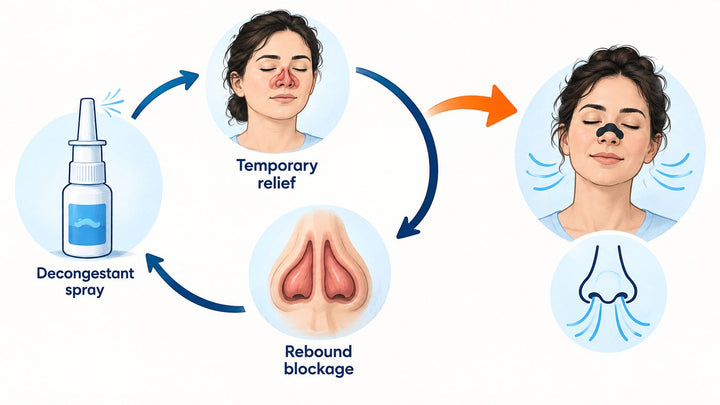
When the blockage is vascular rather than structural - turbinate swelling from the nasal cycle, position, or mild irritation - gently widening the nasal opening can make airflow feel noticeably easier. A nasal strip works by lifting the sides of the nose outward, which reduces resistance at the nasal valve and lets air move more freely through whichever passage is open. It does not deflate the turbinate, but it does give the available airflow a wider channel to pass through.
Nelamant Air nasal strips use a wider, more evenly distributed lift across the bridge of the nose rather than one concentrated pull point, which means the opening effect is spread more naturally across both sides. The extra-hold adhesive is designed to stay on through overnight movement, and the materials peel off cleanly in the morning. If you regularly notice one nostril blocked during sleep - whether from the nasal cycle, a mild structural asymmetry, or position - a strip can help support easier nose breathing without any medication.
When to See a Doctor
The nasal cycle and positional swelling are benign. However, persistent one-sided blockage - meaning one side of your nose is blocked more days than not for several weeks with no clear temporary cause - deserves a medical evaluation. A clinician can examine the septum and turbinates, check for polyps, and determine whether the cause is structural, inflammatory, or something else.
Seek prompt care if the blocked nostril is accompanied by significant facial pain or swelling, a change in smell, nosebleeds, or if it developed after a head or facial injury. These are not typical nasal cycle symptoms.
For a full checklist of symptoms that warrant a visit and what to expect from that appointment, see the guide on when to see a doctor for nasal congestion.
Frequently Asked Questions
Is it normal for one nostril to always feel more blocked?
It depends on what "always" means. The nasal cycle creates a rotating blockage where one nostril is more restricted for a few hours, then the sides switch. If you consistently notice the same side blocked but it clears on its own and switches sides across the day, that is the normal cycle. If the same side is permanently more blocked without ever fully clearing, a structural cause like a deviated septum or enlarged turbinate is more likely and is worth having evaluated.
How long does the nasal cycle last?
The full cycle - from one side being dominant to the other side taking over and back again - typically runs anywhere from two to six hours in healthy adults, with meaningful individual variation. Some people cycle faster, some slower. You are unlikely to notice it unless you pay close attention or have a structural asymmetry that makes the restricted phase feel especially pronounced.
Why does the one side of nose blocked feeling get worse when I lie down?
Lying down reduces the effect of gravity on your circulatory system, which allows more blood to pool in the turbinate tissue. This is why both nostrils tend to feel somewhat more congested at night than during the day. Whichever side you are lying on gets it worse because the lower turbinate is more engorged. Rolling over usually switches which side is more open within a few minutes, which is why people with congestion instinctively change positions during the night.
Can a nasal strip help when only one nostril is blocked?
Yes, particularly when the blockage is from swollen turbinates rather than a fixed structural obstruction. A nasal strip widens the nasal valve area - the narrowest part of the nostril - which reduces the resistance air has to overcome entering the nose. Even if one side is more restricted, the strip improves overall nasal airflow and can make the difference between breathing comfortably through your nose all night versus defaulting to mouth breathing. It does not treat the underlying cause of congestion, but it supports easier breathing while that cause resolves.
When does one-sided nasal blockage mean a deviated septum?
A deviated septum is likely when one nostril is consistently, reliably more blocked than the other - not alternating, not clearing fully - and has been that way for as long as you can remember or since a nasal injury. Many people live comfortably with a mild deviation. A significant deviation may cause chronic one-sided blockage, recurrent sinus infections on one side, or noisy breathing. An ENT specialist can confirm the diagnosis and discuss whether any intervention makes sense. External nasal strips can support airflow comfort but do not correct the septum itself.
The Bottom Line
A one nostril blocked feeling is, most of the time, the nasal cycle doing exactly what it is supposed to do - alternating airflow to keep your nasal lining healthy. Understanding that rhythm takes most of the worry out of it. If the blockage rotates, clears on its own, and fits the pattern described here, you are likely looking at normal physiology. If it is fixed, worsening, or comes with other symptoms, that is when a clinician's assessment is the right move. In the meantime, positional adjustments and, for overnight comfort, a nasal strip that gently widens the nasal opening can help you breathe more freely through whatever side is taking its turn to carry the load.