Thomas Tiemann

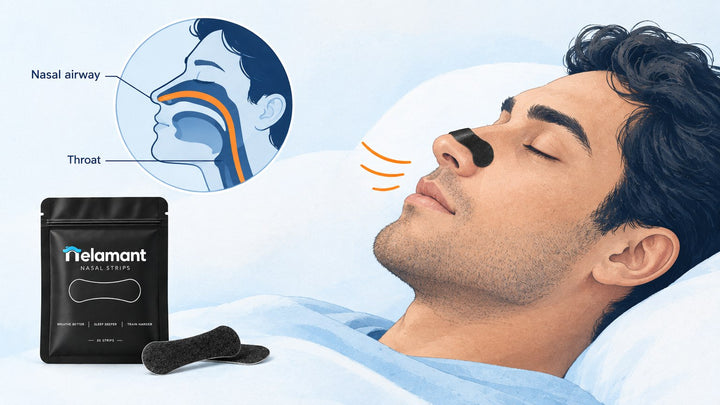
Nasal strips can help with snoring, but only when that snoring originates in the nose. If your airway narrows at the nostrils or along the nasal passages, a strip widens the opening and lets air flow more freely, which removes the turbulence that produces the sound. If your snoring comes from your throat, palate, or tongue, a strip on your nose will not reach the source and won't make a meaningful difference.
That single distinction - nose versus throat - is what determines whether nasal strips are the right tool for you. The rest of this guide explains how to figure out which type you're dealing with, what the evidence says, and how to use strips correctly if they are a good fit. For a broader look at all the strategies available, see the full guide to how to stop snoring.
- Nasal strips work by mechanically widening the nasal passages - drug-free, no medication involved.
- They are most effective when snoring is caused by nasal restriction: congestion, narrow nostrils, or a partially collapsed nasal valve.
- They do not address snoring that originates in the throat, soft palate, or from the tongue falling back.
- They are not a treatment for sleep apnea.
- Correct placement and dry, clean skin are essential - a strip that won't stay on won't help.
How Snoring Actually Starts
Snoring is the sound of soft tissue vibrating when air moves through a narrowed or partially obstructed airway. The key word is where that narrowing occurs, because the location changes everything about which remedies will and won't work.
Nose-origin snoring
When the nose is the bottleneck, air accelerates to squeeze through a smaller space - the same principle that makes wind whistle through a gap in a window. Nasal congestion from a cold or allergies, a structurally narrow nostril, a partially collapsed nasal valve, or even sleeping position can all reduce the nasal opening enough to create that turbulence. The resulting snore tends to be a lower-pitched rumble, and it often fluctuates with your congestion levels or the time of year.
People who snore through the nose typically breathe with their mouth closed, or at least start that way. If you or your partner notice the sound seems to come distinctly from the nose rather than an open mouth, that is a useful early clue.
Throat-origin snoring
Throat snoring happens when the soft palate, uvula, or tongue vibrates as air passes through the throat. This is by far the more common category, and it accounts for the majority of adult snoring. The muscles around the airway relax during sleep; if there isn't enough muscle tone to keep the passage open, tissue collapses inward and vibrates with every breath. Alcohol, body weight around the neck, sleeping on your back, and natural aging all make this more likely.
Because the obstruction is in the throat rather than the nose, widening the nostrils with a strip does not change what is happening several inches further down the airway. Understanding which type you have before buying anything saves time and money. The full breakdown is in the guide to nose snoring versus mouth snoring.
Do Nasal Strips Stop Snoring - and When?
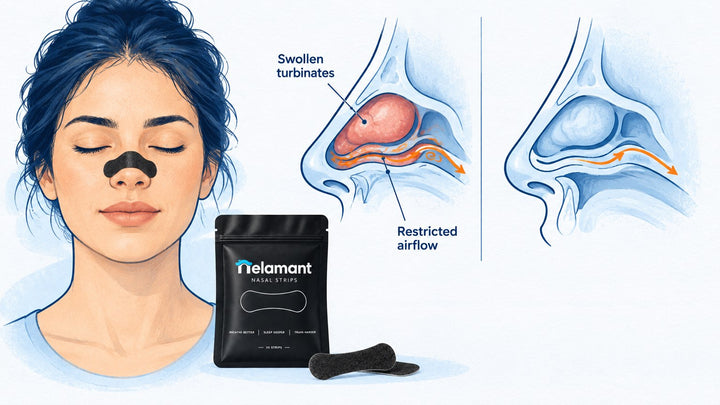
The honest answer is: sometimes, and for a specific reason. A nasal strip spans the bridge of the nose and uses a small spring-like backbone to gently pull the sides of the nose outward. That mechanical action increases the cross-sectional area of the nasal passage. More room means air moves at lower velocity, turbulence drops, and - if the nose was the pinch point - the vibration that causes snoring is reduced or eliminated.
This is a real effect, not a placebo. The question of whether nasal strips actually work has been studied in the context of nasal airflow, and the evidence supports their effectiveness for nasal resistance specifically. What the research does not consistently show is a significant benefit for snorers whose primary obstruction is in the throat.
When nasal strips can help with snoring
- Congestion-related snoring. When a cold, allergies, or sinusitis swells the nasal lining, the passage narrows temporarily. A strip compensates by holding the external valve wider, partially offsetting the internal swelling.
- Narrow or collapsing nostrils. Some people have naturally narrower nostrils or nasal valves that partially collapse under the negative pressure of inhalation. A strip provides external support that prevents that collapse.
- Snoring that gets noticeably worse with congestion. If your partner reports that your snoring tracks directly with your blocked-nose episodes, that is strong evidence the nose is the main driver.
- Mouth-closed snoring. If you snore with your lips together, the air is almost certainly moving through your nose. That makes it a prime candidate for a strip.
When nasal strips won't stop snoring
If your snoring is driven by throat tissue, a relaxed soft palate, or the tongue falling back during sleep, a nasal strip cannot help because it never reaches that part of the airway. Similarly, if you are a confirmed mouth breather during sleep, opening the nose further may not redirect your breathing or stop the snoring.
The most important exception: nasal strips are not a treatment for obstructive sleep apnea. Sleep apnea involves a repeated collapse of the throat that briefly stops breathing altogether. If you wake unrefreshed, have been told you stop breathing during sleep, or experience significant daytime sleepiness, that needs medical evaluation - not a nasal strip. The differences between snoring and sleep apnea are covered in detail in the guide to snoring versus sleep apnea.
How to Use Nasal Strips for Snoring
Placement and skin preparation have a bigger impact than most people expect. A strip that peels off at 2 a.m. provides no benefit for the rest of the night.
- Wash and dry your nose. Gently wash the bridge of your nose with soap and water, rinse thoroughly, and pat fully dry. Skin oils and residual moisturizer are the leading reasons strips fail to stick overnight.
- Wait a few minutes. Let any remaining moisture evaporate completely before you open the strip. Even a slightly damp surface reduces adhesion.
- Find the flare of the nostrils. Position the strip across the widest part of the nasal bridge - roughly over the lower third of the nose, not up near the nasal bone. This is where the cartilage is most flexible and where the strip can actually spring the sides outward.
- Press firmly along the full length. Run your fingertip along the entire strip for several seconds, pressing all edges into contact with the skin. Don't just press the center.
- Avoid creams or oils on the nose before bed. If you use a nightly face moisturizer, apply it after placing the strip, not before, and keep product away from the strip area.
- To remove, don't peel from one end. In the morning, use a wet cloth or a few drops of water to gently soften the adhesive first, then roll the strip off slowly from both sides toward the center. This prevents skin irritation and is especially helpful for sensitive skin.

Choosing the Right Strip - and What to Look For
Not all nasal strips deliver the same lift. Strips vary in width, spring tension, and adhesive strength - and those differences matter when you're wearing one through eight hours of movement and sleep.
A wider strip distributes the lifting force across more of the nasal bridge rather than concentrating it at a single point. That broader, more even lift is more comfortable for extended wear and tends to maintain better contact with the skin throughout the night. Adhesive quality is equally important: a strip with strong adhesive that resists sweat and skin oils will stay in place and keep the nasal passage open from the time you put it on until you wake up.
Nelamant Air Nasal Strips are designed with a wider lift profile for a more balanced pull across the bridge, paired with an extra-hold adhesive formulated to resist overnight movement, sweat, and oil. The materials are peel off cleanly without sticky residue, which matters if you plan to use them regularly. Like all nasal strips, they work mechanically - no drugs, no sprays. For a side-by-side comparison of options specifically tested against snoring-related criteria, the guide to best nasal strips for snoring covers the main contenders in detail.

Frequently Asked Questions
Do nasal strips stop snoring completely?
They can eliminate snoring entirely if the nose is the only obstruction driving it. In practice, many people see a noticeable reduction rather than complete silence, because snoring often has more than one contributing factor. If your snoring is purely nasal in origin - congestion, narrow nostrils, or a partially collapsing nasal valve - a well-fitted strip is likely to make a significant difference.
Can nasal strips help with snoring caused by allergies or a cold?
Yes, this is one of the clearest use cases. When congestion from allergies or illness narrows the nasal passage, a strip mechanically holds the external valve open and partially compensates for the swollen lining inside. The effect is temporary relief, not a treatment for the allergy itself, but it can meaningfully reduce congestion-linked snoring night to night.
What about nasal strips and snoring when I breathe through my mouth?
If you sleep with your mouth open, the primary airflow is through your mouth and throat, not your nose. Opening the nasal passage won't redirect that airflow automatically, and the strip is unlikely to stop the snoring on its own. The underlying question is why you're mouth-breathing - whether it's habit, a blocked nose, or anatomy. Addressing the nasal blockage may encourage nose breathing, but that varies from person to person.
How long does it take to notice a difference with nasal strips and snoring?
The effect is immediate if it's going to occur at all. Nasal strips work mechanically from the moment they're placed on the skin; there is no buildup period. If you try a strip correctly placed for several nights and see no change in snoring, that is useful diagnostic information - it suggests the snoring is not primarily driven by nasal restriction.
Could my snoring be sleep apnea rather than a nasal issue?
It's possible, and the distinction matters. Ordinary snoring and obstructive sleep apnea can sound similar to a bed partner. Loud snoring accompanied by pauses in breathing, gasping, choking at night, or significant daytime fatigue warrants a conversation with a doctor rather than a trial-and-error approach with strips. A strip is not appropriate as a substitute for evaluation or treatment of sleep apnea. The full comparison is in the guide to snoring versus sleep apnea.
The Bottom Line
Nasal strips help with snoring when the nose is the source of the problem - and they do nothing when it isn't. If your snoring tracks with congestion, your nostrils narrow under inhalation pressure, or you snore with your mouth closed, a strip is a reasonable, drug-free first step worth trying. If the snoring is louder, consistent regardless of nasal condition, and comes with poor sleep quality, look beyond the nose. The broader guide on how to stop snoring maps out the full range of options, and the evidence on whether nasal strips work generally goes deeper into the mechanism if you want more detail before deciding.