Thomas Tiemann

Specific mouth and throat exercises can reduce snoring by toning the muscles that collapse and vibrate during sleep. Done consistently - typically 10 to 20 minutes a day - they address one of the most common mechanical causes of snoring: weak, floppy tissue in the upper airway. This guide explains exactly which exercises to stop snoring are worth doing, how to perform them correctly, and how to build a routine that sticks.
- Snoring often results from relaxed, vibrating tissue in the throat - targeted exercises build enough tone to reduce that vibration.
- Tongue, soft palate, and jaw exercises all target different parts of the same problem; doing a mix works better than any single move.
- Myofunctional therapy is a structured, clinician-guided version of these exercises with a stronger evidence base.
- Results typically take several weeks of daily practice - consistency matters more than session length.
- Exercises help most when snoring comes from soft-tissue tone. Structural causes and sleep apnea need a different approach.
Why Throat Muscles Drive Snoring
During sleep, every muscle in your body relaxes - including the ones that hold your airway open. When the tongue base, soft palate, or pharynx walls lose enough tone, they partially collapse inward. Passing air then causes that slack tissue to flutter, which is the noise you or your partner hear. The louder and more frequent the snoring, the more the tissue is vibrating with each breath.
Muscle tone is trainable. Just as you can strengthen any other group of muscles through repetition, you can build tone in the airway muscles through targeted oral and pharyngeal exercises. The goal is not to flex those muscles consciously while you sleep - it is to raise their resting baseline tone enough that they stay partly supported even when relaxed.
Snoring has several possible causes beyond soft-tissue tone - nasal obstruction, sleeping position, body weight, and alcohol are common contributors. For a broader look at the full picture, see the complete guide to how to stop snoring, which covers all the major levers.
Throat Exercises for Snoring
The exercises below target the three main regions that contribute to airway vibration: the tongue, the soft palate, and the jaw and cheeks. Work through all three groups if you can - each one addresses a different part of the same problem.
Tongue Exercises
The tongue is the single biggest soft-tissue structure in the upper airway. Strengthening it - and specifically training it to rest higher in the mouth - reduces how far it can fall back during sleep.
- Tongue slide: Press the tip of your tongue firmly against the roof of your mouth just behind your front teeth, then slide it straight back toward your throat as far as it will reach. Return to the start. Do 20 repetitions.
- Tongue press: Push the entire flat of your tongue up against the roof of your mouth and hold for 10 seconds, as if you are trying to seal your whole tongue to the palate. Release. Repeat 10 times.
- Tongue stretch: Stick your tongue out as far as possible, point the tip down toward your chin, hold for 5 seconds. Then curl the tip up toward your nose, hold for 5 seconds. Repeat the full sequence 5 times. This extends the range through which the tongue muscle works.
Soft Palate Exercises
The soft palate is the flexible rear section of the roof of your mouth and the single most common snoring source. It vibrates when air rushes past it, especially when your mouth falls open during sleep.
- Vowel repetition: Say the vowels A-E-I-O-U out loud, exaggerating the mouth shapes and really pushing each vowel sound from the back of the throat. Do 3 sets of 10 repetitions. This activates the levator and tensor muscles that tense the palate.
- Palate lift: Open your mouth wide, say a prolonged "Ahhh" as if a doctor is checking your throat, and try to consciously lift the uvula (the small hanging structure at the back). Hold the lifted position for 5 seconds. Repeat 10 times.
- Singing: Sustained vowel sounds sung on a single pitch put the soft palate through repeated contractions. Deliberate singing also involves the soft palate.
Jaw and Cheek Exercises
The muscles around the jaw and cheeks influence how the lower face and tongue base are supported during sleep. A loose jaw drops the tongue backward and opens the mouth, worsening both soft palate and tongue vibration.
- Pursed-lip resistance: Press your lips together firmly and puff out your cheeks with air. Hold the air in for 10 seconds, pushing back against any leakage. Repeat 10 times. This builds orbicularis oris and buccinator tone, which helps keep the mouth closed at night.
- Cheek puffs: Fill your left cheek with air, push it to your right cheek, and alternate back and forth 20 times - like a slow mouthwash swish. This trains the lateral cheek muscles that support jaw position.
- Jaw resistance press: Place a knuckle under your chin and gently push upward while opening your jaw downward against the resistance. Hold 5 seconds. Repeat 10 times. Keep the resistance light; this is a toning exercise, not a strength test.
Myofunctional Therapy for Snoring
Myofunctional therapy is a structured programme of orofacial exercises delivered by a trained therapist - typically a speech-language pathologist or a myofunctional specialist. It covers the same territory as the exercises above but adds assessment, progression, and correction of compensatory habits like mouth breathing and incorrect tongue resting posture.
Structured oropharyngeal exercise programs have been studied for snoring. Program length, appointments, and home practice depend on the prescribed plan.
Self-directed exercises from a guide like this one are a reasonable starting point. If you do them consistently for 6 to 8 weeks and see little change, a referral to a myofunctional therapist is worth exploring - they can identify which specific muscle patterns are driving your snoring and adjust the protocol accordingly.
How to Build a Daily Exercise Routine
Frequency and consistency matter far more than the total number of reps in any single session. Here is a simple framework:
- Choose a fixed time. Morning after brushing teeth or evening before bed both work well. What matters is that it happens at roughly the same point each day so it becomes automatic.
- Start with 10 minutes. Two or three exercises from each of the three groups above, done at the reps listed, takes around 10 minutes. That is enough to begin building tone.
- Add variety after two weeks. Once the basic exercises feel easy, increase reps or introduce the next exercise in each group. Progressive load - gradually asking more of a muscle - is what drives adaptation.
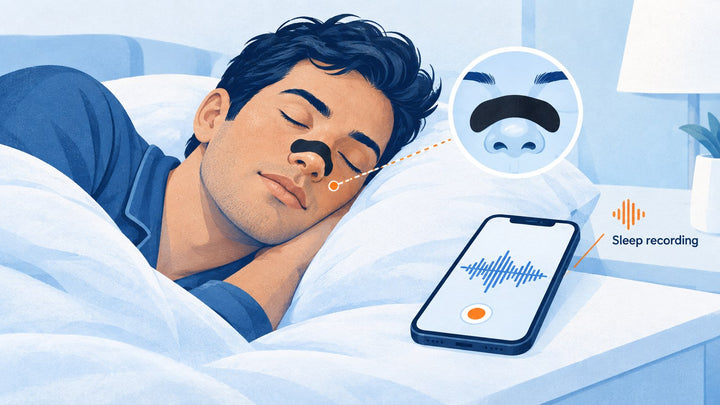
- Track whether snoring changes. Ask a bed partner, use a phone app, or simply notice whether you wake up feeling less raspy.
- Keep going even when results plateau. Tone is maintenance-dependent. If you stop, the muscles lose the baseline you built.
If you want to layer in broader breathing work, nasal breathing exercises to pair with this routine cover diaphragmatic patterns and breath-hold drills that complement oral muscle training.

When Nasal Congestion Is Also a Factor
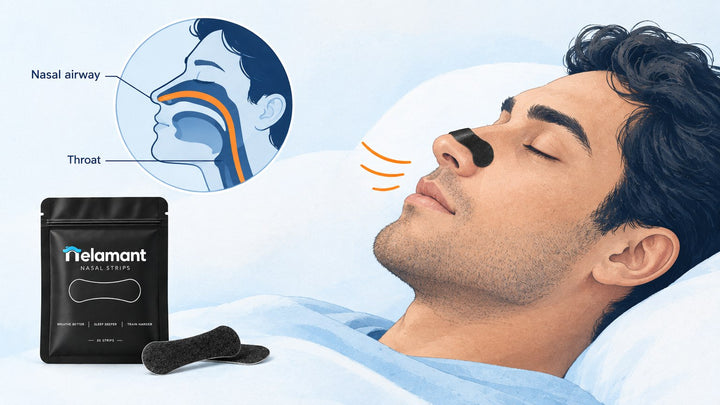
Throat exercises work on soft-tissue tone, but they cannot do anything about a blocked nose. If congestion is forcing you to breathe through your mouth at night, that mouth-open position puts the soft palate under far more strain - and makes even a toned palate more likely to vibrate. Clearing the nasal passage is a separate lever worth pulling alongside any exercise programme.
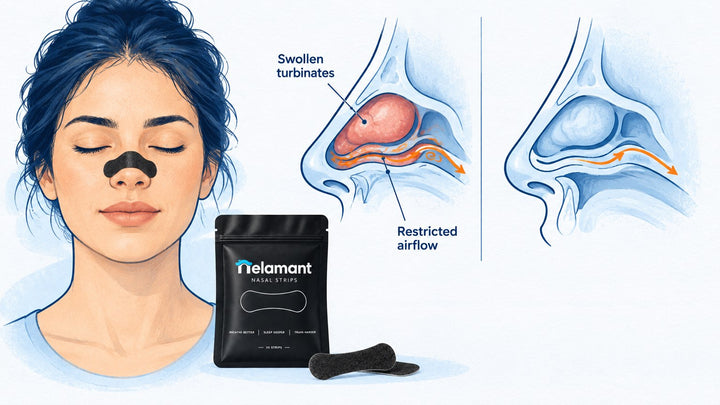
A nasal strip can help here. Nelamant Air uses a wider spring to lift the nasal passages open along the whole bridge, which supports easier nose breathing through the night without any medication. If your snoring has both a soft-tissue and a nasal component, combining exercises with a strip addresses both causes at once. For a full breakdown of how nasal strips fit into the snoring picture, see the guide on whether nasal strips help snoring.

What Exercises Won't Fix
Throat exercises are effective for snoring that comes from weak, floppy soft tissue - but that is not the only cause of snoring, and it is worth being clear about the limits.
- Obstructive sleep apnea: Exercises may reduce mild snoring associated with OSA, but they are not a treatment for sleep apnea itself. If you wake frequently, gasp during sleep, or feel unrefreshed regardless of sleep time, speak with a doctor before relying on exercises alone. The guide on snoring versus sleep apnea explains how to tell the difference and what each requires.
- Structural issues: A deviated septum, nasal valve collapse, or significantly enlarged turbinates are physical structures that exercises cannot remodel. Those typically need medical assessment.
- Positional snoring: If you only snore on your back, sleep position changes will have a larger effect than any exercise programme.
Frequently Asked Questions
How long before exercises to stop snoring actually make a difference?
A noticeable reduction is not guaranteed on a fixed timetable. The muscles of the soft palate and tongue need repeated activation before tone accumulates enough to change how they behave during sleep. Follow the practice schedule in your prescribed program.
How often should you do these exercises, and for how long each session?
Daily practice is part of some studied programs. Sessions at the prescribed length - covering tongue, palate, and jaw exercises - should follow that program rather than be extended to chase faster results.
Do tongue exercises for snoring actually work, or is that overstated?
Tongue exercises are included in studied programs of oropharyngeal exercise for snoring. The mechanism is straightforward - a stronger tongue rests higher and falls back less during sleep. The caveat is that they work best when a weak tongue is the primary driver, which is not true for every snorer.
What is myofunctional therapy for snoring, and do I need a therapist?
Myofunctional therapy is a clinician-guided programme of orofacial exercises that corrects abnormal muscle function patterns - poor tongue posture, habitual mouth breathing, and incorrect swallowing mechanics among them. You do not strictly need a therapist to start doing these exercises, but if self-directed practice produces limited results, a myofunctional evaluation is worth pursuing.
Can exercises help if I snore through my nose rather than my mouth?
Throat and tongue exercises target the soft tissue of the oropharynx - the zone behind the mouth. If your snoring originates primarily from the nose (a fluttering noise at a higher pitch, with mouth closed), exercises have less direct impact. Nasal snoring is more often addressed by improving airflow through the nasal passages. The question of which type you have is covered in detail in the cluster; your snoring pattern and when it is loudest are useful starting clues.
Throat exercises to stop snoring are one of the more accessible, cost-free options available - no device required, no side effects, and the potential benefit compounds over time. Combine them with whatever else is driving your snoring, and they become part of a genuinely useful toolkit rather than a standalone fix.