Thomas Tiemann

This article is for general information, not medical advice.
Nasal strips for sleep apnea are not a treatment - they cannot prevent the airway from collapsing, reduce apnea events, or replace any prescribed therapy. What they can do is help open your nasal passages, which may ease congestion and support more comfortable nose breathing. If you have sleep apnea or suspect you do, the guidance in this article is about nasal comfort and when to talk to a doctor, not a path to skipping diagnosis or treatment.
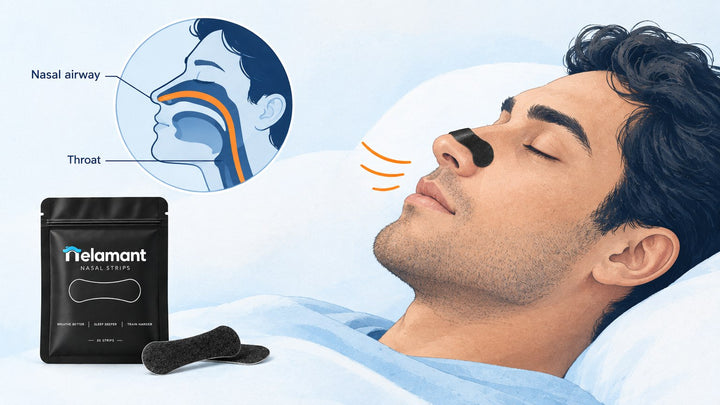
- Nasal strips work at the nose, not the throat. Obstructive sleep apnea happens when the throat airway collapses - nasal strips cannot reach that site.
- No evidence shows nasal strips reduce apnea events (AHI) in people with diagnosed OSA.
- They may help with nasal congestion that makes CPAP or sleep less comfortable - a distinct, limited benefit.
- If you snore loudly, wake gasping, or wake unrefreshed, see a doctor for a proper sleep evaluation.
- Never stop or replace prescribed treatment - including CPAP - with a nasal strip.
What Is Sleep Apnea - and Why It's Different from Snoring
Sleep apnea and snoring overlap in one way: both involve the upper airway. Beyond that, they are very different problems, and conflating them leads to real harm if it delays a diagnosis.
Snoring is a noise produced when soft tissue in the airway vibrates during breathing. It can be disruptive and is sometimes a signal to investigate further, but snoring on its own does not mean breathing has stopped. For a deeper look at where the line falls, the guide to snoring vs. sleep apnea explains the key differences and warning signs in detail. Understanding the broader landscape of how to stop snoring is also a useful first step - it covers which causes respond to simple interventions and which require a clinical workup.
Obstructive vs. Central: Where the Blockage Actually Is
Obstructive sleep apnea (OSA) - by far the most common form - happens when the muscles at the back of the throat relax too much during sleep, causing the soft palate, tongue, and surrounding tissue to fall back and physically block the airway. The brain then signals the body to rouse briefly so breathing restarts, often dozens of times a night. The person usually has no memory of these arousals.
Central sleep apnea is different: the airway stays open, but the brain fails to send the correct signal to the breathing muscles. Neither form involves the nasal valve.
External nasal strips are adhered to the outside of the nose across the bridge. Their spring-like bands gently lift the sides of the nasal passage to help open your nasal passages - the nostrils and nasal valve, the narrow inlet just inside. That site is anatomically far upstream from the throat obstruction that defines OSA. A strip that widens your nostril opening does nothing to the soft tissue behind your tongue.
What Nasal Strips Actually Do
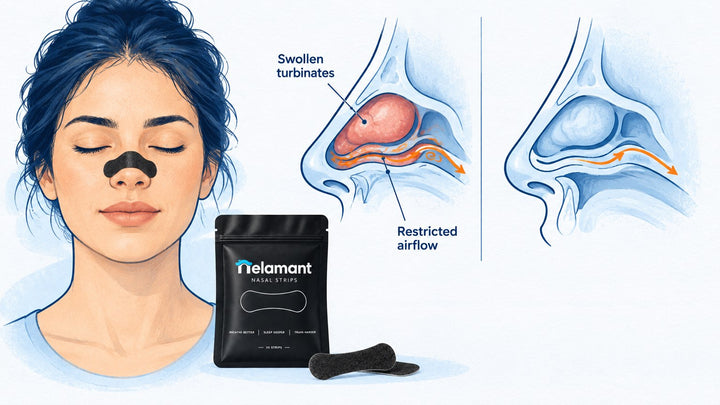
A nasal strip is a small, spring-tensioned adhesive band placed across the lower bridge of the nose. When it tries to return to its flat shape, it gently lifts the flexible outer walls of the nostrils, widening the nasal inlet. The result is a mechanical increase in the cross-sectional area of the nasal passage - no drugs, no active airflow device, no effect on the throat.
This mechanism is useful when the limiting factor in your breathing is somewhere between your nostril and the back of your nasal cavity - congestion from a cold, allergies, swollen turbinates, or narrowing at the nasal valve. It is not useful when breathing is being interrupted by a collapsing throat.
Can Nasal Strips Reduce Sleep Apnea Events?
This is the core question, and the honest answer is: almost certainly not in any clinically meaningful way for people with true OSA.
Apnea-hypopnea index (AHI) - the standard measure of sleep apnea severity - counts how many times per hour breathing stops or becomes critically shallow. For nasal strips to reduce AHI, they would need to prevent the throat from collapsing. They cannot do that.
Existing research on nasal dilation and OSA has generally focused on whether reducing nasal resistance changes apnea severity; the evidence for external strips specifically producing a clinically significant reduction in AHI is weak at best.
Some people with OSA also have nasal congestion, and the congestion can make the overall breathing effort worse and CPAP harder to tolerate. Addressing the nasal component may make sleep feel slightly more comfortable without changing the underlying disorder. That is a meaningful but narrow benefit - comfort support, not treatment.
Where Nasal Strips May Help: Nasal Congestion and Comfort
People with sleep apnea often have coexisting nasal problems - seasonal allergies, chronic congestion, or anatomical narrowing that makes breathing through the nose harder than it needs to be. When a doctor has confirmed the diagnosis and has a treatment plan in place, easing nasal congestion can make that plan more tolerable night to night.
Nasal strips can support easier nose breathing and may reduce the sensation of stuffiness without interfering with any prescribed therapy. They are drug-free and act only mechanically, so there is no pharmacological interaction to worry about.
Using Strips Alongside CPAP Therapy
CPAP (continuous positive airway pressure) is the first-line treatment for moderate-to-severe OSA. Some CPAP users find that nasal congestion - whether from allergies, a cold, or a dry bedroom - makes the mask uncomfortable and raises pressure resistance. A nasal strip placed on the bridge of the nose before putting on a nasal or full-face mask may help open the nasal passages and reduce that resistance for some users.
This is not a medically proven add-on protocol; it is a practical comfort measure. The full guide to nasal strips with CPAP covers fit, positioning, and what the evidence does and does not support in detail. Always discuss any changes to your CPAP setup with the clinician managing your care.
What Actually Helps Snoring vs. Sleep Apnea
Nasal strips can support easier breathing when snoring has a nasal cause - congestion, a narrowed nostril, or increased airflow resistance through the nose. For that specific scenario, the evidence is more supportive. The article on whether nasal strips help snoring covers the nose-specific snoring case in depth, including which snorers are most likely to notice a difference.
Broader Snoring Solutions
When snoring is mild and not connected to apnea, there are several approaches worth knowing about: sleep position changes, alcohol and sedative reduction, weight management, and addressing nasal congestion. The full guide to how to stop snoring walks through each of these in detail, helps you identify which category your snoring falls into, and points toward when a sleep study is the right next step.
Nasal Strips and Nasal Comfort at Night
If your sleep apnea is being treated and nasal congestion is making nights uncomfortable on top of that, a well-made nasal strip can support the nasal side of the equation without interfering with your existing care. Nelamant Air is designed with a wider, more balanced lift across the bridge of the nose - spreading the opening force rather than concentrating it at one point - and uses an extra-hold adhesive that resists overnight movement while staying gentle enough to peel off cleanly in the morning. It is a drug-free, mechanical option for people who want to support nasal airflow comfort alongside, not instead of, their prescribed treatment.

When to See a Doctor
Nasal strips are not a diagnostic tool and will not reveal whether you have sleep apnea. See a doctor if you experience any of the following:
- Loud or irregular snoring reported by a partner
- Waking up gasping, choking, or short of breath
- Persistent daytime sleepiness even after a full night in bed
- Morning headaches or a dry, sore mouth
- Difficulty concentrating or unexplained mood changes
These are potential signs of a sleep-disordered breathing condition that requires proper evaluation - a home sleep test or in-lab polysomnography, not a breathing aid. The guide to snoring vs. sleep apnea can help you recognize warning signs before your appointment. For persistent nasal symptoms that are separate from sleep apnea - chronic congestion, sinus pressure, or breathing difficulty when awake - see the guide on when to see a doctor for nasal congestion.

Frequently Asked Questions
Do nasal strips help sleep apnea?
No - not in any treatment sense. Nasal strips open the nasal passages by lifting the outer nostril walls. Obstructive sleep apnea is caused by throat-level airway collapse, which nasal strips cannot reach or prevent. They are not a recognized treatment for OSA and should never replace prescribed therapy.
Can I use nasal strips instead of my CPAP?
No. If your doctor has prescribed CPAP, that treatment is addressing a serious breathing disorder that nasal strips are not equipped to manage. Using a strip instead of CPAP could leave apnea events untreated throughout the night. Never stop or skip prescribed treatment without talking to your doctor first.
Do nasal strips reduce snoring caused by sleep apnea?
Not reliably. The snoring associated with OSA is generated at the throat, not the nose. Even if a strip quiets some nasal airflow noise, the underlying apnea events - the pauses in breathing - would continue. Treating the noise without treating the cause is not a safe outcome.
Are nasal strips safe to wear with a CPAP mask?
Generally yes, as a comfort measure - many CPAP users place a strip on the nose before fitting their mask to help reduce nasal resistance. Whether this is appropriate for your specific mask type and pressure settings is worth confirming with your care provider. The dedicated guide to nasal strips with CPAP covers this in more detail.
How do I know if my snoring is sleep apnea or just simple snoring?
Simple snoring is steady and continuous; apnea-related snoring often involves pauses followed by a gasp or snort, and is typically accompanied by daytime sleepiness, unrefreshed waking, or witnessed breathing stoppages. A partner's observations are often the first clue. The guide to snoring vs. sleep apnea outlines the key differences and explains when to pursue a sleep study.
The Short Answer
Nasal strips for sleep apnea are not a treatment, a replacement for CPAP, or a way to reduce apnea events. Their job is mechanical and localized: opening the nasal inlet to support easier nose breathing. That can matter for comfort - especially if congestion is making your nights harder on top of a managed sleep disorder - but it does not address the throat-level collapse that defines OSA. If there is any doubt about whether your snoring or poor sleep reflects an underlying breathing disorder, a medical evaluation is the right first move, not a breathing aid.