Thomas Tiemann

This article is for general information, not medical advice.
If you wake up with a dry mouth, a sore throat, or someone tells you that you breathe loudly at night, the answer is almost always the same: your nose isn't moving enough air, so your body switches to mouth breathing. The question of why do I breathe through my mouth when I sleep usually points to nasal obstruction, anatomy, or a long-standing habit - and most of the time there are concrete steps you can take. The full guide to how to breathe through your nose while sleeping covers the broader approach; this article focuses on what is causing the switch in the first place.
- Mouth breathing at night is almost always a symptom of restricted nasal airflow, not a separate condition in itself.
- The most common triggers are congestion, allergies, nasal anatomy, and long-held habits.
- Clearing or widening the nasal passage - even partially - is usually enough to restore nose breathing during sleep.
- Persistent mouth breathing despite clear sinuses, or mouth breathing paired with gasping or choking, warrants a medical evaluation.
- Simple mechanical tools like nasal strips can help widen the nasal opening, making nose breathing easier at night.
What Is Mouth Breathing at Night?
Breathing is controlled automatically during sleep. Your body will always choose the path of least resistance: if the nose is clear, air moves through it; if resistance is high enough, the jaw drops and air comes through the mouth instead. This isn't a conscious decision - it happens the moment nasal resistance crosses a threshold your nervous system finds too high to sustain comfortably.
Mouth breathing at night can be occasional (during a cold, for example) or chronic (happening most nights regardless of illness). Chronic nighttime mouth breathing usually signals an underlying structural or inflammatory issue that deserves attention rather than just symptom management.
The Most Common Causes of Mouth Breathing While You Sleep
Understanding mouth breathing at night causes is the first step toward fixing them. Most people have one primary driver, but two or three factors often stack together - congestion on top of narrow passages on top of allergies, for instance - which is why the problem can feel stubborn.
Nasal Congestion and Blockage
Swollen nasal tissue from a cold, sinus infection, or ongoing inflammation is the single most common reason for nighttime mouth breathing. When you lie down, blood pools more readily in the nasal lining, which can make congestion worse at night than it is during the day. Even when there is no visible mucus, the nasal passage can feel physically closed - a situation explained in detail in the guide to why your nose feels blocked but there's no mucus. Reducing the underlying inflammation, or mechanically widening the nasal opening, is usually enough to let you switch back to nose breathing.
Nasal Anatomy: Deviated Septum and Narrow Passages
Some people have nasal passages that are structurally narrow or a septum that leans to one side, reducing airflow on one or both sides. This doesn't always cause problems during waking hours, when muscle tone keeps the airway open, but during sleep, reduced muscle activity can push the resistance high enough that the body defaults to the mouth. A deviated septum or nasal valve weakness doesn't cause mouth breathing in every person who has one, but it is a frequent contributor in people who mouth-breathe chronically without obvious congestion.
Allergies and Nighttime Inflammation
Allergens in the bedroom - dust mites in bedding, pet dander, mold - tend to be concentrated right at the level where you're sleeping and breathing. Allergic rhinitis causes the nasal lining to swell and produce mucus, and because allergen exposure continues through the night, the inflammation doesn't resolve the way it might after leaving a dusty environment. If you notice that mouth breathing is worse at certain times of year, or that it improved after changing pillowcases or removing a pet from the room, allergens are likely a significant factor.
Habitual Mouth Breathing
In some people, mouth breathing started during a period of congestion or illness and simply never stopped. The jaw and tongue can settle into a resting position that keeps the mouth slightly open, and the nervous system stops automatically routing air through the nose even after the original blockage is gone. Habitual mouth breathing is more common in people who mouth-breathed as children, but it can develop at any age after a prolonged period of nasal obstruction.
How Mouth Breathing Affects Your Sleep and Health
Breathing through the mouth bypasses the nose's filtration, humidification, and nitric-oxide production functions. The downstream effects on sleep quality and health are covered in depth in the sibling guide on mouth breathing effects on the body, but the key points are:
- Dry mouth and throat, leading to a rough or sore feeling on waking.
- Reduced sleep quality - mouth breathing can accompany sleep-disordered breathing and disrupted sleep.
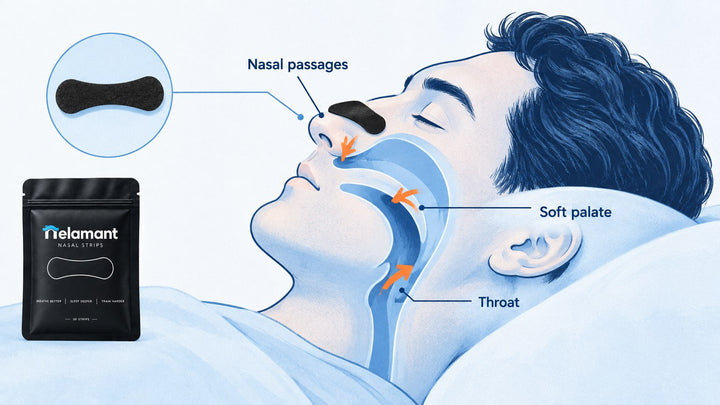
- Increased likelihood of snoring, because the soft tissue of the throat vibrates more when air is pulled through an open mouth at an uncontrolled rate.
- Bad breath, as saliva dries out overnight and oral bacteria are less effectively managed.
If you want the full picture on what repeated nights of mouth breathing can do over time, the guide to mouth breathing effects covers each mechanism in detail.
How to Stop Breathing Through Your Mouth at Night
The goal in every step below is the same: lower nasal resistance enough that your body chooses the nose over the mouth. You don't need to achieve perfect nasal breathing on the first night. Incremental improvements tend to stick.
Step 1 - Clear Nasal Obstruction First
Before any mechanical or behavioral strategy can work, the nose has to be open enough to breathe through. For congestion, a saline rinse before bed can reduce swelling and clear mucus. If you use a neti pot, always use sterile, distilled, or boiled-and-cooled water - never tap water directly. Decongestant sprays can help in the short term, but follow the label duration instructions carefully to avoid rebound congestion. For persistent blockage that doesn't respond to these steps, see the section on when to see a doctor below.
Step 2 - Adjust Your Sleep Position
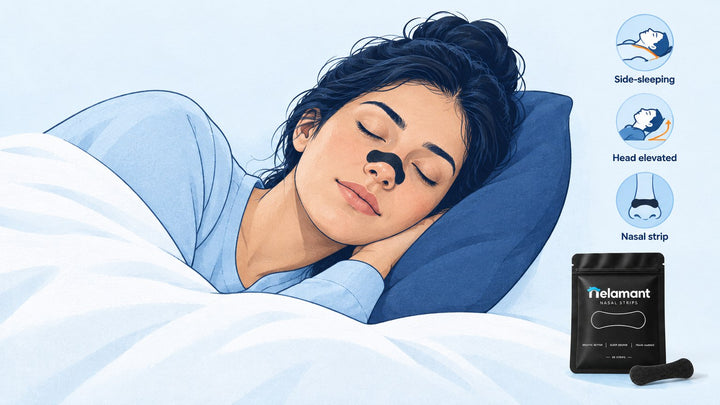
Sleeping on your back encourages the jaw to fall open and worsens nasal congestion from blood pooling. Side sleeping - either side - tends to reduce both. It also reduces the soft-tissue collapse that makes mouth breathing louder. If you have trouble staying on your side, a body pillow or a rolled towel tucked behind your back can help maintain the position through the night.
Step 3 - Manage Allergens and Humidity
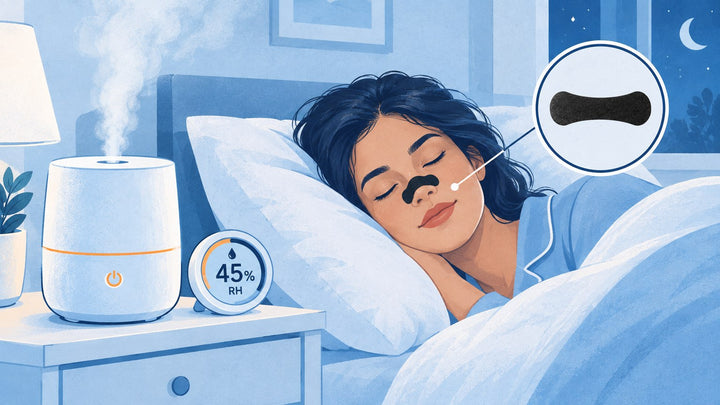
Wash bedding weekly in hot water. Keep pets out of the bedroom if possible, or at minimum off the bed. A bedroom humidity level of roughly 40–50% keeps nasal tissue from drying out without creating conditions that encourage dust mites or mold. Clean humidifier tanks regularly according to the manufacturer's instructions - a dirty humidifier can make airborne irritants worse, not better.
Step 4 - Try a Nasal Strip
If your nose is structurally narrow or if the nasal valve area collapses slightly when you inhale during sleep, a nasal strip can provide immediate mechanical support. Strips sit on the outside of the nose and gently spring the sides of the nasal passage wider, reducing resistance without any drug effect. Nelamant Air Nasal Strips are designed to provide a broader, more balanced lift across the bridge rather than a single sharp pull point, which helps keep the nasal opening wider through the night. They use an extra-hold adhesive that resists overnight movement and sweat, and the materials are designed to peel off cleanly in the morning. For people whose mouth breathing is primarily driven by a narrow or slightly obstructed nasal passage, this is one of the more direct interventions available.
If you're deciding which strip to choose based on your specific situation, the guide to best nasal strips for mouth breathers compares the main options for this audience.
Step 5 - Consider Whether Mouth Taping Is Appropriate
Mouth taping - lightly sealing the lips during sleep to encourage nose breathing - has attracted attention as a behavioral training approach. A few important points before trying it:
- Mouth taping is only appropriate if your nose is clear enough to breathe through comfortably. Do not tape your mouth if you have significant nasal obstruction.
- It is not a substitute for clearing the cause of the obstruction.
- People with suspected sleep apnea should not try mouth taping without medical guidance - an obstructed throat cannot be fixed by redirecting air through the nose.

A broader lift, extra-hold adhesive, and materials designed to stay on through the night and peel off cleanly in the morning.
$14.99 for 30 strips · 30-day returns
Shop Nelamant Air
When to See a Doctor
Most nighttime mouth breathing responds to the steps above. See a doctor if:
- Your nose feels chronically blocked despite saline rinses, position changes, and allergen management - this may point to structural issues like a deviated septum, enlarged turbinates, or nasal polyps that need direct treatment.
- You or your partner notice pauses in breathing, gasping, or choking during sleep. These are potential signs of sleep apnea, which is a separate medical condition from simple mouth breathing. The guide to snoring vs. sleep apnea explains how to tell the difference and what to do next.
- Mouth breathing is accompanied by significant snoring that disrupts your sleep or your partner's.
- You've had nasal symptoms - congestion, discharge, pressure - lasting more than 10 days that are not improving. For guidance on when nasal symptoms cross the line into a clinical concern, see the article on when to see a doctor for nasal congestion.
- You're considering any nasal or throat procedure based on what you've read here - that decision belongs with a clinician who can examine your airway directly.
Frequently Asked Questions
Why do I suddenly breathe through my mouth at night when I didn't used to?
A sudden change usually means something has changed in your nose. Common triggers include a new allergy, weight gain (which can narrow the upper airway), a cold or sinus infection that left behind lingering inflammation, new allergen exposure in the bedroom, or hormonal shifts. If you can't identify a clear cause and the change persists, it's worth checking with a doctor to rule out a structural or inflammatory issue that developed gradually.
Can mouth breathing at night cause a dry mouth or sore throat in the morning?
Yes. Breathing through the mouth all night dries out the mucous membranes in your mouth and throat, which is why many mouth breathers wake up with a parched feeling, a rough or scratchy throat, or noticeably bad breath. These symptoms often disappear quickly if you manage to keep the nose open through the night.
Is nighttime mouth breathing a sign of sleep apnea?
Not automatically. Mouth breathing on its own doesn't confirm sleep apnea. However, mouth breathing and sleep apnea often overlap because both are driven by upper-airway resistance. If mouth breathing comes with loud snoring, gasping, or daytime exhaustion despite a full night in bed, those are reasons to get evaluated. The guide to snoring vs. sleep apnea walks through the key differences. Nasal strips support the nasal opening and can improve nasal comfort, but they are not a treatment for sleep apnea.
Do nasal strips help stop mouth breathing while sleeping?
They can, specifically when the cause is a narrow or partially obstructed nasal passage. By gently widening the nasal opening from the outside, a nasal strip reduces resistance enough that the body routes air through the nose rather than the mouth. They work best when the nose is the bottleneck - they don't help if the obstruction is deeper in the airway or if the throat is the primary site of restriction. If you want to compare options, the guide to best nasal strips for mouth breathers covers the main products for this use case.
Can adults train themselves to stop mouth breathing at night?
Habitual mouth breathing - where the nose is physically clear but the jaw stays open anyway - can often be improved with deliberate practice and, in some cases, myofunctional therapy (exercises targeting the tongue and jaw position). Nasal breathing during waking hours first, then using a nasal strip at night to support the transition, is a practical starting point. The guide to how to breathe through your nose while sleeping covers retraining approaches in more detail.
When should I see a doctor about mouth breathing?
See a doctor if mouth breathing is chronic despite clear sinuses, if it's paired with gasping or pauses in breathing during sleep, if it started alongside significant nasal symptoms that haven't resolved, or if you have a child who is a consistent mouth breather. Chronic mouth breathing in children especially warrants early evaluation because of its potential effects on development. For persistent nasal symptoms in adults, the when to see a doctor for nasal congestion guide provides a useful checklist.
The Bottom Line
When you ask yourself why do I breathe through my mouth when I sleep, the answer almost always leads back to the nose. Congestion, anatomy, allergens, and habit are the usual suspects, and most of them respond to the practical steps in this guide. Clear the obstruction, adjust your position, reduce allergens, and - if the nasal passage itself is narrow - try a nasal strip to give your nose a mechanical assist. If those steps don't resolve it, or if you have any of the warning signs above, a conversation with a doctor is the right next move.